

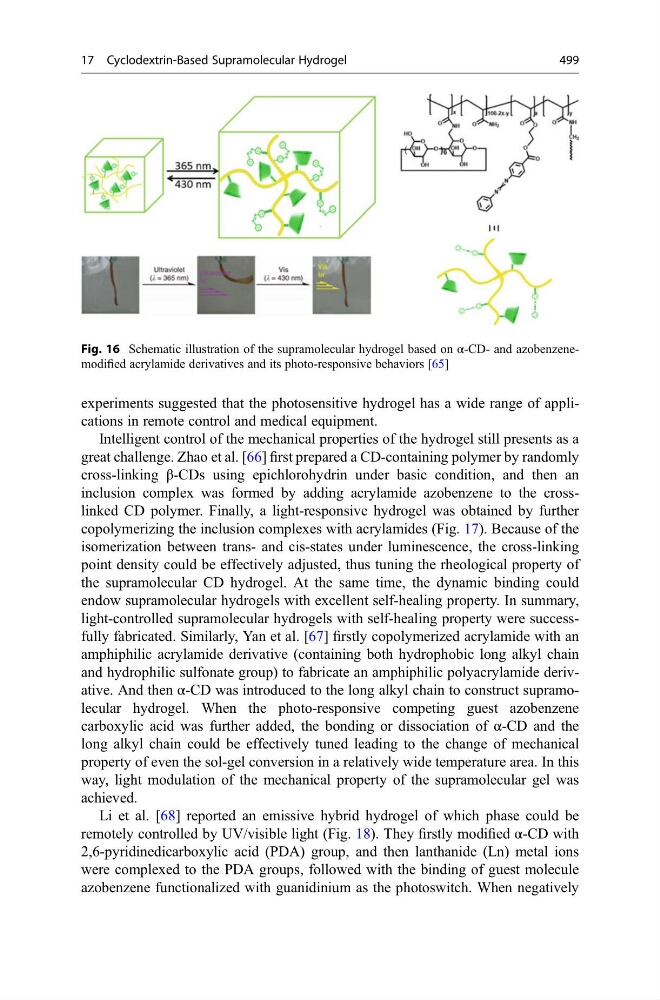
experiments suggested that the photosensitive hydrogel has a wide range of applications in remote control and medical equipment.
Intelligent control of the mechanical properties of the hydrogel still presents as a
great challenge. Zhao et al. [66] first prepared a CD-containing polymer by randomly
cross-linking β-CDs using epichlorohydrin under basic condition, and then an
inclusion complex was formed by adding acrylamide azobenzene to the crosslinked CD polymer. Finally, a light-responsive hydrogel was obtained by further
copolymerizing the inclusion complexes with acrylamides (Fig. 17). Because of the
isomerization between trans- and cis-states under luminescence, the cross-linking
point density could be effectively adjusted, thus tuning the rheological property of
the supramolecular CD hydrogel. At the same time, the dynamic binding could
endow supramolecular hydrogels with excellent self-healing property. In summary,
light-controlled supramolecular hydrogels with self-healing property were successfully fabricated. Similarly, Yan et al. [67] firstly copolymerized acrylamide with an
amphiphilic acrylamide derivative (containing both hydrophobic long alkyl chain
and hydrophilic sulfonate group) to fabricate an amphiphilic polyacrylamide derivative. And then α-CD was introduced to the long alkyl chain to construct supramolecular hydrogel. When the photo-responsive competing guest azobenzene
carboxylic acid was further added, the bonding or dissociation of α-CD and the
long alkyl chain could be effectively tuned leading to the change of mechanical
property of even the sol-gel conversion in a relatively wide temperature area. In this
way, light modulation of the mechanical property of the supramolecular gel was
achieved.
Li et al. [68] reported an emissive hybrid hydrogel of which phase could be
remotely controlled by UV/visible light (Fig. 18). They firstly modified α-CD with
2,6-pyridinedicarboxylic acid (PDA) group, and then lanthanide (Ln) metal ions
were complexed to the PDA groups, followed with the binding of guest molecule
azobenzene functionalized with guanidinium as the photoswitch. When negatively
Fig. 16 Schematic illustration of the supramolecular hydrogel based on α-CD- and azobenzenemodified acrylamide derivatives and its photo-responsive behaviors [65]
17 Cyclodextrin-Based Supramolecular Hydrogel
499