

which were comparable efficiencies to those of analogous conventional conjugated
polymers, indicating that pillar[n]arenes could be an ideal choice for supramolecular
polymer-based optoelectronic applications. This study inspired us to take a deeper
insight on pillar[n]arene-based polymers and further illuminate their applications in
organic semiconductor area.
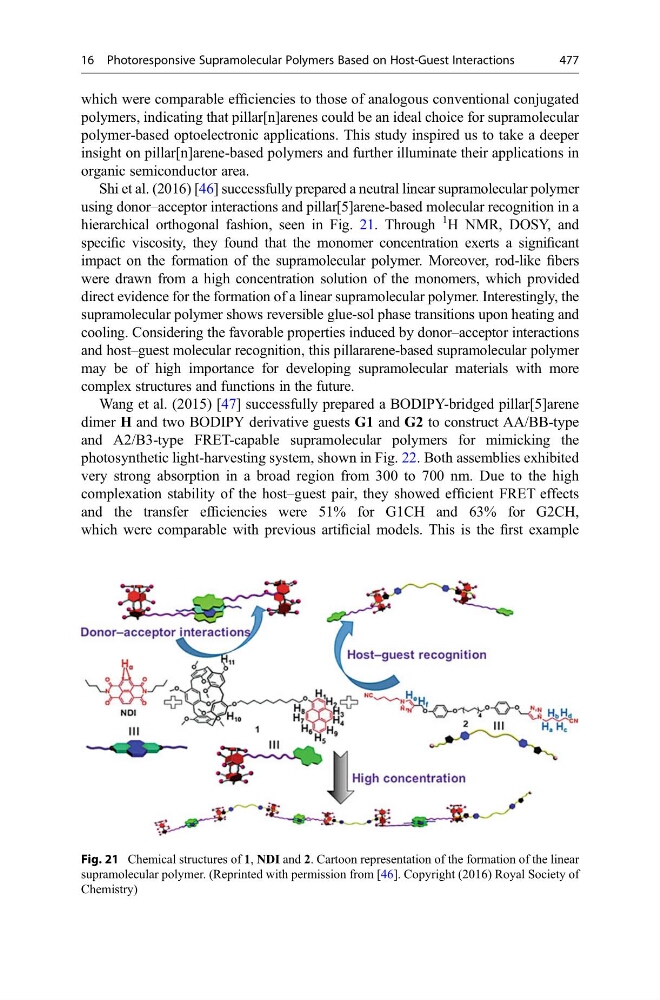
Shi et al. (2016) [46] successfully prepared a neutral linear supramolecular polymer
using donor–acceptor interactions and pillar[5]arene-based molecular recognition in a
hierarchical orthogonal fashion, seen in Fig. 21. Through
1
H NMR, DOSY, and
specific viscosity, they found that the monomer concentration exerts a significant
impact on the formation of the supramolecular polymer. Moreover, rod-like fibers
were drawn from a high concentration solution of the monomers, which provided
direct evidence for the formation of a linear supramolecular polymer. Interestingly, the
supramolecular polymer shows reversible glue-sol phase transitions upon heating and
cooling. Considering the favorable properties induced by donor–acceptor interactions
and host–guest molecular recognition, this pillararene-based supramolecular polymer
may be of high importance for developing supramolecular materials with more
complex structures and functions in the future.
Wang et al. (2015) [47] successfully prepared a BODIPY-bridged pillar[5]arene
dimer H and two BODIPY derivative guests G1 and G2 to construct AA/BB-type
and A2/B3-type FRET-capable supramolecular polymers for mimicking the
photosynthetic light-harvesting system, shown in Fig. 22. Both assemblies exhibited
very strong absorption in a broad region from 300 to 700 nm. Due to the high
complexation stability of the host–guest pair, they showed efficient FRET effects
and the transfer efficiencies were 51% for G1CH and 63% for G2CH,
which were comparable with previous artificial models. This is the first example
Fig. 21 Chemical structures of 1, NDI and 2. Cartoon representation of the formation of the linear
supramolecular polymer. (Reprinted with permission from [46]. Copyright (2016) Royal Society of
Chemistry)
16 Photoresponsive Supramolecular Polymers Based on Host-Guest Interactions
477