

network. Atomic force microscopy analysis of PCF[5]/C 60 -Pyr highlighted
the formation of a bicontinuous network consisting of a uniform distribution
of prominent structures, within a polymeric background forming a biphasic structure.
Haino et al. (2014) [36] described a facile process for fabricating fullerene polymers driven by host–guest interactions between calix[5]arene and C 60 . The formation and structures of the supramolecular polymers and networks were carefully
examined using a variety of spectroscopic techniques. During the experiments, the
dimensions of the supramolecular polymers were controlled by the rational design
of the monomer components. Although each of the monomers was connected
via noncovalent interactions, supramolecular polymers belong to the class of polymers in terms of macroscopic properties. The designability of supramolecular polymers can open up new possibilities for molecular organization in nanospace.
16.6 Photoresponsive Supramolecular Polymers Based on
Pillararene
Pillararenes, a novel class of macrocyclic molecules, were first reported by Ogoshi et
al. (2008) [37]. They are formed by the 2, 5 positions of methylene-bridged hydroquinone. Unlike the traditional cup-aroma basket structure, it has a symmetrical
columnar structure with typical characteristics [38]: first, with simple preparation
and flexible modification, it can be easily dissolved in organic solvents and can also
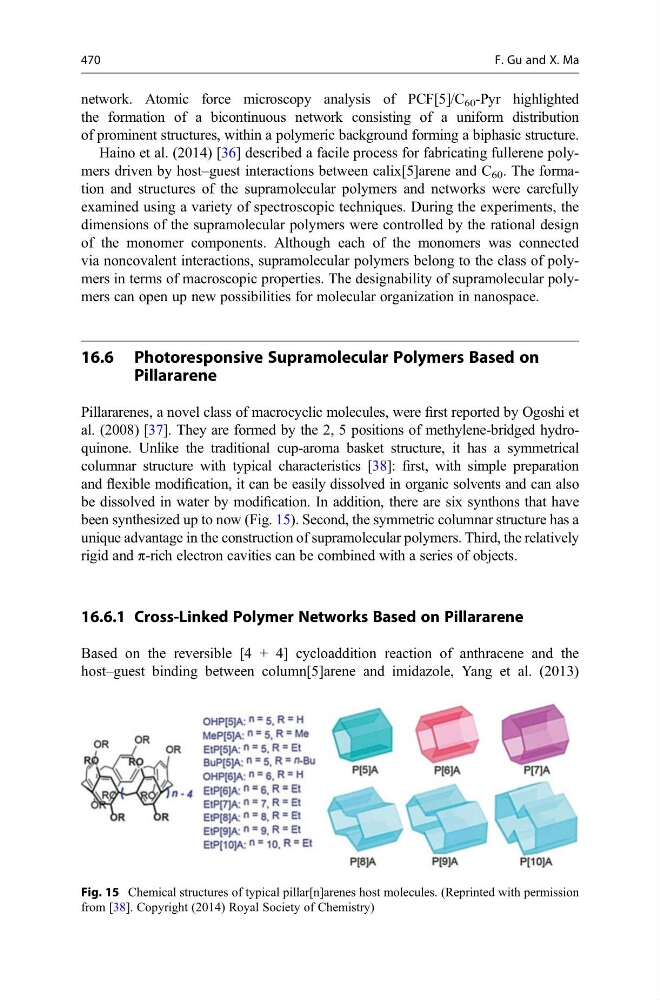
be dissolved in water by modification. In addition, there are six synthons that have
been synthesized up to now (Fig. 15). Second, the symmetric columnar structure has a
unique advantage in the construction of supramolecular polymers. Third, the relatively
rigid and π-rich electron cavities can be combined with a series of objects.
16.6.1 Cross-Linked Polymer Networks Based on Pillararene
Based on the reversible [4 + 4] cycloaddition reaction of anthracene and the
host–guest binding between column[5]arene and imidazole, Yang et al. (2013)
Fig. 15 Chemical structures of typical pillar[n]arenes host molecules. (Reprinted with permission
from [38]. Copyright (2014) Royal Society of Chemistry)
470
F. Gu and X. Ma