

on the IC between the dendritic host polymer and the linear guest polymer. The
morphologies of the aggregates could be adjusted by changing the molar ratio of
(PCL-CD)16: Azo-PDMAEMA in the supramolecules. The supramolecular aggregates changed from nanorods to nanowires, and then to spherical micelles when the
(PCL-CD)16:Azo-PDMAEMA molar ratio was changed from 1:1 to 1:8 and 1:16,
respectively. Benefitting from the UV-response of β-CD/Azo IC, the supramolecular
aggregates demonstrated UV responsive properties. Upon UV light irradiation,
the morphologies of the aggregates became irregular and agglomeration occurred.
Meanwhile, because of the thermoresponsive PDMAEMA, the supramolecular
aggregates showed thermoresponsive properties. When the temperature was
increased, the aggregates changed into smaller aggregates and then aggregated
with each other upon further heating. Therefore, the supramolecular aggregates
with tunable morphologies were UV- and thermoresponsive. These functional nanomaterials have potential applications in nanotechnology and biomedicine.
16.3 Photoresponsive Supramolecular Polymers Based on
Cucurbituril (CBs)
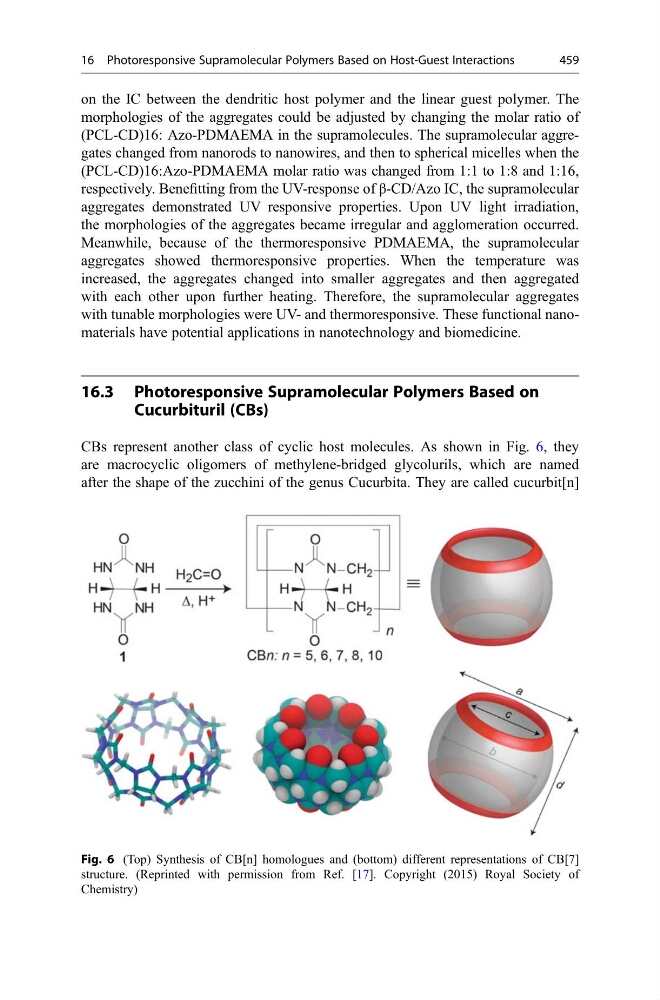
CBs represent another class of cyclic host molecules. As shown in Fig. 6, they
are macrocyclic oligomers of methylene-bridged glycolurils, which are named
after the shape of the zucchini of the genus Cucurbita. They are called cucurbit[n]
Fig. 6 (Top) Synthesis of CB[n] homologues and (bottom) different representations of CB[7]
structure. (Reprinted with permission from Ref. [17]. Copyright (2015) Royal Society of
Chemistry)
16 Photoresponsive Supramolecular Polymers Based on Host-Guest Interactions
459
morphologies of the aggregates could be adjusted by changing the molar ratio of
(PCL-CD)16: Azo-PDMAEMA in the supramolecules. The supramolecular aggregates changed from nanorods to nanowires, and then to spherical micelles when the
(PCL-CD)16:Azo-PDMAEMA molar ratio was changed from 1:1 to 1:8 and 1:16,
respectively. Benefitting from the UV-response of β-CD/Azo IC, the supramolecular
aggregates demonstrated UV responsive properties. Upon UV light irradiation,
the morphologies of the aggregates became irregular and agglomeration occurred.
Meanwhile, because of the thermoresponsive PDMAEMA, the supramolecular
aggregates showed thermoresponsive properties. When the temperature was
increased, the aggregates changed into smaller aggregates and then aggregated
with each other upon further heating. Therefore, the supramolecular aggregates
with tunable morphologies were UV- and thermoresponsive. These functional nanomaterials have potential applications in nanotechnology and biomedicine.
16.3 Photoresponsive Supramolecular Polymers Based on
Cucurbituril (CBs)
CBs represent another class of cyclic host molecules. As shown in Fig. 6, they
are macrocyclic oligomers of methylene-bridged glycolurils, which are named
after the shape of the zucchini of the genus Cucurbita. They are called cucurbit[n]
Fig. 6 (Top) Synthesis of CB[n] homologues and (bottom) different representations of CB[7]
structure. (Reprinted with permission from Ref. [17]. Copyright (2015) Royal Society of
Chemistry)
16 Photoresponsive Supramolecular Polymers Based on Host-Guest Interactions
459