

polypseudorotaxane could be constructed by adding n-hexane. Moreover, the formation of polypseudorotaxane was certificated by X-ray crystal analysis. Połoński and
coworkers reported two crystalline supramolecular polypseudorotaxanes constructed
by combining permethylated pillar[5]arene as a macrocyclic wheel with 1,4-bis(1imidazolyl)butane and 1,4-bis(iodoethynyl)benzene or 1,4-diiodo-1,3-butadiyne
linked by C–IÁÁÁN halogen bonds and creating a polyrotaxane axis [17b].
13.2.3 Supramolecular Polymer Formed by Metal-Ligand Binding
Mental-ligand binding is also another widely existed binding module in the nature,
which gradually evolved to be a controllable and highly efficient methodology for
the construction of supramolecular architectures with well-defined shapes and sizes.
The moderate bond energy (15–50 kcal/mol) of metal-ligand bonds, as well as their
directional and predictable features, endowed these supramolecular coordination
complexes considerable stability yet reversibility [18].
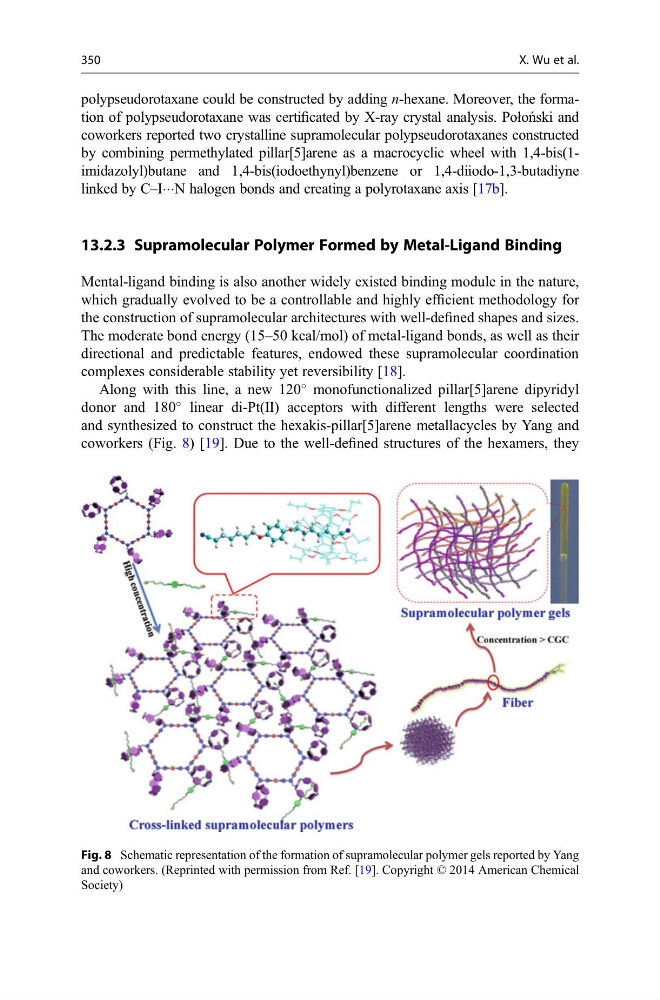
Along with this line, a new 120
monofunctionalized pillar[5]arene dipyridyl
donor and 180
linear di-Pt(II) acceptors with different lengths were selected
and synthesized to construct the hexakis-pillar[5]arene metallacycles by Yang and
coworkers (Fig. 8) [19]. Due to the well-defined structures of the hexamers, they
Fig. 8 Schematic representation of the formation of supramolecular polymer gels reported by Yang
and coworkers. (Reprinted with permission from Ref. [19]. Copyright © 2014 American Chemical
Society)
350
X. Wu et al.
coworkers reported two crystalline supramolecular polypseudorotaxanes constructed
by combining permethylated pillar[5]arene as a macrocyclic wheel with 1,4-bis(1imidazolyl)butane and 1,4-bis(iodoethynyl)benzene or 1,4-diiodo-1,3-butadiyne
linked by C–IÁÁÁN halogen bonds and creating a polyrotaxane axis [17b].
13.2.3 Supramolecular Polymer Formed by Metal-Ligand Binding
Mental-ligand binding is also another widely existed binding module in the nature,
which gradually evolved to be a controllable and highly efficient methodology for
the construction of supramolecular architectures with well-defined shapes and sizes.
The moderate bond energy (15–50 kcal/mol) of metal-ligand bonds, as well as their
directional and predictable features, endowed these supramolecular coordination
complexes considerable stability yet reversibility [18].
Along with this line, a new 120
monofunctionalized pillar[5]arene dipyridyl
donor and 180
linear di-Pt(II) acceptors with different lengths were selected
and synthesized to construct the hexakis-pillar[5]arene metallacycles by Yang and
coworkers (Fig. 8) [19]. Due to the well-defined structures of the hexamers, they
Fig. 8 Schematic representation of the formation of supramolecular polymer gels reported by Yang
and coworkers. (Reprinted with permission from Ref. [19]. Copyright © 2014 American Chemical
Society)
350
X. Wu et al.