

For terphen[n]arenes and quaterphen[n]arenes, one single crystal of the smallest
macrocycle TP3 was successfully obtained [27]. As shown in Fig. 4, TP3 has
a triangular-prism structure, similar to that of 44BP3. Analogous to 22BP4, TP3
in the solid state is also a racemic mixture (Fig. 4b, c). Variable-temperature
1 H NMR
experiments showed no obvious proton signal changes of TP3 when the temperature
was decreased to À60
C, indicating that TP3 adopts a fixed conformation in
solution, which is distinctly different from the behavior of calixarenes and
pillararenes. Of note, there are two types of intermolecular πÁ Á Áπ stacking interactions in the crystal structure of TP3 terphen[3]arene, i.e., three face-to-face πÁ Á Áπ
interactions with distances of 3.84–3.97 Å and sextuple edge-to-face πÁ Á Áπ interactions with distances of 4.60–4.91 Å between the centers of the aromatic rings
(Fig. 4a). The distance between the centroid of the middle benzene ring and the
opposite methylene linker is 0.99–1.30 nm (Fig. 5a).
The structures of other macrocycles were calculated and optimized by molecular
mechanics simulation. As shown in Fig. 5, the conformations of the larger macrocycles of pentamers and hexamers are not twisted, similar to that of pillar[5, 6]arene
[18, 44]. Meanwhile, the cavity size of the largest macrocycle QP6, more than
3.0 nm, is much larger than that of classic macrocyclic hosts.
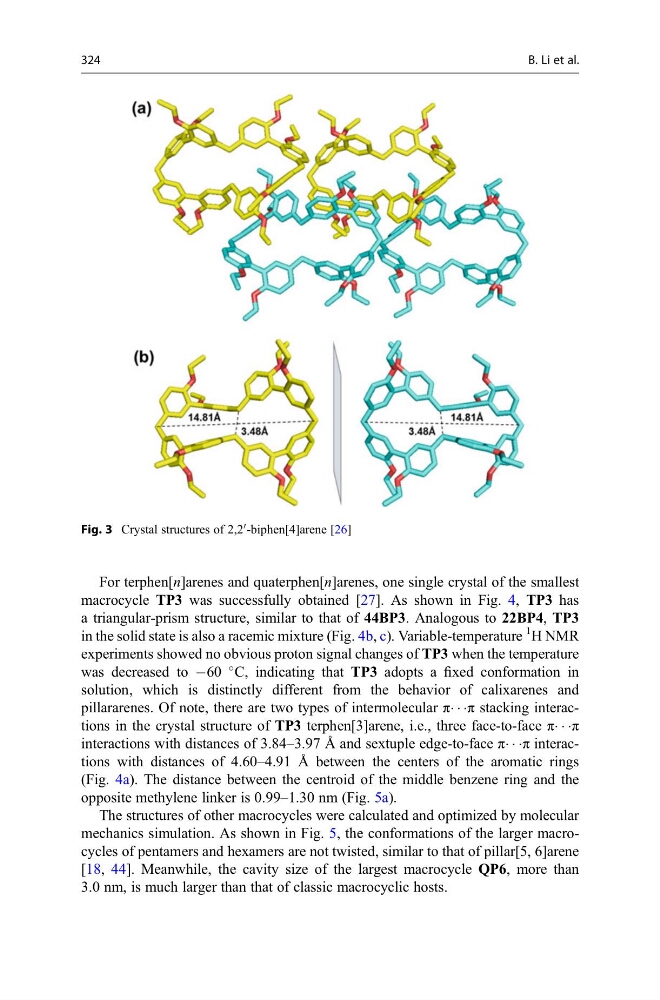
Fig. 3 Crystal structures of 2,2
0 -biphen[4]arene [26]
324
B. Li et al.
macrocycle TP3 was successfully obtained [27]. As shown in Fig. 4, TP3 has
a triangular-prism structure, similar to that of 44BP3. Analogous to 22BP4, TP3
in the solid state is also a racemic mixture (Fig. 4b, c). Variable-temperature
1 H NMR
experiments showed no obvious proton signal changes of TP3 when the temperature
was decreased to À60
C, indicating that TP3 adopts a fixed conformation in
solution, which is distinctly different from the behavior of calixarenes and
pillararenes. Of note, there are two types of intermolecular πÁ Á Áπ stacking interactions in the crystal structure of TP3 terphen[3]arene, i.e., three face-to-face πÁ Á Áπ
interactions with distances of 3.84–3.97 Å and sextuple edge-to-face πÁ Á Áπ interactions with distances of 4.60–4.91 Å between the centers of the aromatic rings
(Fig. 4a). The distance between the centroid of the middle benzene ring and the
opposite methylene linker is 0.99–1.30 nm (Fig. 5a).
The structures of other macrocycles were calculated and optimized by molecular
mechanics simulation. As shown in Fig. 5, the conformations of the larger macrocycles of pentamers and hexamers are not twisted, similar to that of pillar[5, 6]arene
[18, 44]. Meanwhile, the cavity size of the largest macrocycle QP6, more than
3.0 nm, is much larger than that of classic macrocyclic hosts.
Fig. 3 Crystal structures of 2,2
0 -biphen[4]arene [26]
324
B. Li et al.