

monomers, with total yields of up to 51%, which is much larger than that for 44BPns
(about 30%).
12.2.3 Terphen[n]arenes and Quaterphen[n]arenes
The classic macrocycles such as cyclodextrins, calixarenes, cucurbiturils, and
pillar[n]arenes have relatively small cavity sizes of less than 10 Å. Therefore,
some biomacromolecules (e.g., peptides and proteins) cannot be encapsulated by
these macrocycles due to their limited cavity sizes. What’s more, it is difficult to
enlarge the cavity sizes by increasing the number of monomers. For instance, pillar
[8-10]arenes and cucurbit[13-15]urils exhibit very small pseudo-cavities [28] and
a twisted configuration [29], respectively. Despite the fact that larger macrocycles
have been constructed via coordination [30, 31] or dynamic covalent bonds [32, 33],
their structural stabilities are relatively poor compared with covalent macrocycles.
Inspired by biphen[n]arenes, we wondered whether oligo(para-phenylene)s could be
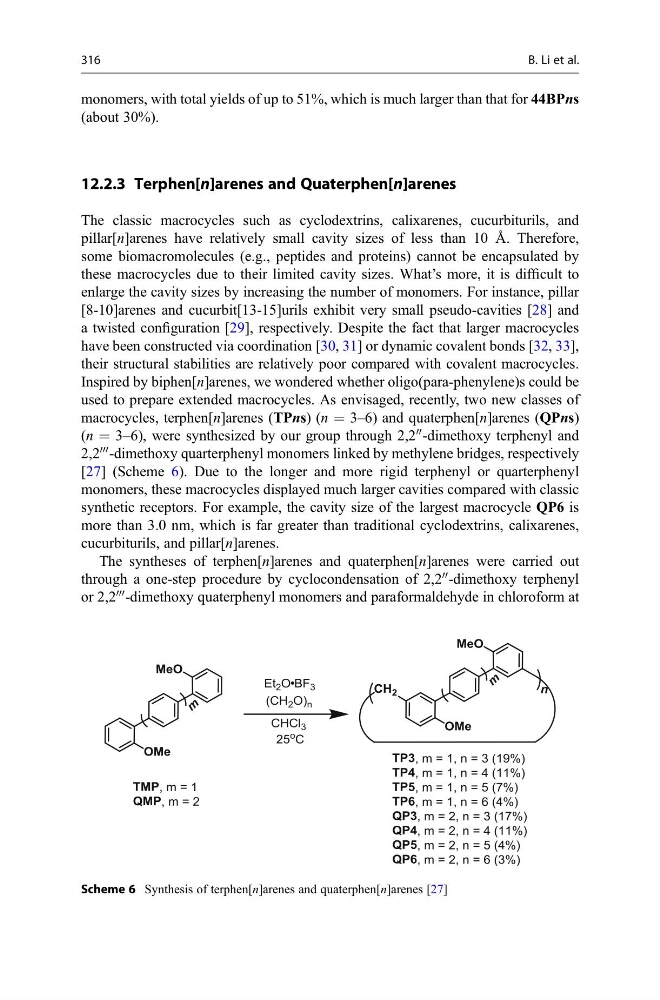
used to prepare extended macrocycles. As envisaged, recently, two new classes of
macrocycles, terphen[n]arenes (TPns) (n = 3–6) and quaterphen[n]arenes (QPns)
(n = 3–6), were synthesized by our group through 2,2
00 -dimethoxy terphenyl and
2,2
000 -dimethoxy quarterphenyl monomers linked by methylene bridges, respectively
[27] (Scheme 6). Due to the longer and more rigid terphenyl or quarterphenyl
monomers, these macrocycles displayed much larger cavities compared with classic
synthetic receptors. For example, the cavity size of the largest macrocycle QP6 is
more than 3.0 nm, which is far greater than traditional cyclodextrins, calixarenes,
cucurbiturils, and pillar[n]arenes.
The syntheses of terphen[n]arenes and quaterphen[n]arenes were carried out
through a one-step procedure by cyclocondensation of 2,2
00 -dimethoxy terphenyl
or 2,2
000 -dimethoxy quaterphenyl monomers and paraformaldehyde in chloroform at
Scheme 6 Synthesis of terphen[n]arenes and quaterphen[n]arenes [27]
316
B. Li et al.
(about 30%).
12.2.3 Terphen[n]arenes and Quaterphen[n]arenes
The classic macrocycles such as cyclodextrins, calixarenes, cucurbiturils, and
pillar[n]arenes have relatively small cavity sizes of less than 10 Å. Therefore,
some biomacromolecules (e.g., peptides and proteins) cannot be encapsulated by
these macrocycles due to their limited cavity sizes. What’s more, it is difficult to
enlarge the cavity sizes by increasing the number of monomers. For instance, pillar
[8-10]arenes and cucurbit[13-15]urils exhibit very small pseudo-cavities [28] and
a twisted configuration [29], respectively. Despite the fact that larger macrocycles
have been constructed via coordination [30, 31] or dynamic covalent bonds [32, 33],
their structural stabilities are relatively poor compared with covalent macrocycles.
Inspired by biphen[n]arenes, we wondered whether oligo(para-phenylene)s could be
used to prepare extended macrocycles. As envisaged, recently, two new classes of
macrocycles, terphen[n]arenes (TPns) (n = 3–6) and quaterphen[n]arenes (QPns)
(n = 3–6), were synthesized by our group through 2,2
00 -dimethoxy terphenyl and
2,2
000 -dimethoxy quarterphenyl monomers linked by methylene bridges, respectively
[27] (Scheme 6). Due to the longer and more rigid terphenyl or quarterphenyl
monomers, these macrocycles displayed much larger cavities compared with classic
synthetic receptors. For example, the cavity size of the largest macrocycle QP6 is
more than 3.0 nm, which is far greater than traditional cyclodextrins, calixarenes,
cucurbiturils, and pillar[n]arenes.
The syntheses of terphen[n]arenes and quaterphen[n]arenes were carried out
through a one-step procedure by cyclocondensation of 2,2
00 -dimethoxy terphenyl
or 2,2
000 -dimethoxy quaterphenyl monomers and paraformaldehyde in chloroform at
Scheme 6 Synthesis of terphen[n]arenes and quaterphen[n]arenes [27]
316
B. Li et al.