

essential for the sequence-specific peptide synthesis through the working mechanism
presented in Fig. 7. Despite there are some limitations, such as slow kinetics
compared to a ribosome and loss of the sequence information on the track during
its working, this rotaxane-based molecular walker is an excellent simulation of
sequence-specific peptide synthesis in biological systems and represents an important step toward complex artificial molecular machinery.
11.3.4 Artificial Molecular Pumps
A machine that works like a pump is capable of the directional transport of cargo
even from a lower energy state to a higher one, which occurs not only in the
macroscopic world (such as a water pump or a crane) but also in biological systems
(such as the membrane-spanning carrier protein that is capable of driving cargoes
across cell membranes against concentration gradients) [52]. However, to mimic this
function using synthetic molecules is challenging because the directional motion
needs the precise control of two “driving forces”: one has to drive the cargoes to
enter into the pump from one side, and the other has to drive the cargoes out of the
pump from the other side. Hence, the driving force must be directional [53]. Furthermore, for an artificial system, the two processes should be sequential and controllable by external stimuli, also the input energy to power the pump [54].
Some development on pumping protons and metal ions across a membrane has
been realized by artificial systems [55]. Besides, pumps made of small molecules are
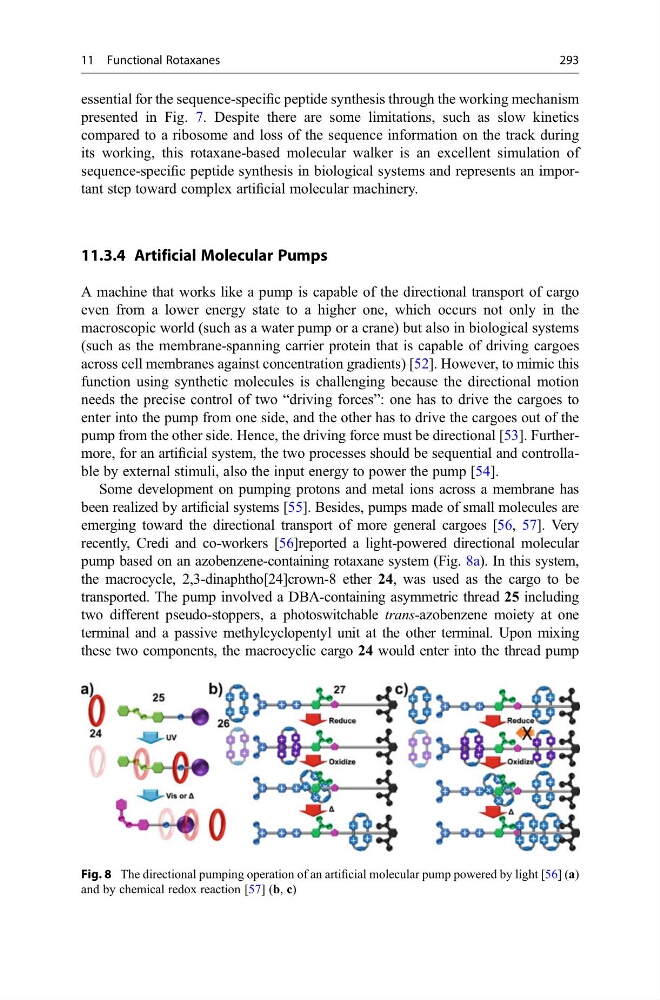
emerging toward the directional transport of more general cargoes [56, 57]. Very
recently, Credi and co-workers [56]reported a light-powered directional molecular
pump based on an azobenzene-containing rotaxane system (Fig. 8a). In this system,
the macrocycle, 2,3-dinaphtho[24]crown-8 ether 24, was used as the cargo to be
transported. The pump involved a DBA-containing asymmetric thread 25 including
two different pseudo-stoppers, a photoswitchable trans-azobenzene moiety at one
terminal and a passive methylcyclopentyl unit at the other terminal. Upon mixing
these two components, the macrocyclic cargo 24 would enter into the thread pump
Fig. 8 The directional pumping operation of an artificial molecular pump powered by light [56] (a)
and by chemical redox reaction [57] (b, c)
11 Functional Rotaxanes
293
presented in Fig. 7. Despite there are some limitations, such as slow kinetics
compared to a ribosome and loss of the sequence information on the track during
its working, this rotaxane-based molecular walker is an excellent simulation of
sequence-specific peptide synthesis in biological systems and represents an important step toward complex artificial molecular machinery.
11.3.4 Artificial Molecular Pumps
A machine that works like a pump is capable of the directional transport of cargo
even from a lower energy state to a higher one, which occurs not only in the
macroscopic world (such as a water pump or a crane) but also in biological systems
(such as the membrane-spanning carrier protein that is capable of driving cargoes
across cell membranes against concentration gradients) [52]. However, to mimic this
function using synthetic molecules is challenging because the directional motion
needs the precise control of two “driving forces”: one has to drive the cargoes to
enter into the pump from one side, and the other has to drive the cargoes out of the
pump from the other side. Hence, the driving force must be directional [53]. Furthermore, for an artificial system, the two processes should be sequential and controllable by external stimuli, also the input energy to power the pump [54].
Some development on pumping protons and metal ions across a membrane has
been realized by artificial systems [55]. Besides, pumps made of small molecules are
emerging toward the directional transport of more general cargoes [56, 57]. Very
recently, Credi and co-workers [56]reported a light-powered directional molecular
pump based on an azobenzene-containing rotaxane system (Fig. 8a). In this system,
the macrocycle, 2,3-dinaphtho[24]crown-8 ether 24, was used as the cargo to be
transported. The pump involved a DBA-containing asymmetric thread 25 including
two different pseudo-stoppers, a photoswitchable trans-azobenzene moiety at one
terminal and a passive methylcyclopentyl unit at the other terminal. Upon mixing
these two components, the macrocyclic cargo 24 would enter into the thread pump
Fig. 8 The directional pumping operation of an artificial molecular pump powered by light [56] (a)
and by chemical redox reaction [57] (b, c)
11 Functional Rotaxanes
293