

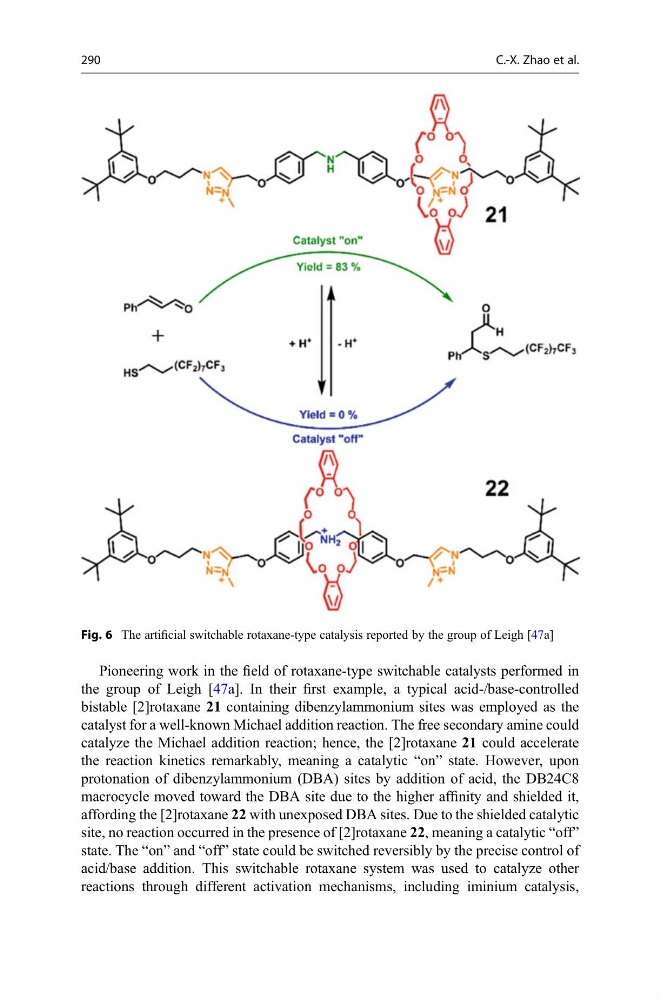
Pioneering work in the field of rotaxane-type switchable catalysts performed in
the group of Leigh [47a]. In their first example, a typical acid-/base-controlled
bistable [2]rotaxane 21 containing dibenzylammonium sites was employed as the
catalyst for a well-known Michael addition reaction. The free secondary amine could
catalyze the Michael addition reaction; hence, the [2]rotaxane 21 could accelerate
the reaction kinetics remarkably, meaning a catalytic “on” state. However, upon
protonation of dibenzylammonium (DBA) sites by addition of acid, the DB24C8
macrocycle moved toward the DBA site due to the higher affinity and shielded it,
affording the [2]rotaxane 22 with unexposed DBA sites. Due to the shielded catalytic
site, no reaction occurred in the presence of [2]rotaxane 22, meaning a catalytic “off”
state. The “on” and “off” state could be switched reversibly by the precise control of
acid/base addition. This switchable rotaxane system was used to catalyze other
reactions through different activation mechanisms, including iminium catalysis,
Fig. 6 The artificial switchable rotaxane-type catalysis reported by the group of Leigh [47a]
290
C.-X. Zhao et al.
the group of Leigh [47a]. In their first example, a typical acid-/base-controlled
bistable [2]rotaxane 21 containing dibenzylammonium sites was employed as the
catalyst for a well-known Michael addition reaction. The free secondary amine could
catalyze the Michael addition reaction; hence, the [2]rotaxane 21 could accelerate
the reaction kinetics remarkably, meaning a catalytic “on” state. However, upon
protonation of dibenzylammonium (DBA) sites by addition of acid, the DB24C8
macrocycle moved toward the DBA site due to the higher affinity and shielded it,
affording the [2]rotaxane 22 with unexposed DBA sites. Due to the shielded catalytic
site, no reaction occurred in the presence of [2]rotaxane 22, meaning a catalytic “off”
state. The “on” and “off” state could be switched reversibly by the precise control of
acid/base addition. This switchable rotaxane system was used to catalyze other
reactions through different activation mechanisms, including iminium catalysis,
Fig. 6 The artificial switchable rotaxane-type catalysis reported by the group of Leigh [47a]
290
C.-X. Zhao et al.