

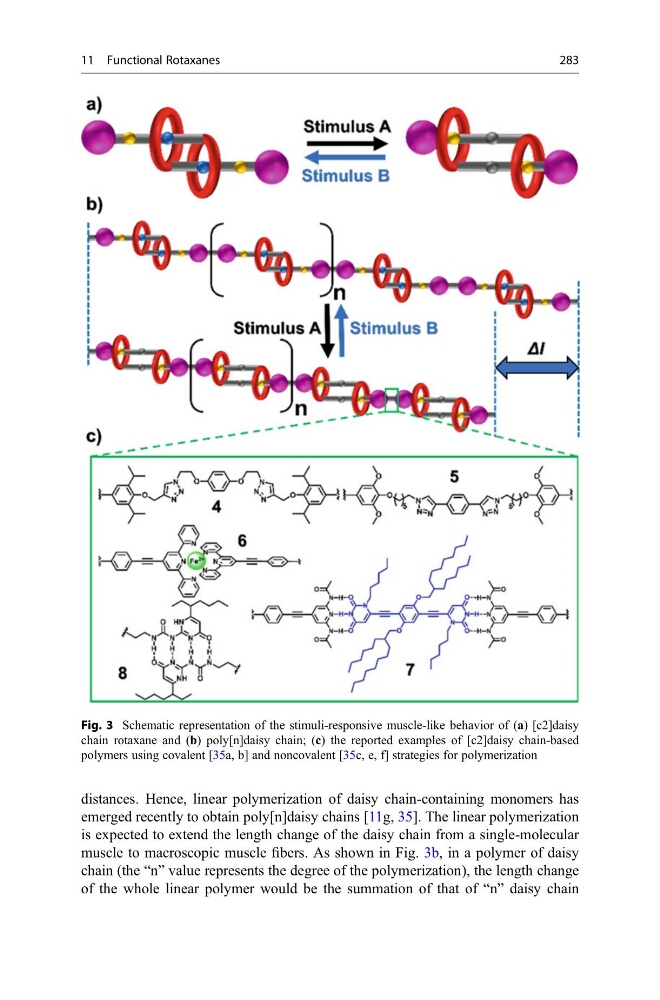
distances. Hence, linear polymerization of daisy chain-containing monomers has
emerged recently to obtain poly[n]daisy chains [11g, 35]. The linear polymerization
is expected to extend the length change of the daisy chain from a single-molecular
muscle to macroscopic muscle fibers. As shown in Fig. 3b, in a polymer of daisy
chain (the “n” value represents the degree of the polymerization), the length change
of the whole linear polymer would be the summation of that of “n” daisy chain
Fig. 3 Schematic representation of the stimuli-responsive muscle-like behavior of (a) [c2]daisy
chain rotaxane and (b) poly[n]daisy chain; (c) the reported examples of [c2]daisy chain-based
polymers using covalent [35a, b] and noncovalent [35c, e, f] strategies for polymerization
11 Functional Rotaxanes
283
emerged recently to obtain poly[n]daisy chains [11g, 35]. The linear polymerization
is expected to extend the length change of the daisy chain from a single-molecular
muscle to macroscopic muscle fibers. As shown in Fig. 3b, in a polymer of daisy
chain (the “n” value represents the degree of the polymerization), the length change
of the whole linear polymer would be the summation of that of “n” daisy chain
Fig. 3 Schematic representation of the stimuli-responsive muscle-like behavior of (a) [c2]daisy
chain rotaxane and (b) poly[n]daisy chain; (c) the reported examples of [c2]daisy chain-based
polymers using covalent [35a, b] and noncovalent [35c, e, f] strategies for polymerization
11 Functional Rotaxanes
283