

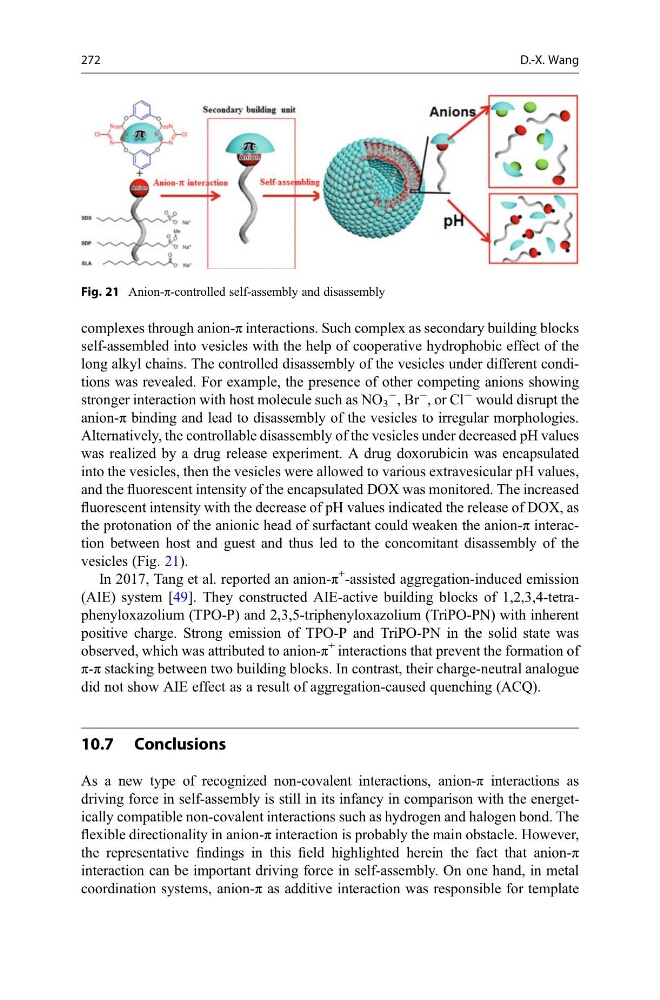
complexes through anion-π interactions. Such complex as secondary building blocks
self-assembled into vesicles with the help of cooperative hydrophobic effect of the
long alkyl chains. The controlled disassembly of the vesicles under different conditions was revealed. For example, the presence of other competing anions showing
stronger interaction with host molecule such as NO 3
À , Br
À
, or Cl
À would disrupt the
anion-π binding and lead to disassembly of the vesicles to irregular morphologies.
Alternatively, the controllable disassembly of the vesicles under decreased pH values
was realized by a drug release experiment. A drug doxorubicin was encapsulated
into the vesicles, then the vesicles were allowed to various extravesicular pH values,
and the fluorescent intensity of the encapsulated DOX was monitored. The increased
fluorescent intensity with the decrease of pH values indicated the release of DOX, as
the protonation of the anionic head of surfactant could weaken the anion-π interaction between host and guest and thus led to the concomitant disassembly of the
vesicles (Fig. 21).
In 2017, Tang et al. reported an anion-π
+ -assisted aggregation-induced emission
(AIE) system [49]. They constructed AIE-active building blocks of 1,2,3,4-tetraphenyloxazolium (TPO-P) and 2,3,5-triphenyloxazolium (TriPO-PN) with inherent
positive charge. Strong emission of TPO-P and TriPO-PN in the solid state was
observed, which was attributed to anion-π
+ interactions that prevent the formation of
π-π stacking between two building blocks. In contrast, their charge-neutral analogue
did not show AIE effect as a result of aggregation-caused quenching (ACQ).
10.7 Conclusions
As a new type of recognized non-covalent interactions, anion-π interactions as
driving force in self-assembly is still in its infancy in comparison with the energetically compatible non-covalent interactions such as hydrogen and halogen bond. The
flexible directionality in anion-π interaction is probably the main obstacle. However,
the representative findings in this field highlighted herein the fact that anion-π
interaction can be important driving force in self-assembly. On one hand, in metal
coordination systems, anion-π as additive interaction was responsible for template
Fig. 21 Anion-π-controlled self-assembly and disassembly
272
D.-X. Wang
self-assembled into vesicles with the help of cooperative hydrophobic effect of the
long alkyl chains. The controlled disassembly of the vesicles under different conditions was revealed. For example, the presence of other competing anions showing
stronger interaction with host molecule such as NO 3
À , Br
À
, or Cl
À would disrupt the
anion-π binding and lead to disassembly of the vesicles to irregular morphologies.
Alternatively, the controllable disassembly of the vesicles under decreased pH values
was realized by a drug release experiment. A drug doxorubicin was encapsulated
into the vesicles, then the vesicles were allowed to various extravesicular pH values,
and the fluorescent intensity of the encapsulated DOX was monitored. The increased
fluorescent intensity with the decrease of pH values indicated the release of DOX, as
the protonation of the anionic head of surfactant could weaken the anion-π interaction between host and guest and thus led to the concomitant disassembly of the
vesicles (Fig. 21).
In 2017, Tang et al. reported an anion-π
+ -assisted aggregation-induced emission
(AIE) system [49]. They constructed AIE-active building blocks of 1,2,3,4-tetraphenyloxazolium (TPO-P) and 2,3,5-triphenyloxazolium (TriPO-PN) with inherent
positive charge. Strong emission of TPO-P and TriPO-PN in the solid state was
observed, which was attributed to anion-π
+ interactions that prevent the formation of
π-π stacking between two building blocks. In contrast, their charge-neutral analogue
did not show AIE effect as a result of aggregation-caused quenching (ACQ).
10.7 Conclusions
As a new type of recognized non-covalent interactions, anion-π interactions as
driving force in self-assembly is still in its infancy in comparison with the energetically compatible non-covalent interactions such as hydrogen and halogen bond. The
flexible directionality in anion-π interaction is probably the main obstacle. However,
the representative findings in this field highlighted herein the fact that anion-π
interaction can be important driving force in self-assembly. On one hand, in metal
coordination systems, anion-π as additive interaction was responsible for template
Fig. 21 Anion-π-controlled self-assembly and disassembly
272
D.-X. Wang