

including spherical Cl
À , Br
À and I
À , linear SCN
À
, planar triangular NO 3
À , tetrahedral BF 4
À and ClO 4
À , and organic anion naphthalene-1,5-disulfonate. All complexes involved typical anion-π interactions between anion and tetrazine moiety
with only the exception of complexation with nitrate in which anion interacted with
tetrazine through σ-type interactions. Most anions were sandwiched by two tetrazine
rings from two macrocycles. Depending on the nature of anions, and due to the effect
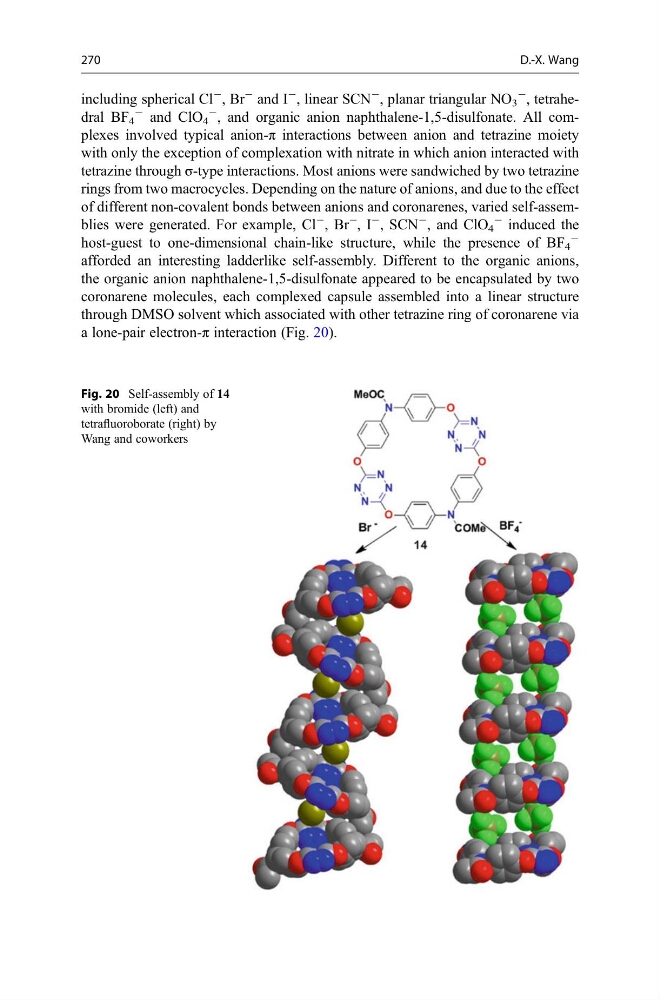
of different non-covalent bonds between anions and coronarenes, varied self-assemblies were generated. For example, Cl
À
, Br
À
, I
À , SCN
À , and ClO 4
À induced the
host-guest to one-dimensional chain-like structure, while the presence of BF 4
À
afforded an interesting ladderlike self-assembly. Different to the organic anions,
the organic anion naphthalene-1,5-disulfonate appeared to be encapsulated by two
coronarene molecules, each complexed capsule assembled into a linear structure
through DMSO solvent which associated with other tetrazine ring of coronarene via
a lone-pair electron-π interaction (Fig. 20).
Fig. 20 Self-assembly of 14
with bromide (left) and
tetrafluoroborate (right) by
Wang and coworkers
270
D.-X. Wang
À , Br
À and I
À , linear SCN
À
, planar triangular NO 3
À , tetrahedral BF 4
À and ClO 4
À , and organic anion naphthalene-1,5-disulfonate. All complexes involved typical anion-π interactions between anion and tetrazine moiety
with only the exception of complexation with nitrate in which anion interacted with
tetrazine through σ-type interactions. Most anions were sandwiched by two tetrazine
rings from two macrocycles. Depending on the nature of anions, and due to the effect
of different non-covalent bonds between anions and coronarenes, varied self-assemblies were generated. For example, Cl
À
, Br
À
, I
À , SCN
À , and ClO 4
À induced the
host-guest to one-dimensional chain-like structure, while the presence of BF 4
À
afforded an interesting ladderlike self-assembly. Different to the organic anions,
the organic anion naphthalene-1,5-disulfonate appeared to be encapsulated by two
coronarene molecules, each complexed capsule assembled into a linear structure
through DMSO solvent which associated with other tetrazine ring of coronarene via
a lone-pair electron-π interaction (Fig. 20).
Fig. 20 Self-assembly of 14
with bromide (left) and
tetrafluoroborate (right) by
Wang and coworkers
270
D.-X. Wang