

electron-deficient arenes into macrocyclic and supramolecular skeletons [5–9] or
employing extended π units such as naphthalenediimides (NDI) [10, 11] and
hexaazatriphenylene-hexacarbonitrile (HAT(CN) 6 ) [12, 13], have exemplified
and demonstrated not only the existence but also the marvelous applications of
anion-π interactions. Now anion-π interaction has been realized as one of the
important driving forces in anion recognition, sensing, ion channel, and catalysis.
It is worth addressing that utilizing anion-π interactions as a driving force to direct
self-assembly, however, remains largely unexplored. This hindrance is mainly
caused by the various interaction modes in anion-π interactions. In sharp contrast
to cation-π interaction where cations are exclusively located over the center of an
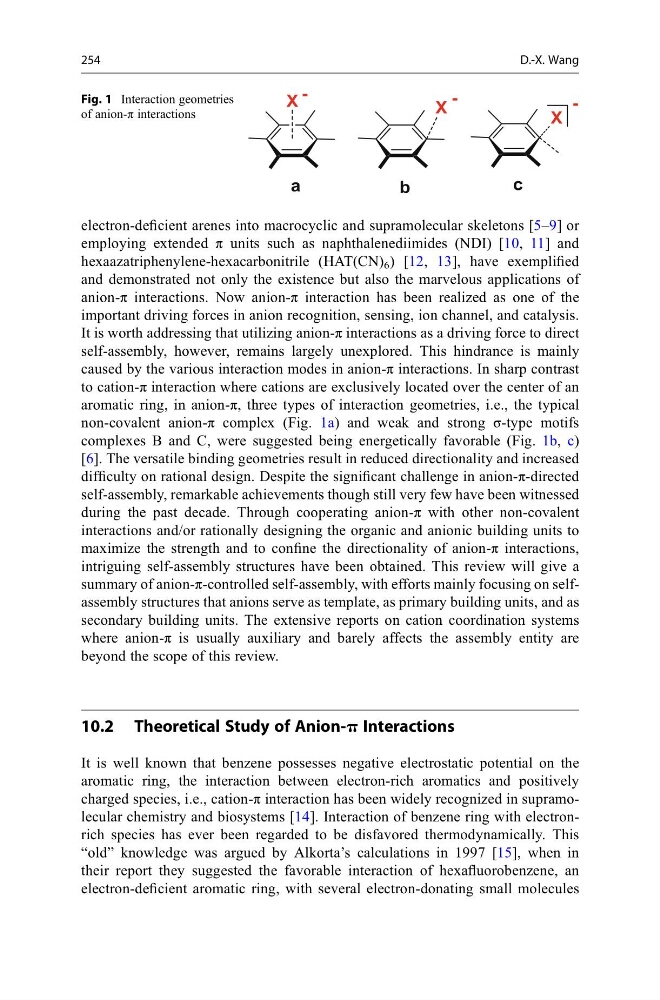
aromatic ring, in anion-π, three types of interaction geometries, i.e., the typical
non-covalent anion-π complex (Fig. 1a) and weak and strong σ-type motifs
complexes B and C, were suggested being energetically favorable (Fig. 1b, c)
[6]. The versatile binding geometries result in reduced directionality and increased
difficulty on rational design. Despite the significant challenge in anion-π-directed
self-assembly, remarkable achievements though still very few have been witnessed
during the past decade. Through cooperating anion-π with other non-covalent
interactions and/or rationally designing the organic and anionic building units to
maximize the strength and to confine the directionality of anion-π interactions,
intriguing self-assembly structures have been obtained. This review will give a
summary of anion-π-controlled self-assembly, with efforts mainly focusing on selfassembly structures that anions serve as template, as primary building units, and as
secondary building units. The extensive reports on cation coordination systems
where anion-π is usually auxiliary and barely affects the assembly entity are
beyond the scope of this review.
10.2 Theoretical Study of Anion-p Interactions
It is well known that benzene possesses negative electrostatic potential on the
aromatic ring, the interaction between electron-rich aromatics and positively
charged species, i.e., cation-π interaction has been widely recognized in supramolecular chemistry and biosystems [14]. Interaction of benzene ring with electronrich species has ever been regarded to be disfavored thermodynamically. This
“old” knowledge was argued by Alkorta’s calculations in 1997 [15], when in
their report they suggested the favorable interaction of hexafluorobenzene, an
electron-deficient aromatic ring, with several electron-donating small molecules
Fig. 1 Interaction geometries
of anion-π interactions
254
D.-X. Wang
employing extended π units such as naphthalenediimides (NDI) [10, 11] and
hexaazatriphenylene-hexacarbonitrile (HAT(CN) 6 ) [12, 13], have exemplified
and demonstrated not only the existence but also the marvelous applications of
anion-π interactions. Now anion-π interaction has been realized as one of the
important driving forces in anion recognition, sensing, ion channel, and catalysis.
It is worth addressing that utilizing anion-π interactions as a driving force to direct
self-assembly, however, remains largely unexplored. This hindrance is mainly
caused by the various interaction modes in anion-π interactions. In sharp contrast
to cation-π interaction where cations are exclusively located over the center of an
aromatic ring, in anion-π, three types of interaction geometries, i.e., the typical
non-covalent anion-π complex (Fig. 1a) and weak and strong σ-type motifs
complexes B and C, were suggested being energetically favorable (Fig. 1b, c)
[6]. The versatile binding geometries result in reduced directionality and increased
difficulty on rational design. Despite the significant challenge in anion-π-directed
self-assembly, remarkable achievements though still very few have been witnessed
during the past decade. Through cooperating anion-π with other non-covalent
interactions and/or rationally designing the organic and anionic building units to
maximize the strength and to confine the directionality of anion-π interactions,
intriguing self-assembly structures have been obtained. This review will give a
summary of anion-π-controlled self-assembly, with efforts mainly focusing on selfassembly structures that anions serve as template, as primary building units, and as
secondary building units. The extensive reports on cation coordination systems
where anion-π is usually auxiliary and barely affects the assembly entity are
beyond the scope of this review.
10.2 Theoretical Study of Anion-p Interactions
It is well known that benzene possesses negative electrostatic potential on the
aromatic ring, the interaction between electron-rich aromatics and positively
charged species, i.e., cation-π interaction has been widely recognized in supramolecular chemistry and biosystems [14]. Interaction of benzene ring with electronrich species has ever been regarded to be disfavored thermodynamically. This
“old” knowledge was argued by Alkorta’s calculations in 1997 [15], when in
their report they suggested the favorable interaction of hexafluorobenzene, an
electron-deficient aromatic ring, with several electron-donating small molecules
Fig. 1 Interaction geometries
of anion-π interactions
254
D.-X. Wang