

interactions between a fluorene derivative carrying two bispyridinium units (FPy)
and cucurbit[8]uril (CB[8]) [74]. On account of the hydrophobicity of polycyclic
aromatic hydrocarbon and near planarity of biphenyl, FPy in aqueous solution
produced weak fluorescence emission. When the molar ratio of FPy to CB[8] was
1:1, the obtained FPy/CB[8] (1:1) complex displayed an obviously enhanced fluorescence emission. After the further increase of stoichiometry to 1:2, a 30 nm redshift
was obtained, indicating a tunable fluorescence emission property. Considering the
aggregation-induced quenching effect, the strong electrostatic attraction between
FPy/CB[8] (1:1) and adenosine-5
0 -triphosphate (ATP) resulted in a remarkable
decay of fluorescence signal, which exhibited a sensitive ATP sensing with a low
detection limit at the nM level. By selecting catalyzed hairpin assembly (CHA) as the
enzyme-free nucleic acid-based signal amplification method, a novel fluorescence
biosensor was developed for the small molecule adenosine detection [75]. In the
absence of adenosine, the specific binding between aptamer-trigger strand and
inhibitor strand hindered the activation of two hairpin probes (H1 and H2)
(Fig. 12a). Pyrene labeled at the single-stranded stem of H1 probe could be easily
captured by the hydrophobic cavity of β-CDP and then generated a significantly
enhanced fluorescence signal. Upon the addition of adenosine, CHA reaction was
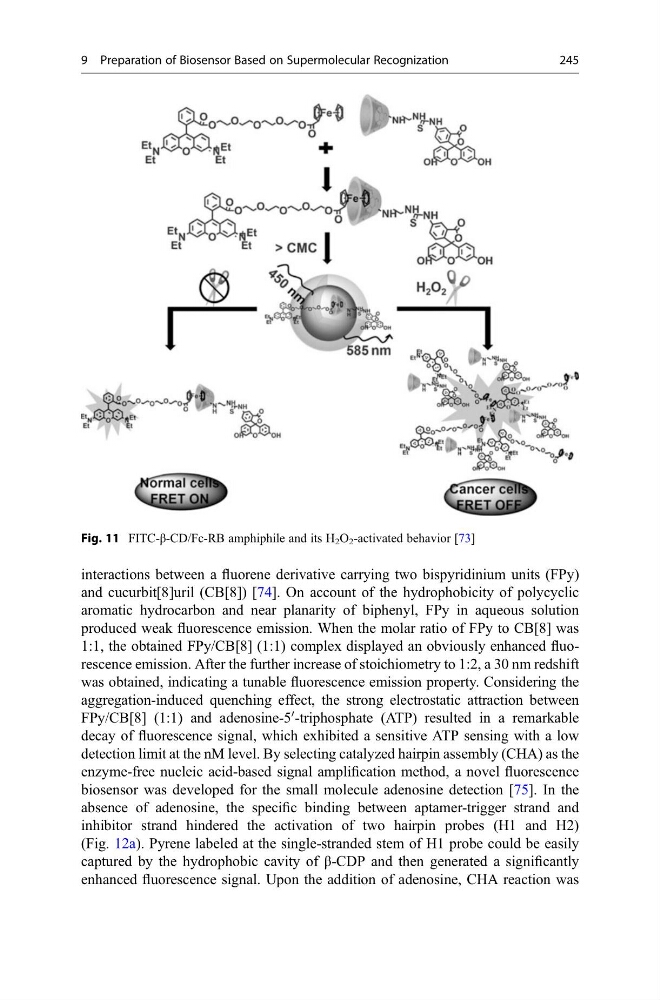
Fig. 11 FITC-β-CD/Fc-RB amphiphile and its H 2 O 2 -activated behavior [73]
9 Preparation of Biosensor Based on Supermolecular Recognization
245
and cucurbit[8]uril (CB[8]) [74]. On account of the hydrophobicity of polycyclic
aromatic hydrocarbon and near planarity of biphenyl, FPy in aqueous solution
produced weak fluorescence emission. When the molar ratio of FPy to CB[8] was
1:1, the obtained FPy/CB[8] (1:1) complex displayed an obviously enhanced fluorescence emission. After the further increase of stoichiometry to 1:2, a 30 nm redshift
was obtained, indicating a tunable fluorescence emission property. Considering the
aggregation-induced quenching effect, the strong electrostatic attraction between
FPy/CB[8] (1:1) and adenosine-5
0 -triphosphate (ATP) resulted in a remarkable
decay of fluorescence signal, which exhibited a sensitive ATP sensing with a low
detection limit at the nM level. By selecting catalyzed hairpin assembly (CHA) as the
enzyme-free nucleic acid-based signal amplification method, a novel fluorescence
biosensor was developed for the small molecule adenosine detection [75]. In the
absence of adenosine, the specific binding between aptamer-trigger strand and
inhibitor strand hindered the activation of two hairpin probes (H1 and H2)
(Fig. 12a). Pyrene labeled at the single-stranded stem of H1 probe could be easily
captured by the hydrophobic cavity of β-CDP and then generated a significantly
enhanced fluorescence signal. Upon the addition of adenosine, CHA reaction was
Fig. 11 FITC-β-CD/Fc-RB amphiphile and its H 2 O 2 -activated behavior [73]
9 Preparation of Biosensor Based on Supermolecular Recognization
245