

designed calixarene host should have the ability to selectively bind strongly to the
target analyte. In the case of insufficient binding selectivity, an enzyme can be
introduced into the supramolecular tandem assay to ultimately achieve specific
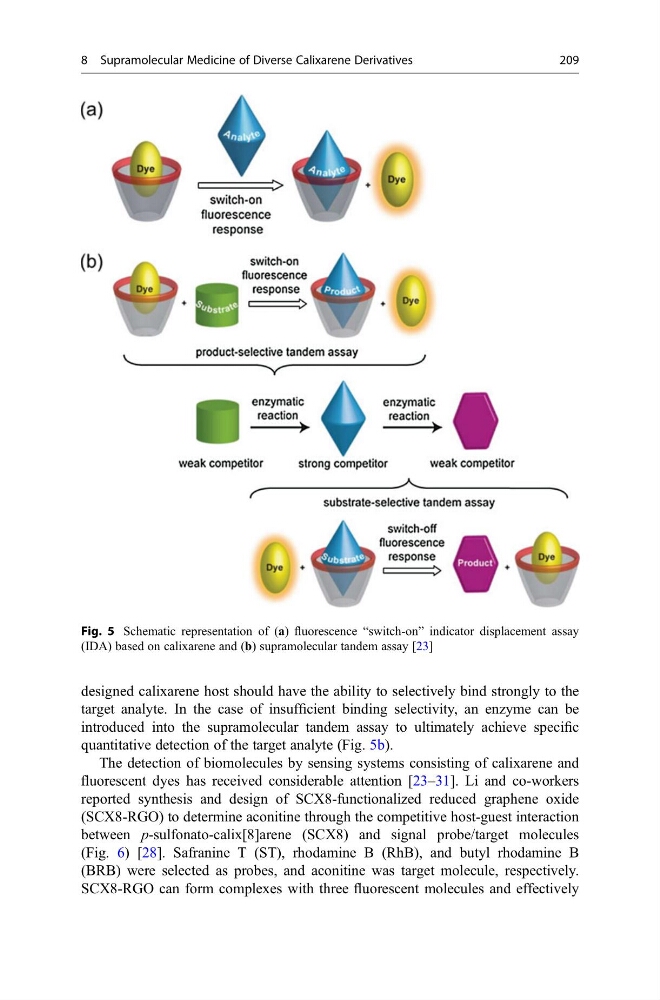
quantitative detection of the target analyte (Fig. 5b).
The detection of biomolecules by sensing systems consisting of calixarene and
fluorescent dyes has received considerable attention [23–31]. Li and co-workers
reported synthesis and design of SCX8-functionalized reduced graphene oxide
(SCX8-RGO) to determine aconitine through the competitive host-guest interaction
between p-sulfonato-calix[8]arene (SCX8) and signal probe/target molecules
(Fig. 6) [28]. Safranine T (ST), rhodamine B (RhB), and butyl rhodamine B
(BRB) were selected as probes, and aconitine was target molecule, respectively.
SCX8-RGO can form complexes with three fluorescent molecules and effectively
Fig. 5 Schematic representation of (a) fluorescence “switch-on” indicator displacement assay
(IDA) based on calixarene and (b) supramolecular tandem assay [23]
8 Supramolecular Medicine of Diverse Calixarene Derivatives
209
target analyte. In the case of insufficient binding selectivity, an enzyme can be
introduced into the supramolecular tandem assay to ultimately achieve specific
quantitative detection of the target analyte (Fig. 5b).
The detection of biomolecules by sensing systems consisting of calixarene and
fluorescent dyes has received considerable attention [23–31]. Li and co-workers
reported synthesis and design of SCX8-functionalized reduced graphene oxide
(SCX8-RGO) to determine aconitine through the competitive host-guest interaction
between p-sulfonato-calix[8]arene (SCX8) and signal probe/target molecules
(Fig. 6) [28]. Safranine T (ST), rhodamine B (RhB), and butyl rhodamine B
(BRB) were selected as probes, and aconitine was target molecule, respectively.
SCX8-RGO can form complexes with three fluorescent molecules and effectively
Fig. 5 Schematic representation of (a) fluorescence “switch-on” indicator displacement assay
(IDA) based on calixarene and (b) supramolecular tandem assay [23]
8 Supramolecular Medicine of Diverse Calixarene Derivatives
209