

8.2
Calixarene Overview
Calixarenes are a class of third-generation supramolecular host molecules, appearing
after cyclodextrin and crown ether. These molecules are formed by the orthocondensation of para-substituted phenols with formaldehyde, generally in the
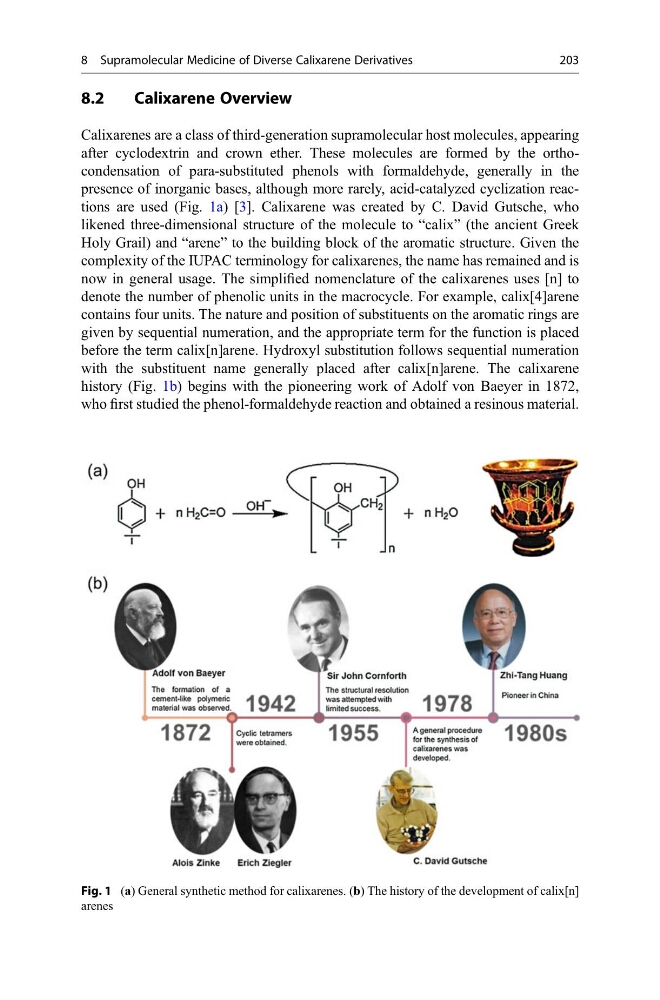
presence of inorganic bases, although more rarely, acid-catalyzed cyclization reactions are used (Fig. 1a) [3]. Calixarene was created by C. David Gutsche, who
likened three-dimensional structure of the molecule to “calix” (the ancient Greek
Holy Grail) and “arene” to the building block of the aromatic structure. Given the
complexity of the IUPAC terminology for calixarenes, the name has remained and is
now in general usage. The simplified nomenclature of the calixarenes uses [n] to
denote the number of phenolic units in the macrocycle. For example, calix[4]arene
contains four units. The nature and position of substituents on the aromatic rings are
given by sequential numeration, and the appropriate term for the function is placed
before the term calix[n]arene. Hydroxyl substitution follows sequential numeration
with the substituent name generally placed after calix[n]arene. The calixarene
history (Fig. 1b) begins with the pioneering work of Adolf von Baeyer in 1872,
who first studied the phenol-formaldehyde reaction and obtained a resinous material.
Fig. 1 (a) General synthetic method for calixarenes. (b) The history of the development of calix[n]
arenes
8 Supramolecular Medicine of Diverse Calixarene Derivatives
203
Calixarene Overview
Calixarenes are a class of third-generation supramolecular host molecules, appearing
after cyclodextrin and crown ether. These molecules are formed by the orthocondensation of para-substituted phenols with formaldehyde, generally in the
presence of inorganic bases, although more rarely, acid-catalyzed cyclization reactions are used (Fig. 1a) [3]. Calixarene was created by C. David Gutsche, who
likened three-dimensional structure of the molecule to “calix” (the ancient Greek
Holy Grail) and “arene” to the building block of the aromatic structure. Given the
complexity of the IUPAC terminology for calixarenes, the name has remained and is
now in general usage. The simplified nomenclature of the calixarenes uses [n] to
denote the number of phenolic units in the macrocycle. For example, calix[4]arene
contains four units. The nature and position of substituents on the aromatic rings are
given by sequential numeration, and the appropriate term for the function is placed
before the term calix[n]arene. Hydroxyl substitution follows sequential numeration
with the substituent name generally placed after calix[n]arene. The calixarene
history (Fig. 1b) begins with the pioneering work of Adolf von Baeyer in 1872,
who first studied the phenol-formaldehyde reaction and obtained a resinous material.
Fig. 1 (a) General synthetic method for calixarenes. (b) The history of the development of calix[n]
arenes
8 Supramolecular Medicine of Diverse Calixarene Derivatives
203