

dominant in the polar solvents. Then, 45 was successfully synthesized by the same
group in 2016 [61]. Similarly, the initial single crystal of 45 also exhibits a flat
conformation, and only enol-imine tautomer exists in nonpolar solvents (Fig. 7b).
Recently, campestarenes bearing functional moieties were first designed and synthesized by Brothers and coworkers in 2018 and, indeed, extended the application
fields of campestarene family [62]. Meanwhile, by introducing the ranyl(VI) as the
template, MacLachlan and coworkers discovered two expanded version of
campestarenes with six (46) or eight (47) repeating units, definitely, and their
electron-rich features guarantee a wide range of supramolecular functions to be
exploited in the near future (Fig. 7c) [63].
7.3.5 Oxatub[n]arenes
Oxatub[4]arene (48), a macrocyclic receptor with multiple interconvertible cavities,
was first introduced by Jiang and coworkers in 2015 [64]. 48 was synthesized in a
reasonable yield of 21% through the well-known Williamson ether condensation by
reaction of 2,6-dihydroxynaphthalene and 2,6-dibromonaphthalene under a highdilution condition (Fig. 8a). Meanwhile, the intriguing structure endows 48 with
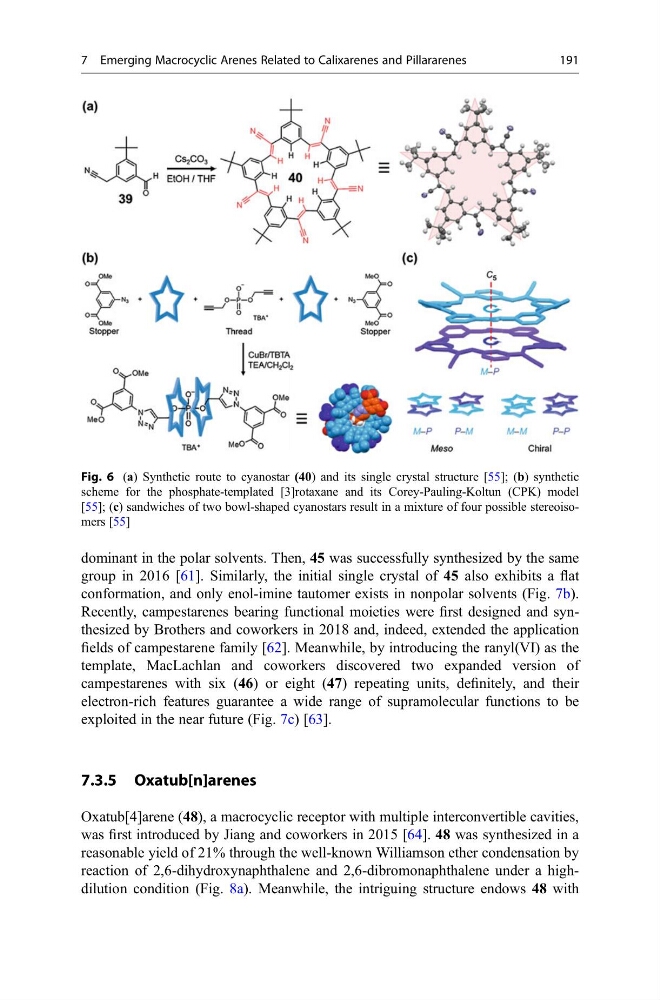
Fig. 6 (a) Synthetic route to cyanostar (40) and its single crystal structure [55]; (b) synthetic
scheme for the phosphate-templated [3]rotaxane and its Corey-Pauling-Koltun (CPK) model
[55]; (c) sandwiches of two bowl-shaped cyanostars result in a mixture of four possible stereoisomers [55]
7 Emerging Macrocyclic Arenes Related to Calixarenes and Pillararenes
191
group in 2016 [61]. Similarly, the initial single crystal of 45 also exhibits a flat
conformation, and only enol-imine tautomer exists in nonpolar solvents (Fig. 7b).
Recently, campestarenes bearing functional moieties were first designed and synthesized by Brothers and coworkers in 2018 and, indeed, extended the application
fields of campestarene family [62]. Meanwhile, by introducing the ranyl(VI) as the
template, MacLachlan and coworkers discovered two expanded version of
campestarenes with six (46) or eight (47) repeating units, definitely, and their
electron-rich features guarantee a wide range of supramolecular functions to be
exploited in the near future (Fig. 7c) [63].
7.3.5 Oxatub[n]arenes
Oxatub[4]arene (48), a macrocyclic receptor with multiple interconvertible cavities,
was first introduced by Jiang and coworkers in 2015 [64]. 48 was synthesized in a
reasonable yield of 21% through the well-known Williamson ether condensation by
reaction of 2,6-dihydroxynaphthalene and 2,6-dibromonaphthalene under a highdilution condition (Fig. 8a). Meanwhile, the intriguing structure endows 48 with
Fig. 6 (a) Synthetic route to cyanostar (40) and its single crystal structure [55]; (b) synthetic
scheme for the phosphate-templated [3]rotaxane and its Corey-Pauling-Koltun (CPK) model
[55]; (c) sandwiches of two bowl-shaped cyanostars result in a mixture of four possible stereoisomers [55]
7 Emerging Macrocyclic Arenes Related to Calixarenes and Pillararenes
191