

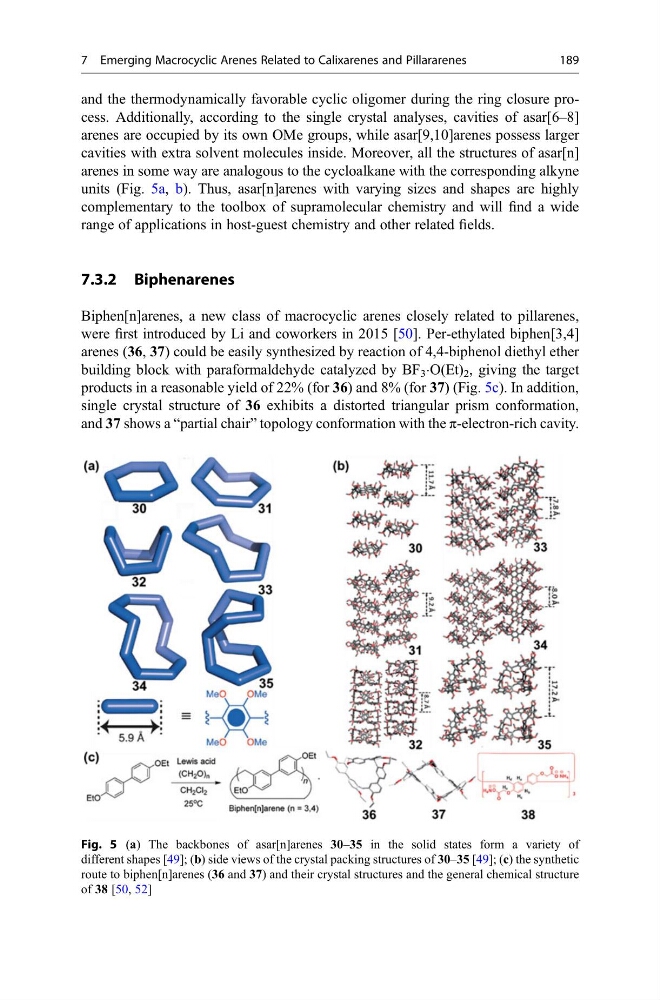
and the thermodynamically favorable cyclic oligomer during the ring closure process. Additionally, according to the single crystal analyses, cavities of asar[6–8]
arenes are occupied by its own OMe groups, while asar[9,10]arenes possess larger
cavities with extra solvent molecules inside. Moreover, all the structures of asar[n]
arenes in some way are analogous to the cycloalkane with the corresponding alkyne
units (Fig. 5a, b). Thus, asar[n]arenes with varying sizes and shapes are highly
complementary to the toolbox of supramolecular chemistry and will find a wide
range of applications in host-guest chemistry and other related fields.
7.3.2 Biphenarenes
Biphen[n]arenes, a new class of macrocyclic arenes closely related to pillarenes,
were first introduced by Li and coworkers in 2015 [50]. Per-ethylated biphen[3,4]
arenes (36, 37) could be easily synthesized by reaction of 4,4-biphenol diethyl ether
building block with paraformaldehyde catalyzed by BF 3 ÁO(Et) 2 , giving the target
products in a reasonable yield of 22% (for 36) and 8% (for 37) (Fig. 5c). In addition,
single crystal structure of 36 exhibits a distorted triangular prism conformation,
and 37 shows a “partial chair” topology conformation with the π-electron-rich cavity.
Fig. 5 (a) The backbones of asar[n]arenes 30–35 in the solid states form a variety of
different shapes [49]; (b) side views of the crystal packing structures of 30–35 [49]; (c) the synthetic
route to biphen[n]arenes (36 and 37) and their crystal structures and the general chemical structure
of 38 [50, 52]
7 Emerging Macrocyclic Arenes Related to Calixarenes and Pillararenes
189
arenes are occupied by its own OMe groups, while asar[9,10]arenes possess larger
cavities with extra solvent molecules inside. Moreover, all the structures of asar[n]
arenes in some way are analogous to the cycloalkane with the corresponding alkyne
units (Fig. 5a, b). Thus, asar[n]arenes with varying sizes and shapes are highly
complementary to the toolbox of supramolecular chemistry and will find a wide
range of applications in host-guest chemistry and other related fields.
7.3.2 Biphenarenes
Biphen[n]arenes, a new class of macrocyclic arenes closely related to pillarenes,
were first introduced by Li and coworkers in 2015 [50]. Per-ethylated biphen[3,4]
arenes (36, 37) could be easily synthesized by reaction of 4,4-biphenol diethyl ether
building block with paraformaldehyde catalyzed by BF 3 ÁO(Et) 2 , giving the target
products in a reasonable yield of 22% (for 36) and 8% (for 37) (Fig. 5c). In addition,
single crystal structure of 36 exhibits a distorted triangular prism conformation,
and 37 shows a “partial chair” topology conformation with the π-electron-rich cavity.
Fig. 5 (a) The backbones of asar[n]arenes 30–35 in the solid states form a variety of
different shapes [49]; (b) side views of the crystal packing structures of 30–35 [49]; (c) the synthetic
route to biphen[n]arenes (36 and 37) and their crystal structures and the general chemical structure
of 38 [50, 52]
7 Emerging Macrocyclic Arenes Related to Calixarenes and Pillararenes
189