

intense research activity. Integrating luminescent lanthanide series into these systems
will make the spatial configurational change, chemical binding, or triggered molecular motion to be monitored through the change of fluorescent emission intensity.
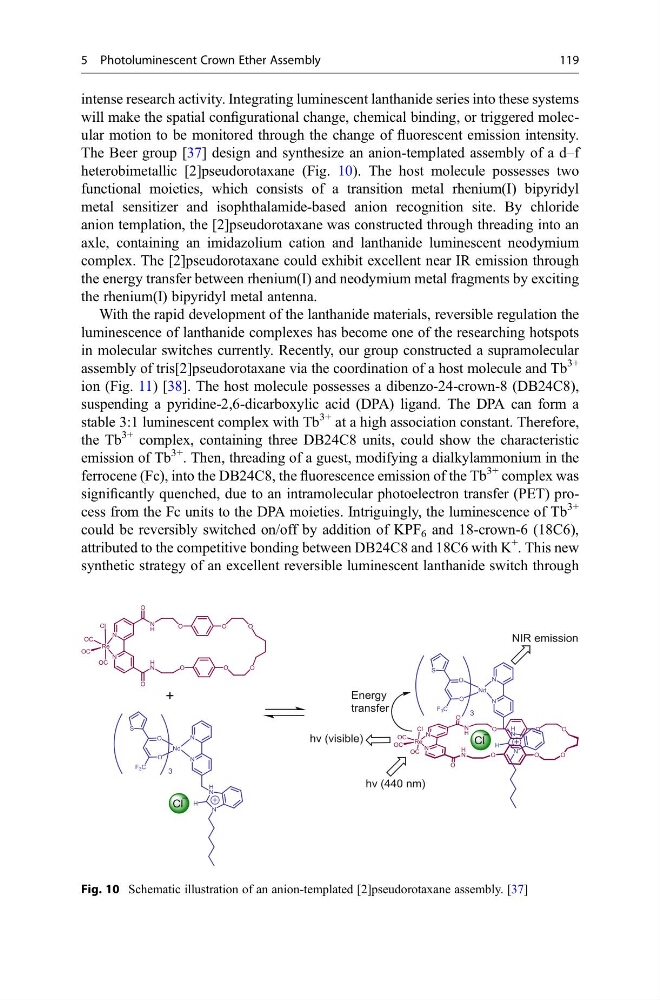
The Beer group [37] design and synthesize an anion-templated assembly of a d–f
heterobimetallic [2]pseudorotaxane (Fig. 10). The host molecule possesses two
functional moieties, which consists of a transition metal rhenium(I) bipyridyl
metal sensitizer and isophthalamide-based anion recognition site. By chloride
anion templation, the [2]pseudorotaxane was constructed through threading into an
axle, containing an imidazolium cation and lanthanide luminescent neodymium
complex. The [2]pseudorotaxane could exhibit excellent near IR emission through
the energy transfer between rhenium(I) and neodymium metal fragments by exciting
the rhenium(I) bipyridyl metal antenna.
With the rapid development of the lanthanide materials, reversible regulation the
luminescence of lanthanide complexes has become one of the researching hotspots
in molecular switches currently. Recently, our group constructed a supramolecular
assembly of tris[2]pseudorotaxane via the coordination of a host molecule and Tb
3+
ion (Fig. 11) [38]. The host molecule possesses a dibenzo-24-crown-8 (DB24C8),
suspending a pyridine-2,6-dicarboxylic acid (DPA) ligand. The DPA can form a
stable 3:1 luminescent complex with Tb
3+ at a high association constant. Therefore,
the Tb
3+ complex, containing three DB24C8 units, could show the characteristic
emission of Tb
3+ . Then, threading of a guest, modifying a dialkylammonium in the
ferrocene (Fc), into the DB24C8, the fluorescence emission of the Tb
3+ complex was
significantly quenched, due to an intramolecular photoelectron transfer (PET) process from the Fc units to the DPA moieties. Intriguingly, the luminescence of Tb
3+
could be reversibly switched on/off by addition of KPF 6 and 18-crown-6 (18C6),
attributed to the competitive bonding between DB24C8 and 18C6 with K
+
. This new
synthetic strategy of an excellent reversible luminescent lanthanide switch through
Fig. 10 Schematic illustration of an anion-templated [2]pseudorotaxane assembly. [37]
5 Photoluminescent Crown Ether Assembly
119
will make the spatial configurational change, chemical binding, or triggered molecular motion to be monitored through the change of fluorescent emission intensity.
The Beer group [37] design and synthesize an anion-templated assembly of a d–f
heterobimetallic [2]pseudorotaxane (Fig. 10). The host molecule possesses two
functional moieties, which consists of a transition metal rhenium(I) bipyridyl
metal sensitizer and isophthalamide-based anion recognition site. By chloride
anion templation, the [2]pseudorotaxane was constructed through threading into an
axle, containing an imidazolium cation and lanthanide luminescent neodymium
complex. The [2]pseudorotaxane could exhibit excellent near IR emission through
the energy transfer between rhenium(I) and neodymium metal fragments by exciting
the rhenium(I) bipyridyl metal antenna.
With the rapid development of the lanthanide materials, reversible regulation the
luminescence of lanthanide complexes has become one of the researching hotspots
in molecular switches currently. Recently, our group constructed a supramolecular
assembly of tris[2]pseudorotaxane via the coordination of a host molecule and Tb
3+
ion (Fig. 11) [38]. The host molecule possesses a dibenzo-24-crown-8 (DB24C8),
suspending a pyridine-2,6-dicarboxylic acid (DPA) ligand. The DPA can form a
stable 3:1 luminescent complex with Tb
3+ at a high association constant. Therefore,
the Tb
3+ complex, containing three DB24C8 units, could show the characteristic
emission of Tb
3+ . Then, threading of a guest, modifying a dialkylammonium in the
ferrocene (Fc), into the DB24C8, the fluorescence emission of the Tb
3+ complex was
significantly quenched, due to an intramolecular photoelectron transfer (PET) process from the Fc units to the DPA moieties. Intriguingly, the luminescence of Tb
3+
could be reversibly switched on/off by addition of KPF 6 and 18-crown-6 (18C6),
attributed to the competitive bonding between DB24C8 and 18C6 with K
+
. This new
synthetic strategy of an excellent reversible luminescent lanthanide switch through
Fig. 10 Schematic illustration of an anion-templated [2]pseudorotaxane assembly. [37]
5 Photoluminescent Crown Ether Assembly
119