

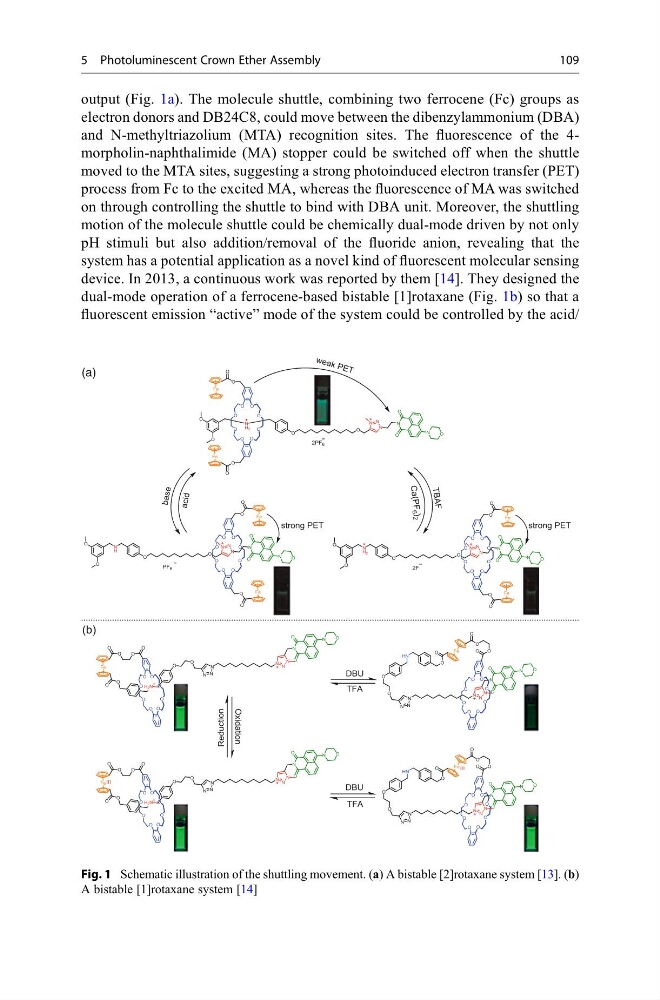
output (Fig. 1a). The molecule shuttle, combining two ferrocene (Fc) groups as
electron donors and DB24C8, could move between the dibenzylammonium (DBA)
and N-methyltriazolium (MTA) recognition sites. The fluorescence of the 4morpholin-naphthalimide (MA) stopper could be switched off when the shuttle
moved to the MTA sites, suggesting a strong photoinduced electron transfer (PET)
process from Fc to the excited MA, whereas the fluorescence of MA was switched
on through controlling the shuttle to bind with DBA unit. Moreover, the shuttling
motion of the molecule shuttle could be chemically dual-mode driven by not only
pH stimuli but also addition/removal of the fluoride anion, revealing that the
system has a potential application as a novel kind of fluorescent molecular sensing
device. In 2013, a continuous work was reported by them [14]. They designed the
dual-mode operation of a ferrocene-based bistable [1]rotaxane (Fig. 1b) so that a
fluorescent emission “active” mode of the system could be controlled by the acid/
(a)
Fig. 1 Schematic illustration of the shuttling movement. (a) A bistable [2]rotaxane system [13]. (b)
A bistable [1]rotaxane system [14]
5 Photoluminescent Crown Ether Assembly
109
electron donors and DB24C8, could move between the dibenzylammonium (DBA)
and N-methyltriazolium (MTA) recognition sites. The fluorescence of the 4morpholin-naphthalimide (MA) stopper could be switched off when the shuttle
moved to the MTA sites, suggesting a strong photoinduced electron transfer (PET)
process from Fc to the excited MA, whereas the fluorescence of MA was switched
on through controlling the shuttle to bind with DBA unit. Moreover, the shuttling
motion of the molecule shuttle could be chemically dual-mode driven by not only
pH stimuli but also addition/removal of the fluoride anion, revealing that the
system has a potential application as a novel kind of fluorescent molecular sensing
device. In 2013, a continuous work was reported by them [14]. They designed the
dual-mode operation of a ferrocene-based bistable [1]rotaxane (Fig. 1b) so that a
fluorescent emission “active” mode of the system could be controlled by the acid/
(a)
Fig. 1 Schematic illustration of the shuttling movement. (a) A bistable [2]rotaxane system [13]. (b)
A bistable [1]rotaxane system [14]
5 Photoluminescent Crown Ether Assembly
109