

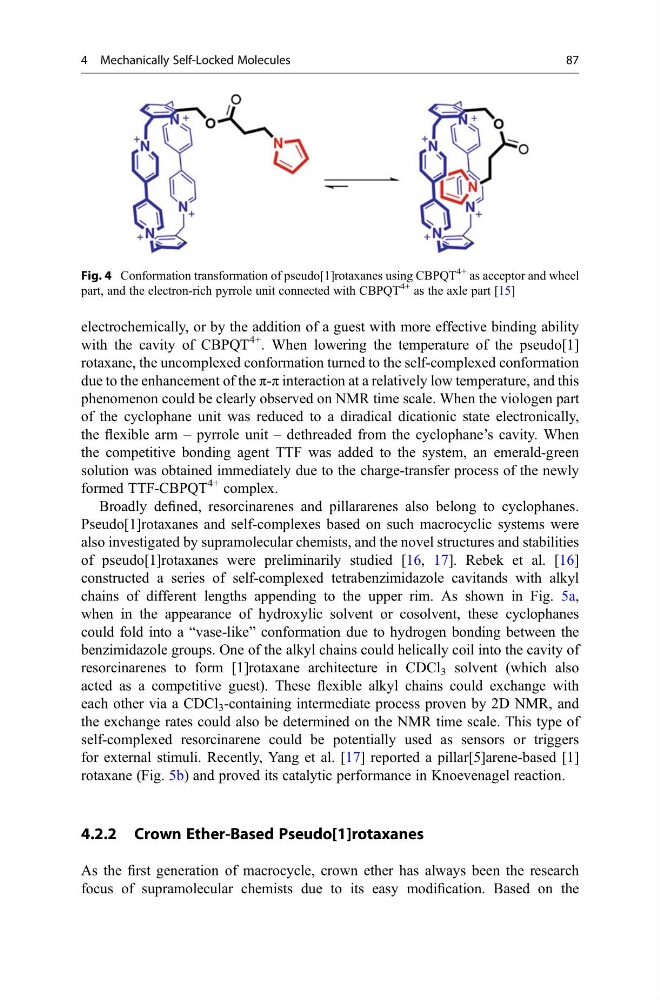
electrochemically, or by the addition of a guest with more effective binding ability
with the cavity of CBPQT
4+ . When lowering the temperature of the pseudo[1]
rotaxane, the uncomplexed conformation turned to the self-complexed conformation
due to the enhancement of the π-π interaction at a relatively low temperature, and this
phenomenon could be clearly observed on NMR time scale. When the viologen part
of the cyclophane unit was reduced to a diradical dicationic state electronically,
the flexible arm – pyrrole unit – dethreaded from the cyclophane’s cavity. When
the competitive bonding agent TTF was added to the system, an emerald-green
solution was obtained immediately due to the charge-transfer process of the newly
formed TTF-CBPQT
4+ complex.
Broadly defined, resorcinarenes and pillararenes also belong to cyclophanes.
Pseudo[1]rotaxanes and self-complexes based on such macrocyclic systems were
also investigated by supramolecular chemists, and the novel structures and stabilities
of pseudo[1]rotaxanes were preliminarily studied [16, 17]. Rebek et al. [16]
constructed a series of self-complexed tetrabenzimidazole cavitands with alkyl
chains of different lengths appending to the upper rim. As shown in Fig. 5a,
when in the appearance of hydroxylic solvent or cosolvent, these cyclophanes
could fold into a “vase-like” conformation due to hydrogen bonding between the
benzimidazole groups. One of the alkyl chains could helically coil into the cavity of
resorcinarenes to form [1]rotaxane architecture in CDCl 3 solvent (which also
acted as a competitive guest). These flexible alkyl chains could exchange with
each other via a CDCl 3 -containing intermediate process proven by 2D NMR, and
the exchange rates could also be determined on the NMR time scale. This type of
self-complexed resorcinarene could be potentially used as sensors or triggers
for external stimuli. Recently, Yang et al. [17] reported a pillar[5]arene-based [1]
rotaxane (Fig. 5b) and proved its catalytic performance in Knoevenagel reaction.
4.2.2 Crown Ether-Based Pseudo[1]rotaxanes
As the first generation of macrocycle, crown ether has always been the research
focus of supramolecular chemists due to its easy modification. Based on the
Fig. 4 Conformation transformation of pseudo[1]rotaxanes using CBPQT
4+ as acceptor and wheel
part, and the electron-rich pyrrole unit connected with CBPQT
4+ as the axle part [15]
4 Mechanically Self-Locked Molecules
87
with the cavity of CBPQT
4+ . When lowering the temperature of the pseudo[1]
rotaxane, the uncomplexed conformation turned to the self-complexed conformation
due to the enhancement of the π-π interaction at a relatively low temperature, and this
phenomenon could be clearly observed on NMR time scale. When the viologen part
of the cyclophane unit was reduced to a diradical dicationic state electronically,
the flexible arm – pyrrole unit – dethreaded from the cyclophane’s cavity. When
the competitive bonding agent TTF was added to the system, an emerald-green
solution was obtained immediately due to the charge-transfer process of the newly
formed TTF-CBPQT
4+ complex.
Broadly defined, resorcinarenes and pillararenes also belong to cyclophanes.
Pseudo[1]rotaxanes and self-complexes based on such macrocyclic systems were
also investigated by supramolecular chemists, and the novel structures and stabilities
of pseudo[1]rotaxanes were preliminarily studied [16, 17]. Rebek et al. [16]
constructed a series of self-complexed tetrabenzimidazole cavitands with alkyl
chains of different lengths appending to the upper rim. As shown in Fig. 5a,
when in the appearance of hydroxylic solvent or cosolvent, these cyclophanes
could fold into a “vase-like” conformation due to hydrogen bonding between the
benzimidazole groups. One of the alkyl chains could helically coil into the cavity of
resorcinarenes to form [1]rotaxane architecture in CDCl 3 solvent (which also
acted as a competitive guest). These flexible alkyl chains could exchange with
each other via a CDCl 3 -containing intermediate process proven by 2D NMR, and
the exchange rates could also be determined on the NMR time scale. This type of
self-complexed resorcinarene could be potentially used as sensors or triggers
for external stimuli. Recently, Yang et al. [17] reported a pillar[5]arene-based [1]
rotaxane (Fig. 5b) and proved its catalytic performance in Knoevenagel reaction.
4.2.2 Crown Ether-Based Pseudo[1]rotaxanes
As the first generation of macrocycle, crown ether has always been the research
focus of supramolecular chemists due to its easy modification. Based on the
Fig. 4 Conformation transformation of pseudo[1]rotaxanes using CBPQT
4+ as acceptor and wheel
part, and the electron-rich pyrrole unit connected with CBPQT
4+ as the axle part [15]
4 Mechanically Self-Locked Molecules
87