

78
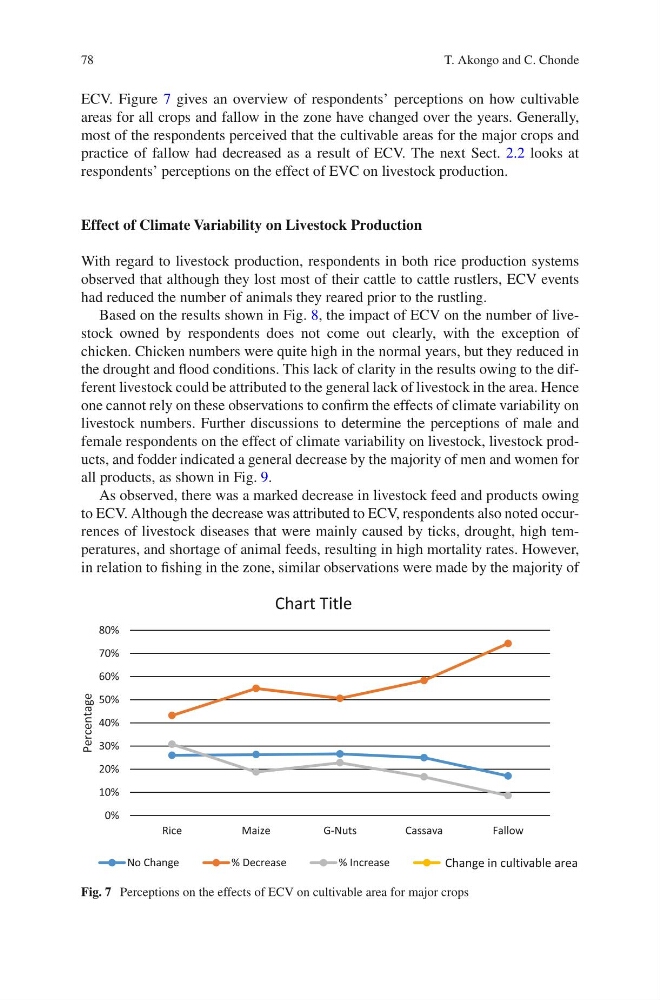
ECV. Figure 7 gives an overview of respondents’ perceptions on how cultivable
areas for all crops and fallow in the zone have changed over the years. Generally,
most of the respondents perceived that the cultivable areas for the major crops and
practice of fallow had decreased as a result of ECV. The next Sect. 2.2 looks at
respondents’ perceptions on the effect of EVC on livestock production.
Effect of Climate Variability on Livestock Production
With regard to livestock production, respondents in both rice production systems
observed that although they lost most of their cattle to cattle rustlers, ECV events
had reduced the number of animals they reared prior to the rustling.
Based on the results shown in Fig. 8, the impact of ECV on the number of livestock owned by respondents does not come out clearly, with the exception of
chicken. Chicken numbers were quite high in the normal years, but they reduced in
the drought and flood conditions. This lack of clarity in the results owing to the different livestock could be attributed to the general lack of livestock in the area. Hence
one cannot rely on these observations to confirm the effects of climate variability on
livestock numbers. Further discussions to determine the perceptions of male and
female respondents on the effect of climate variability on livestock, livestock products, and fodder indicated a general decrease by the majority of men and women for
all products, as shown in Fig. 9.
As observed, there was a marked decrease in livestock feed and products owing
to ECV. Although the decrease was attributed to ECV, respondents also noted occurrences of livestock diseases that were mainly caused by ticks, drought, high temperatures, and shortage of animal feeds, resulting in high mortality rates. However,
in relation to fishing in the zone, similar observations were made by the majority of
Fig. 7 Perceptions on the effects of ECV on cultivable area for major crops
T. Akongo and C. Chonde
ECV. Figure 7 gives an overview of respondents’ perceptions on how cultivable
areas for all crops and fallow in the zone have changed over the years. Generally,
most of the respondents perceived that the cultivable areas for the major crops and
practice of fallow had decreased as a result of ECV. The next Sect. 2.2 looks at
respondents’ perceptions on the effect of EVC on livestock production.
Effect of Climate Variability on Livestock Production
With regard to livestock production, respondents in both rice production systems
observed that although they lost most of their cattle to cattle rustlers, ECV events
had reduced the number of animals they reared prior to the rustling.
Based on the results shown in Fig. 8, the impact of ECV on the number of livestock owned by respondents does not come out clearly, with the exception of
chicken. Chicken numbers were quite high in the normal years, but they reduced in
the drought and flood conditions. This lack of clarity in the results owing to the different livestock could be attributed to the general lack of livestock in the area. Hence
one cannot rely on these observations to confirm the effects of climate variability on
livestock numbers. Further discussions to determine the perceptions of male and
female respondents on the effect of climate variability on livestock, livestock products, and fodder indicated a general decrease by the majority of men and women for
all products, as shown in Fig. 9.
As observed, there was a marked decrease in livestock feed and products owing
to ECV. Although the decrease was attributed to ECV, respondents also noted occurrences of livestock diseases that were mainly caused by ticks, drought, high temperatures, and shortage of animal feeds, resulting in high mortality rates. However,
in relation to fishing in the zone, similar observations were made by the majority of
Fig. 7 Perceptions on the effects of ECV on cultivable area for major crops
T. Akongo and C. Chonde