

53
water use efficiency. Other co-benefits of CA include minimal fossil fuel consumption and labor requirements by avoiding plowing and increased flexibility in planting and harvesting. A meta-analysis of soil C sequestration rates by the World Bank
(2012) revealed that soils under CA in Africa sequestered about 0.37 Mg C
ha
−1
year
−1
on average (Table 1), while other authors estimated sequestration in the
range of 0.05–0.36 Mg C ha
−1
year
−1
(Vågen et al. 2005) and 0.57 ± 0.14 Mg C
ha
−1
year
−1
(West and Post 2002). Variations in SOC sequestration rates under
reduced tillage can be ascribed to site characteristics, such as soil type, climate,
crops grown, previous intensity of tillage, and degree of degradation.
Besides CA, integrated nutrient management (INM) is also a crucial practice for
soil C sequestration in SSA. INM is not characterized by unique field practices, but
is rather an approach that combines the best of organic and conventional technologies in a way that is environmentally appropriate, productive and sustainable
(Agriculture for Impact 2014). That is, it maximizes the use of organic resources
(e.g., manure and compost) and improved germplasm, minimizes nutrient losses,
allows timely and judicious use of inorganic fertilizers based on need and economic
viability, and maintains and enhances beneficial soil organisms and biological processes (Oladele and Braimoh 2014; Sanginga and Woomer 2009). A practical example of INM practice includes intercropping and rotating improved maize with a
legume (e.g., beans), and applying both organic and inorganic fertilizers in conjunction with water harvesting, or soil conservation technologies, such as tied ridges and
retention of crop residues (Zingore et al. 2015; Lal 2009). By boosting the soil’s
physical, chemical, and biological characteristics (e.g., enhanced supply of N and
other essential nutrients in the soil, reduced soil water and nutrient losses, as well as
improved soil porosity and water infiltration), INM strategies stimulate biomass
Integrated
nutrient
management
Land
restoration &
land use
changes
Soil and water
conservation
Conservation
agriculture
Improved
nutrient &
water use
efficiency
Pasture
management
SOIL CARBON
SEQUESTRATION
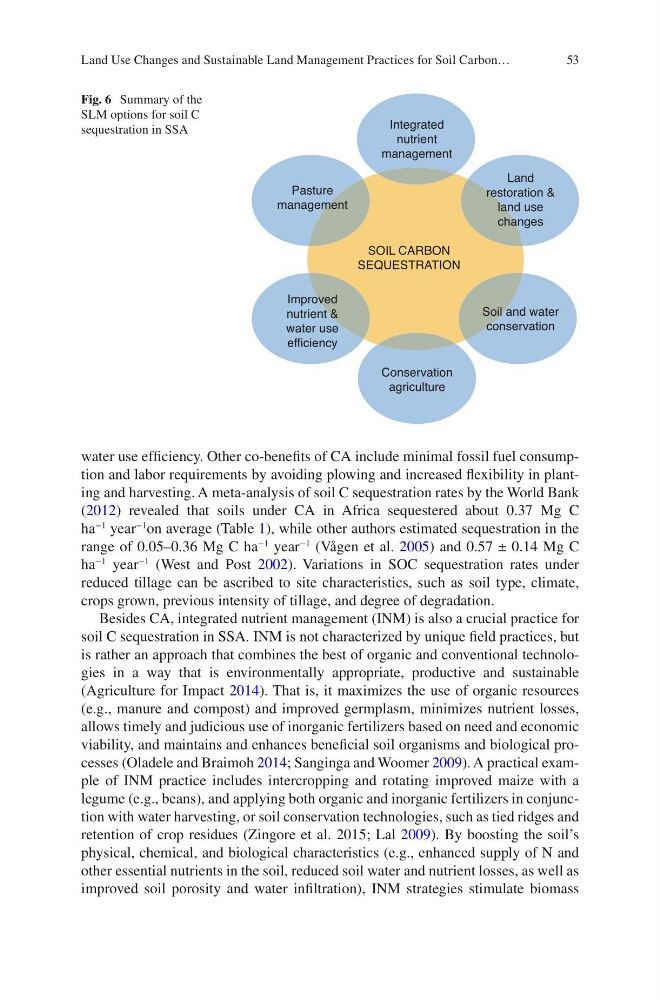
Fig. 6 Summary of the
SLM options for soil C
sequestration in SSA
Land Use Changes and Sustainable Land Management Practices for Soil Carbon…
water use efficiency. Other co-benefits of CA include minimal fossil fuel consumption and labor requirements by avoiding plowing and increased flexibility in planting and harvesting. A meta-analysis of soil C sequestration rates by the World Bank
(2012) revealed that soils under CA in Africa sequestered about 0.37 Mg C
ha
−1
year
−1
on average (Table 1), while other authors estimated sequestration in the
range of 0.05–0.36 Mg C ha
−1
year
−1
(Vågen et al. 2005) and 0.57 ± 0.14 Mg C
ha
−1
year
−1
(West and Post 2002). Variations in SOC sequestration rates under
reduced tillage can be ascribed to site characteristics, such as soil type, climate,
crops grown, previous intensity of tillage, and degree of degradation.
Besides CA, integrated nutrient management (INM) is also a crucial practice for
soil C sequestration in SSA. INM is not characterized by unique field practices, but
is rather an approach that combines the best of organic and conventional technologies in a way that is environmentally appropriate, productive and sustainable
(Agriculture for Impact 2014). That is, it maximizes the use of organic resources
(e.g., manure and compost) and improved germplasm, minimizes nutrient losses,
allows timely and judicious use of inorganic fertilizers based on need and economic
viability, and maintains and enhances beneficial soil organisms and biological processes (Oladele and Braimoh 2014; Sanginga and Woomer 2009). A practical example of INM practice includes intercropping and rotating improved maize with a
legume (e.g., beans), and applying both organic and inorganic fertilizers in conjunction with water harvesting, or soil conservation technologies, such as tied ridges and
retention of crop residues (Zingore et al. 2015; Lal 2009). By boosting the soil’s
physical, chemical, and biological characteristics (e.g., enhanced supply of N and
other essential nutrients in the soil, reduced soil water and nutrient losses, as well as
improved soil porosity and water infiltration), INM strategies stimulate biomass
Integrated
nutrient
management
Land
restoration &
land use
changes
Soil and water
conservation
Conservation
agriculture
Improved
nutrient &
water use
efficiency
Pasture
management
SOIL CARBON
SEQUESTRATION
Fig. 6 Summary of the
SLM options for soil C
sequestration in SSA
Land Use Changes and Sustainable Land Management Practices for Soil Carbon…