

600
included in the design. Therefore, the second approach of preparing the imaginary
EPINAV story has been used to portray what the programme could have achieved.
The fictitious programme story can then be used to guide the preparation of a
related story of a similar plan, either as an imaginary story or an actual story. Both
approaches apply PSF as a tool in programme management. However, the resources
needed would also be different, with the fictitious story utilising fewer resources
than the real one.
The imaginary story has the additional advantage of allowing opposite views to
be presented by relating them to a character rather than a real-life individual. This
opens more possibilities to capture opinions from more targeted beneficiaries, who
might have been reluctant to participate if they were to appear as the source of information, especially from the opposing side. Data collection methods could then be
used to verify the accurate representation of the views of stakeholders.
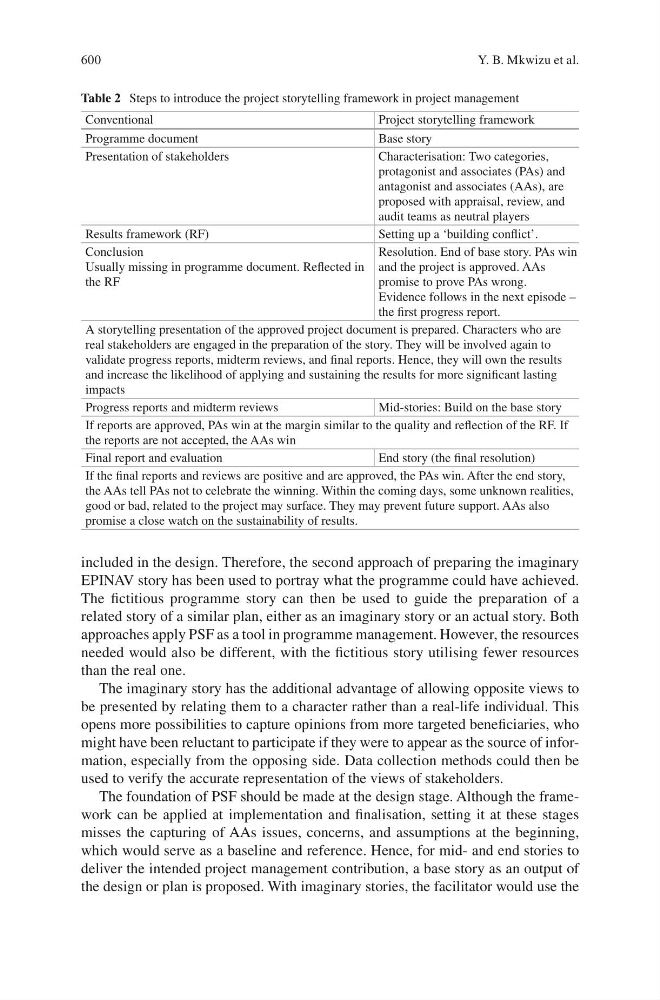
The foundation of PSF should be made at the design stage. Although the framework can be applied at implementation and finalisation, setting it at these stages
misses the capturing of AAs issues, concerns, and assumptions at the beginning,
which would serve as a baseline and reference. Hence, for mid- and end stories to
deliver the intended project management contribution, a base story as an output of
the design or plan is proposed. With imaginary stories, the facilitator would use the
Table 2 Steps to introduce the project storytelling framework in project management
Conventional
Project storytelling framework
Programme document
Base story
Presentation of stakeholders
Characterisation: Two categories,
protagonist and associates (PAs) and
antagonist and associates (AAs), are
proposed with appraisal, review, and
audit teams as neutral players
Results framework (RF)
Setting up a ‘building conflict’.
Conclusion
Usually missing in programme document. Reflected in
the RF
Resolution. End of base story. PAs win
and the project is approved. AAs
promise to prove PAs wrong.
Evidence follows in the next episode –
the first progress report.
A storytelling presentation of the approved project document is prepared. Characters who are
real stakeholders are engaged in the preparation of the story. They will be involved again to
validate progress reports, midterm reviews, and final reports. Hence, they will own the results
and increase the likelihood of applying and sustaining the results for more significant lasting
impacts
Progress reports and midterm reviews
Mid-stories: Build on the base story
If reports are approved, PAs win at the margin similar to the quality and reflection of the RF. If
the reports are not accepted, the AAs win
Final report and evaluation
End story (the final resolution)
If the final reports and reviews are positive and are approved, the PAs win. After the end story,
the AAs tell PAs not to celebrate the winning. Within the coming days, some unknown realities,
good or bad, related to the project may surface. They may prevent future support. AAs also
promise a close watch on the sustainability of results.
Y. B. Mkwizu et al.