

43
1 Introduction
Land use is an important determinant of the physical and human environment. It
refers to the functional role of the biophysical land attributes (i.e., land cover) in the
realization of different human purposes or economic activities (Bibby 2009). Land
use is dynamic and alters in response to changing human needs driven by an array
of socio-economic, technological, political, and environmental factors. However,
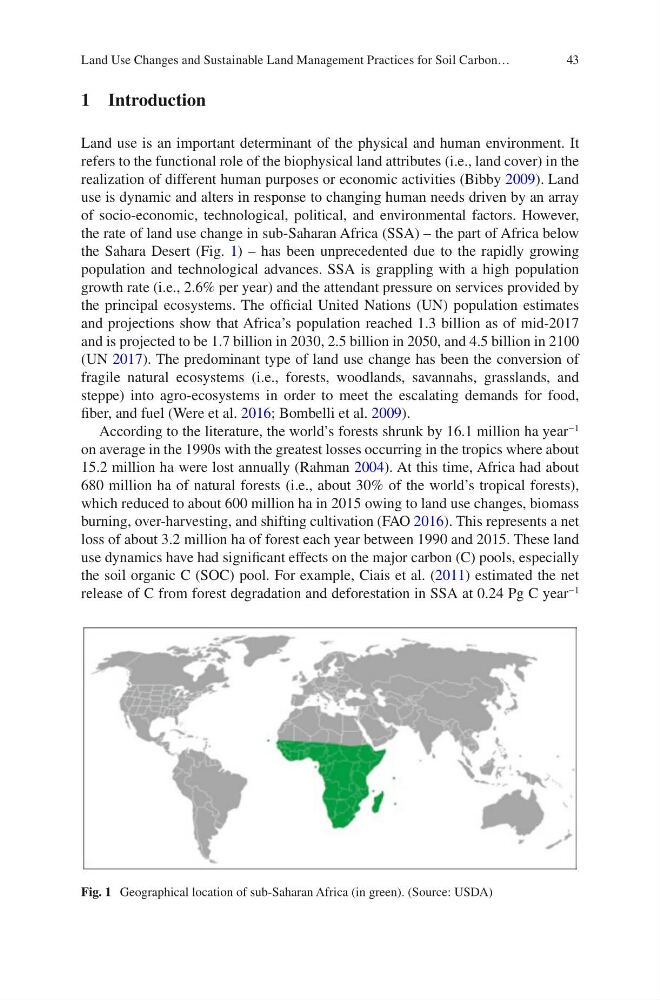
the rate of land use change in sub-Saharan Africa (SSA) – the part of Africa below
the Sahara Desert (Fig. 1) – has been unprecedented due to the rapidly growing
population and technological advances. SSA is grappling with a high population
growth rate (i.e., 2.6% per year) and the attendant pressure on services provided by
the principal ecosystems. The official United Nations (UN) population estimates
and projections show that Africa’s population reached 1.3 billion as of mid-2017
and is projected to be 1.7 billion in 2030, 2.5 billion in 2050, and 4.5 billion in 2100
(UN 2017). The predominant type of land use change has been the conversion of
fragile natural ecosystems (i.e., forests, woodlands, savannahs, grasslands, and
steppe) into agro-ecosystems in order to meet the escalating demands for food,
fiber, and fuel (Were et al. 2016; Bombelli et al. 2009).
According to the literature, the world’s forests shrunk by 16.1 million ha year
−1
on average in the 1990s with the greatest losses occurring in the tropics where about
15.2 million ha were lost annually (Rahman 2004). At this time, Africa had about
680 million ha of natural forests (i.e., about 30% of the world’s tropical forests),
which reduced to about 600 million ha in 2015 owing to land use changes, biomass
burning, over-harvesting, and shifting cultivation (FAO 2016). This represents a net
loss of about 3.2 million ha of forest each year between 1990 and 2015. These land
use dynamics have had significant effects on the major carbon (C) pools, especially
the soil organic C (SOC) pool. For example, Ciais et al. (2011) estimated the net
release of C from forest degradation and deforestation in SSA at 0.24 Pg C year
−1
Fig. 1 Geographical location of sub-Saharan Africa (in green). (Source: USDA)
Land Use Changes and Sustainable Land Management Practices for Soil Carbon…
1 Introduction
Land use is an important determinant of the physical and human environment. It
refers to the functional role of the biophysical land attributes (i.e., land cover) in the
realization of different human purposes or economic activities (Bibby 2009). Land
use is dynamic and alters in response to changing human needs driven by an array
of socio-economic, technological, political, and environmental factors. However,
the rate of land use change in sub-Saharan Africa (SSA) – the part of Africa below
the Sahara Desert (Fig. 1) – has been unprecedented due to the rapidly growing
population and technological advances. SSA is grappling with a high population
growth rate (i.e., 2.6% per year) and the attendant pressure on services provided by
the principal ecosystems. The official United Nations (UN) population estimates
and projections show that Africa’s population reached 1.3 billion as of mid-2017
and is projected to be 1.7 billion in 2030, 2.5 billion in 2050, and 4.5 billion in 2100
(UN 2017). The predominant type of land use change has been the conversion of
fragile natural ecosystems (i.e., forests, woodlands, savannahs, grasslands, and
steppe) into agro-ecosystems in order to meet the escalating demands for food,
fiber, and fuel (Were et al. 2016; Bombelli et al. 2009).
According to the literature, the world’s forests shrunk by 16.1 million ha year
−1
on average in the 1990s with the greatest losses occurring in the tropics where about
15.2 million ha were lost annually (Rahman 2004). At this time, Africa had about
680 million ha of natural forests (i.e., about 30% of the world’s tropical forests),
which reduced to about 600 million ha in 2015 owing to land use changes, biomass
burning, over-harvesting, and shifting cultivation (FAO 2016). This represents a net
loss of about 3.2 million ha of forest each year between 1990 and 2015. These land
use dynamics have had significant effects on the major carbon (C) pools, especially
the soil organic C (SOC) pool. For example, Ciais et al. (2011) estimated the net
release of C from forest degradation and deforestation in SSA at 0.24 Pg C year
−1
Fig. 1 Geographical location of sub-Saharan Africa (in green). (Source: USDA)
Land Use Changes and Sustainable Land Management Practices for Soil Carbon…