

554
prioritized soil and water conservation technologies such as contour and box ridges,
organic manure, minimum tillage, and agroforestry (Government of Malawi 2011).
These CSA technologies were aimed at building soil fertility, preventing soil erosion,
and conserving rainwater. The ASWAp also placed emphasis on the Green Belt
Initiative to establish rainwater harvesting systems to increase the level of irrigation
farming. Other CSA technologies the government is promoting are conservation agriculture (CA), drought-tolerant crops, and precision agriculture (Government of
Malawi 2015; Kaczan et al. 2013). The CSA technologies are also emphasized in the
National Agriculture Policy, and they include: CA, agroforestry, improved seeds, irrigation, organic and inorganic fertilizer, and other integrated soil fertility management
(ISFM) technologies (Government of Malawi 2016b). The focus of this chapter is
ISFM, particularly the integration of inorganic and organic fertilizer, as a CSA technology. The chapter has used this narrow definition of CSA in order to have a focus
and make a critical comparative review of the impacts of inorganic fertilizer accessed
through FISP and the impact of CSA technologies on maize productivity.
4 Maize Productivity
4.1 Impacts of Subsidized Inorganic Fertilizer
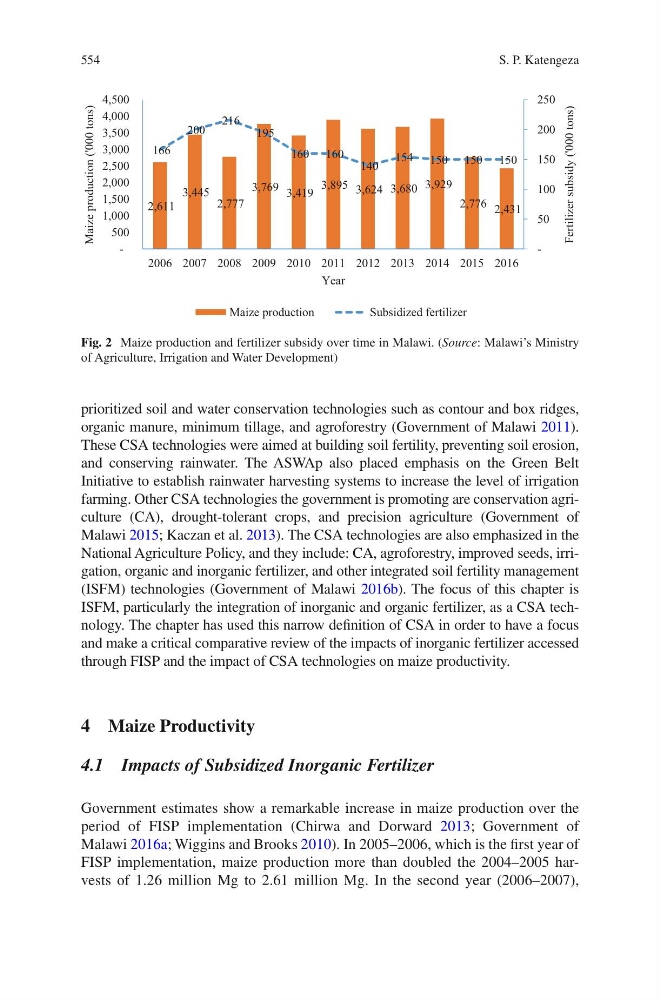
Government estimates show a remarkable increase in maize production over the
period of FISP implementation (Chirwa and Dorward 2013; Government of
Malawi 2016a; Wiggins and Brooks 2010). In 2005–2006, which is the first year of
FISP implementation, maize production more than doubled the 2004–2005 harvests of 1.26 million Mg to 2.61 million Mg. In the second year (2006–2007),
2,611
3,445 2,777
3,769 3,419
3,895 3,624 3,680 3,929
2,776 2,431
166
200
216
195
160 160 140
154 150 150 150
-
50
100
150
200
250
-
500
1,000
1,500
2,000
2,500
3,000
3,500
4,000
4,500
2006 2007 2008 2009 2010 2011 2012 2013 2014 2015 2016
Fertilizer subsidy ('000 tons)
Maize production ('000 tons)
Year
Maize production
Subsidized fertilizer
Fig. 2 Maize production and fertilizer subsidy over time in Malawi. (Source: Malawi’s Ministry
of Agriculture, Irrigation and Water Development)
S. P. Katengeza