

551
However, investments in large-scale input subsidies tend to have high costs that
may outweigh the long-term program benefits. To fund such programs, governments are likely to relocate resources from other agricultural programs (Carr 2014;
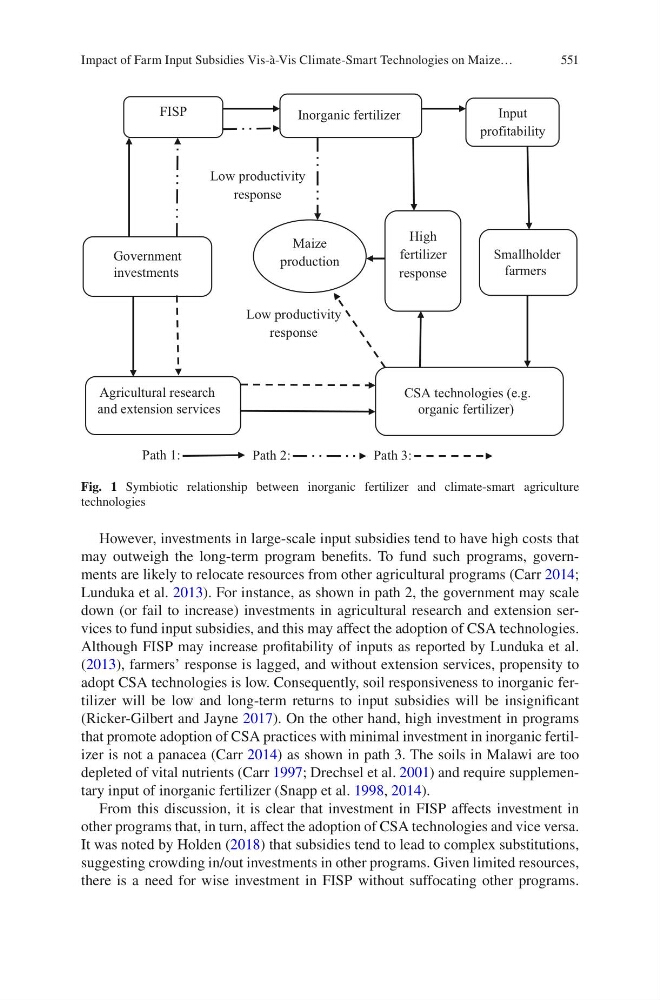
Lunduka et al. 2013). For instance, as shown in path 2, the government may scale
down (or fail to increase) investments in agricultural research and extension services to fund input subsidies, and this may affect the adoption of CSA technologies.
Although FISP may increase profitability of inputs as reported by Lunduka et al.
(2013), farmers’ response is lagged, and without extension services, propensity to
adopt CSA technologies is low. Consequently, soil responsiveness to inorganic fertilizer will be low and long-term returns to input subsidies will be insignificant
(Ricker-Gilbert and Jayne 2017). On the other hand, high investment in programs
that promote adoption of CSA practices with minimal investment in inorganic fertilizer is not a panacea (Carr 2014) as shown in path 3. The soils in Malawi are too
depleted of vital nutrients (Carr 1997; Drechsel et al. 2001) and require supplementary input of inorganic fertilizer (Snapp et al. 1998, 2014).
From this discussion, it is clear that investment in FISP affects investment in
other programs that, in turn, affect the adoption of CSA technologies and vice versa.
It was noted by Holden (2018) that subsidies tend to lead to complex substitutions,
suggesting crowding in/out investments in other programs. Given limited resources,
there is a need for wise investment in FISP without suffocating other programs.
Low productivity
response
Low productivity
response
Maize
production
Agricultural research
and extension services
CSA technologies (e.g.
organic fertilizer)
Input
profitability
Inorganic fertilizer
Smallholder
farmers
Government
investments
FISP
High
fertilizer
response
Path 1:
Path 3:
Path 2:
Fig. 1 Symbiotic relationship between inorganic fertilizer and climate-smart agriculture
technologies
Impact of Farm Input Subsidies Vis-à-Vis Climate-Smart Technologies on Maize…