

538
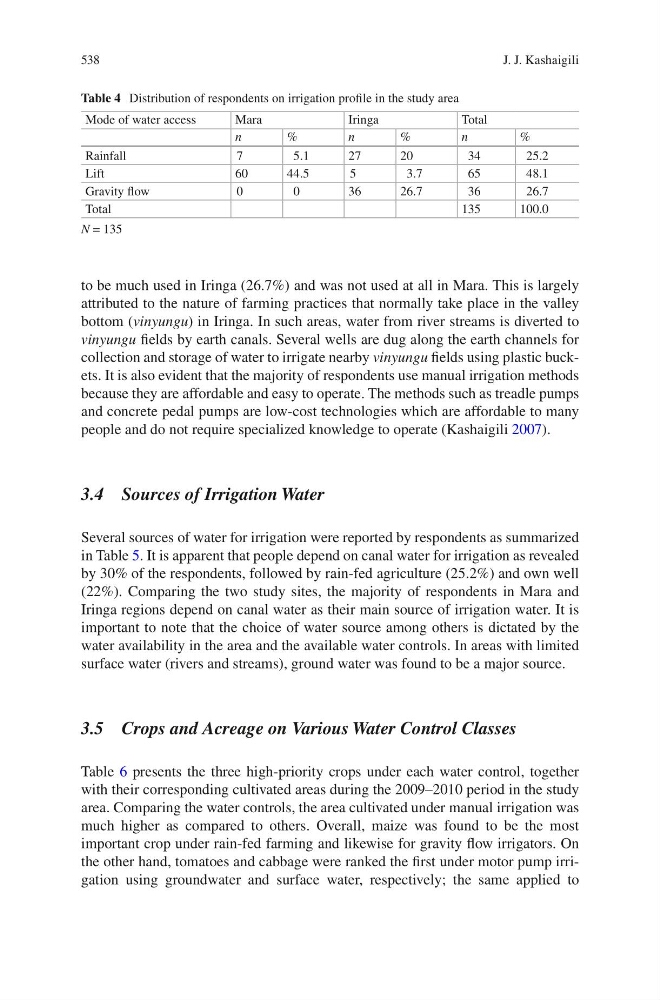
to be much used in Iringa (26.7%) and was not used at all in Mara. This is largely
attributed to the nature of farming practices that normally take place in the valley
bottom (vinyungu) in Iringa. In such areas, water from river streams is diverted to
vinyungu fields by earth canals. Several wells are dug along the earth channels for
collection and storage of water to irrigate nearby vinyungu fields using plastic buckets. It is also evident that the majority of respondents use manual irrigation methods
because they are affordable and easy to operate. The methods such as treadle pumps
and concrete pedal pumps are low-cost technologies which are affordable to many
people and do not require specialized knowledge to operate (Kashaigili 2007).
3.4 Sources of Irrigation Water
Several sources of water for irrigation were reported by respondents as summarized
in Table 5. It is apparent that people depend on canal water for irrigation as revealed
by 30% of the respondents, followed by rain-fed agriculture (25.2%) and own well
(22%). Comparing the two study sites, the majority of respondents in Mara and
Iringa regions depend on canal water as their main source of irrigation water. It is
important to note that the choice of water source among others is dictated by the
water availability in the area and the available water controls. In areas with limited
surface water (rivers and streams), ground water was found to be a major source.
3.5 Crops and Acreage on Various Water Control Classes
Table 6 presents the three high-priority crops under each water control, together
with their corresponding cultivated areas during the 2009–2010 period in the study
area. Comparing the water controls, the area cultivated under manual irrigation was
much higher as compared to others. Overall, maize was found to be the most
important crop under rain-fed farming and likewise for gravity flow irrigators. On
the other hand, tomatoes and cabbage were ranked the first under motor pump irrigation using groundwater and surface water, respectively; the same applied to
Table 4 Distribution of respondents on irrigation profile in the study area
Mode of water access
Mara
Iringa
Total
n
%
n
%
n
%
Rainfall
7
5.1
27
20
34
25.2
Lift
60
44.5
5
3.7
65
48.1
Gravity flow
0
0
36
26.7
36
26.7
Total
135
100.0
N = 135
J. J. Kashaigili
to be much used in Iringa (26.7%) and was not used at all in Mara. This is largely
attributed to the nature of farming practices that normally take place in the valley
bottom (vinyungu) in Iringa. In such areas, water from river streams is diverted to
vinyungu fields by earth canals. Several wells are dug along the earth channels for
collection and storage of water to irrigate nearby vinyungu fields using plastic buckets. It is also evident that the majority of respondents use manual irrigation methods
because they are affordable and easy to operate. The methods such as treadle pumps
and concrete pedal pumps are low-cost technologies which are affordable to many
people and do not require specialized knowledge to operate (Kashaigili 2007).
3.4 Sources of Irrigation Water
Several sources of water for irrigation were reported by respondents as summarized
in Table 5. It is apparent that people depend on canal water for irrigation as revealed
by 30% of the respondents, followed by rain-fed agriculture (25.2%) and own well
(22%). Comparing the two study sites, the majority of respondents in Mara and
Iringa regions depend on canal water as their main source of irrigation water. It is
important to note that the choice of water source among others is dictated by the
water availability in the area and the available water controls. In areas with limited
surface water (rivers and streams), ground water was found to be a major source.
3.5 Crops and Acreage on Various Water Control Classes
Table 6 presents the three high-priority crops under each water control, together
with their corresponding cultivated areas during the 2009–2010 period in the study
area. Comparing the water controls, the area cultivated under manual irrigation was
much higher as compared to others. Overall, maize was found to be the most
important crop under rain-fed farming and likewise for gravity flow irrigators. On
the other hand, tomatoes and cabbage were ranked the first under motor pump irrigation using groundwater and surface water, respectively; the same applied to
Table 4 Distribution of respondents on irrigation profile in the study area
Mode of water access
Mara
Iringa
Total
n
%
n
%
n
%
Rainfall
7
5.1
27
20
34
25.2
Lift
60
44.5
5
3.7
65
48.1
Gravity flow
0
0
36
26.7
36
26.7
Total
135
100.0
N = 135
J. J. Kashaigili