

534
2.2 Data Collection and Analysis
This study adopted purposive sampling, and two regions, namely Iringa and Mara,
were selected, considering their history in surface water and groundwater use for
domestic use and small-scale farming. The two regions are known for horticultural
crops production and different techniques of water lifting were introduced in the
regions under different programmes aiming at ensuring food security, income generation and diversification of crops and creation of employment. For example, the
Water for the Third World (W3W), a Swiss NGO specialized in technology transfer,
introduced a concrete pedal pump (PeP) to improve water lifting from shallow wells
and surface water bodies at a lifting head of about 7 m; it also introduced treadle
pumps. The technology was widely spread by the Food and Agriculture Organization
(FAO) of the United Nations Special Programme for Food Security (SPFS), under
the Swiss Government funding. The main focus of the programme was the introduction of low-cost water control technologies that can be readily adopted by smallholder farmers and contribute to a rapid increase in crop production (FAO 2011).
Four districts, namely Tarime, Serengeti and Bunda in Mara region, and Iringa
Rural in Iringa region, were selected. Purposive sampling was employed to select
the respondents. The aim was to have a good composition of households under different water controls, namely rain-fed farming, gravity flow water delivery, private
manual pump or motor pump irrigation with surface or groundwater. A total of 67
respondent households were purposely selected from the 12 villages, namely
Bong’ore, Ilala Simba, Kiagata, Kidamali, Kilabera, Kirabera ‘A’, Sazira,
Kitaramaka and Serengeti in Mara region, and 68 from Magubike, Nyatwari, Nzihi
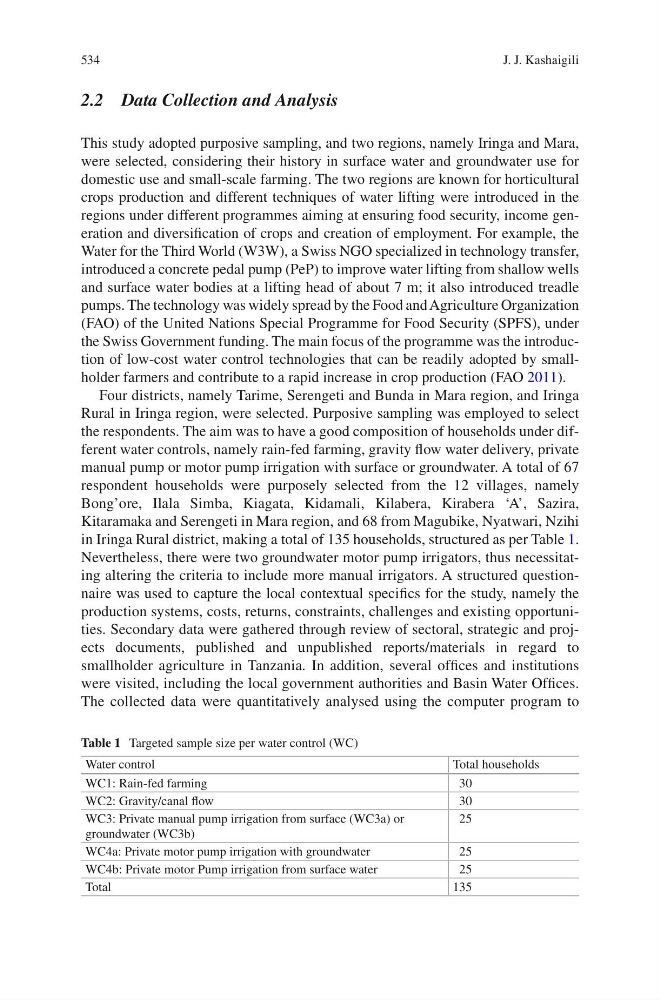
in Iringa Rural district, making a total of 135 households, structured as per Table 1.
Nevertheless, there were two groundwater motor pump irrigators, thus necessitating altering the criteria to include more manual irrigators. A structured questionnaire was used to capture the local contextual specifics for the study, namely the
production systems, costs, returns, constraints, challenges and existing opportunities. Secondary data were gathered through review of sectoral, strategic and projects documents, published and unpublished reports/materials in regard to
smallholder agriculture in Tanzania. In addition, several offices and institutions
were visited, including the local government authorities and Basin Water Offices.
The collected data were quantitatively analysed using the computer program to
Table 1 Targeted sample size per water control (WC)
Water control
Total households
WC1: Rain-fed farming
30
WC2: Gravity/canal flow
30
WC3: Private manual pump irrigation from surface (WC3a) or
groundwater (WC3b)
25
WC4a: Private motor pump irrigation with groundwater
25
WC4b: Private motor Pump irrigation from surface water
25
Total
135
J. J. Kashaigili
2.2 Data Collection and Analysis
This study adopted purposive sampling, and two regions, namely Iringa and Mara,
were selected, considering their history in surface water and groundwater use for
domestic use and small-scale farming. The two regions are known for horticultural
crops production and different techniques of water lifting were introduced in the
regions under different programmes aiming at ensuring food security, income generation and diversification of crops and creation of employment. For example, the
Water for the Third World (W3W), a Swiss NGO specialized in technology transfer,
introduced a concrete pedal pump (PeP) to improve water lifting from shallow wells
and surface water bodies at a lifting head of about 7 m; it also introduced treadle
pumps. The technology was widely spread by the Food and Agriculture Organization
(FAO) of the United Nations Special Programme for Food Security (SPFS), under
the Swiss Government funding. The main focus of the programme was the introduction of low-cost water control technologies that can be readily adopted by smallholder farmers and contribute to a rapid increase in crop production (FAO 2011).
Four districts, namely Tarime, Serengeti and Bunda in Mara region, and Iringa
Rural in Iringa region, were selected. Purposive sampling was employed to select
the respondents. The aim was to have a good composition of households under different water controls, namely rain-fed farming, gravity flow water delivery, private
manual pump or motor pump irrigation with surface or groundwater. A total of 67
respondent households were purposely selected from the 12 villages, namely
Bong’ore, Ilala Simba, Kiagata, Kidamali, Kilabera, Kirabera ‘A’, Sazira,
Kitaramaka and Serengeti in Mara region, and 68 from Magubike, Nyatwari, Nzihi
in Iringa Rural district, making a total of 135 households, structured as per Table 1.
Nevertheless, there were two groundwater motor pump irrigators, thus necessitating altering the criteria to include more manual irrigators. A structured questionnaire was used to capture the local contextual specifics for the study, namely the
production systems, costs, returns, constraints, challenges and existing opportunities. Secondary data were gathered through review of sectoral, strategic and projects documents, published and unpublished reports/materials in regard to
smallholder agriculture in Tanzania. In addition, several offices and institutions
were visited, including the local government authorities and Basin Water Offices.
The collected data were quantitatively analysed using the computer program to
Table 1 Targeted sample size per water control (WC)
Water control
Total households
WC1: Rain-fed farming
30
WC2: Gravity/canal flow
30
WC3: Private manual pump irrigation from surface (WC3a) or
groundwater (WC3b)
25
WC4a: Private motor pump irrigation with groundwater
25
WC4b: Private motor Pump irrigation from surface water
25
Total
135
J. J. Kashaigili