

517
3.2 Level of Adaptive Capacity
The ladder of adaptive capacity that was developed through focus group discussions
had four steps, while the ladder that was preconstructed in the questionnaire for
individual interviews had five steps. The focus group discussions provided a general
overview of the level of adaptive capacity for women and men in their respective
communities. The description on each step of the ladder was based on knowledge
and experience of the community members. This section provides the socioeconomic characteristics on each step of the ladder and also presents the level of
adaptive capacity between men and women and also between female-headed and
male-headed households.
Level of Adaptive Capacity and Socio-Economic Characteristics
The discussions with male and female groups in the three districts came up with
four steps on the ladder of adaptive capacity, representing the four different
groups of people that are found in the community, according to their capacity to
adapt to climate change impacts and effects. The steps were named using the
local names from step 1, representing households with no capacity to adapt up to
step 4, representing a household with highest capacity to adapt. The discussions
also provided characteristics for each group on the steps of the ladder that relates
to their level of capacity (Fig. 2). The criteria to place households on each step of
the ladder depended on the socio-economic characteristics that included: the
type and quantity of livestock, type of house and housing materials, crop yield,
farm equipment, ownership of resources such as land, means of transport, access
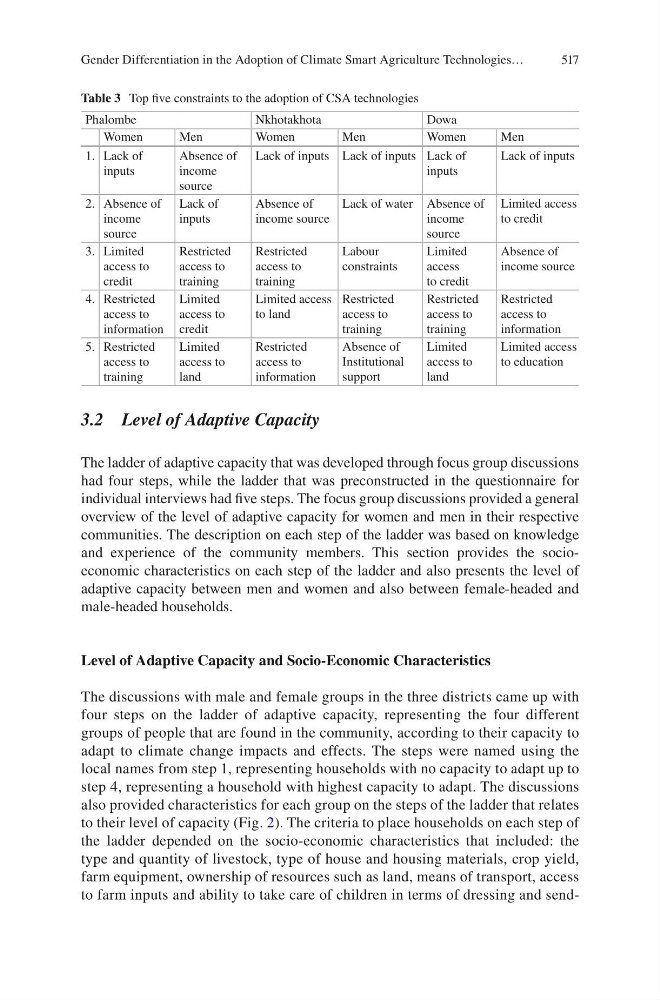
to farm inputs and ability to take care of children in terms of dressing and sendTable 3 Top five constraints to the adoption of CSA technologies
Phalombe
Nkhotakhota
Dowa
Women
Men
Women
Men
Women
Men
1. Lack of
inputs
Absence of
income
source
Lack of inputs Lack of inputs Lack of
inputs
Lack of inputs
2. Absence of
income
source
Lack of
inputs
Absence of
income source
Lack of water Absence of
income
source
Limited access
to credit
3. Limited
access to
credit
Restricted
access to
training
Restricted
access to
training
Labour
constraints
Limited
access
to credit
Absence of
income source
4. Restricted
access to
information
Limited
access to
credit
Limited access
to land
Restricted
access to
training
Restricted
access to
training
Restricted
access to
information
5. Restricted
access to
training
Limited
access to
land
Restricted
access to
information
Absence of
Institutional
support
Limited
access to
land
Limited access
to education
Gender Differentiation in the Adoption of Climate Smart Agriculture Technologies…
3.2 Level of Adaptive Capacity
The ladder of adaptive capacity that was developed through focus group discussions
had four steps, while the ladder that was preconstructed in the questionnaire for
individual interviews had five steps. The focus group discussions provided a general
overview of the level of adaptive capacity for women and men in their respective
communities. The description on each step of the ladder was based on knowledge
and experience of the community members. This section provides the socioeconomic characteristics on each step of the ladder and also presents the level of
adaptive capacity between men and women and also between female-headed and
male-headed households.
Level of Adaptive Capacity and Socio-Economic Characteristics
The discussions with male and female groups in the three districts came up with
four steps on the ladder of adaptive capacity, representing the four different
groups of people that are found in the community, according to their capacity to
adapt to climate change impacts and effects. The steps were named using the
local names from step 1, representing households with no capacity to adapt up to
step 4, representing a household with highest capacity to adapt. The discussions
also provided characteristics for each group on the steps of the ladder that relates
to their level of capacity (Fig. 2). The criteria to place households on each step of
the ladder depended on the socio-economic characteristics that included: the
type and quantity of livestock, type of house and housing materials, crop yield,
farm equipment, ownership of resources such as land, means of transport, access
to farm inputs and ability to take care of children in terms of dressing and sendTable 3 Top five constraints to the adoption of CSA technologies
Phalombe
Nkhotakhota
Dowa
Women
Men
Women
Men
Women
Men
1. Lack of
inputs
Absence of
income
source
Lack of inputs Lack of inputs Lack of
inputs
Lack of inputs
2. Absence of
income
source
Lack of
inputs
Absence of
income source
Lack of water Absence of
income
source
Limited access
to credit
3. Limited
access to
credit
Restricted
access to
training
Restricted
access to
training
Labour
constraints
Limited
access
to credit
Absence of
income source
4. Restricted
access to
information
Limited
access to
credit
Limited access
to land
Restricted
access to
training
Restricted
access to
training
Restricted
access to
information
5. Restricted
access to
training
Limited
access to
land
Restricted
access to
information
Absence of
Institutional
support
Limited
access to
land
Limited access
to education
Gender Differentiation in the Adoption of Climate Smart Agriculture Technologies…