

34
less fodder quality is used as mulch. Cover crops are also cultivated to produce fodder and mulch. The major cover crops are lab-lab, cowpea (Vigna unguiculata) and
pigeon pea. When farmers start CA, they first mulch the field. There are different
ways of preparing the soil for planting. One way is to open a small pit for planting
followed by planting. Alternatively, farms split the mulch by hand according to
distance between lines, followed by one pass of the maresha along this line to open
a furrow to facilitate sowing. The farmers summarised the benefits of CA as follows:
• Able to grow a wider variety of crops because of better water conditions in the
soils, such as taro, papaya and kale.
• Less predation from the stalk borer and fall armyworm as a result of CA.
• Able to cultivate the land without oxen, of particular benefit to female farmers.
• Farmers invest more in fattening animals.
• Reduced erosion.
• Less labour use.
• Able to manage weeds without herbicides when land is 0.5 ha, as in Wolaita.
• Benefits from cover crops for fodder, fuel and mulch.
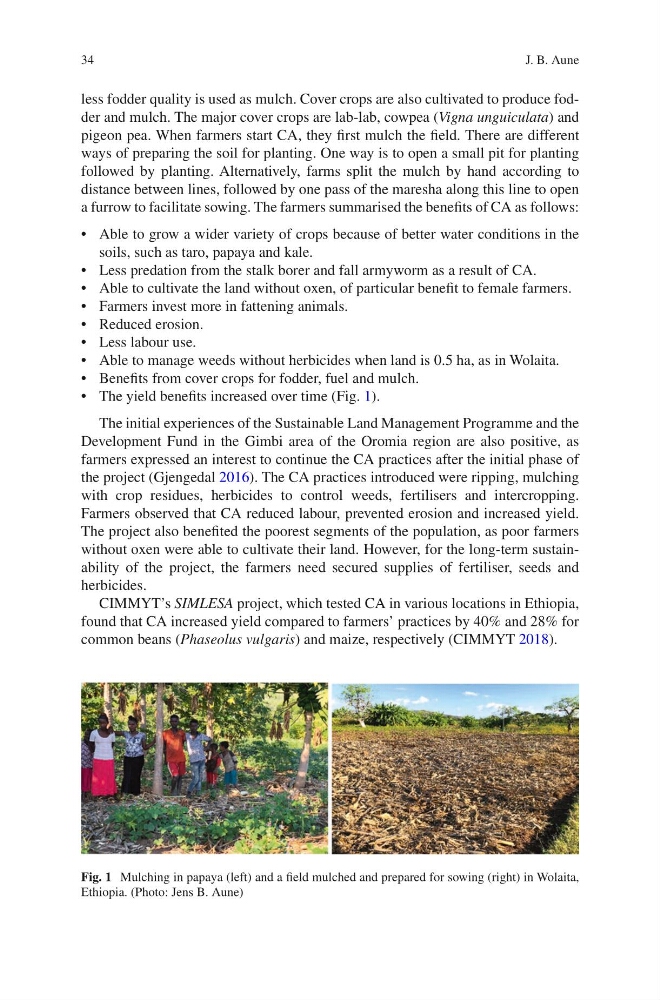
• The yield benefits increased over time (Fig. 1).
The initial experiences of the Sustainable Land Management Programme and the
Development Fund in the Gimbi area of the Oromia region are also positive, as
farmers expressed an interest to continue the CA practices after the initial phase of
the project (Gjengedal 2016). The CA practices introduced were ripping, mulching
with crop residues, herbicides to control weeds, fertilisers and intercropping.
Farmers observed that CA reduced labour, prevented erosion and increased yield.
The project also benefited the poorest segments of the population, as poor farmers
without oxen were able to cultivate their land. However, for the long-term sustainability of the project, the farmers need secured supplies of fertiliser, seeds and
herbicides.
CIMMYT’s SIMLESA project, which tested CA in various locations in Ethiopia,
found that CA increased yield compared to farmers’ practices by 40% and 28% for
common beans (Phaseolus vulgaris) and maize, respectively (CIMMYT 2018).
Fig. 1 Mulching in papaya (left) and a field mulched and prepared for sowing (right) in Wolaita,
Ethiopia. (Photo: Jens B. Aune)
J. B. Aune
less fodder quality is used as mulch. Cover crops are also cultivated to produce fodder and mulch. The major cover crops are lab-lab, cowpea (Vigna unguiculata) and
pigeon pea. When farmers start CA, they first mulch the field. There are different
ways of preparing the soil for planting. One way is to open a small pit for planting
followed by planting. Alternatively, farms split the mulch by hand according to
distance between lines, followed by one pass of the maresha along this line to open
a furrow to facilitate sowing. The farmers summarised the benefits of CA as follows:
• Able to grow a wider variety of crops because of better water conditions in the
soils, such as taro, papaya and kale.
• Less predation from the stalk borer and fall armyworm as a result of CA.
• Able to cultivate the land without oxen, of particular benefit to female farmers.
• Farmers invest more in fattening animals.
• Reduced erosion.
• Less labour use.
• Able to manage weeds without herbicides when land is 0.5 ha, as in Wolaita.
• Benefits from cover crops for fodder, fuel and mulch.
• The yield benefits increased over time (Fig. 1).
The initial experiences of the Sustainable Land Management Programme and the
Development Fund in the Gimbi area of the Oromia region are also positive, as
farmers expressed an interest to continue the CA practices after the initial phase of
the project (Gjengedal 2016). The CA practices introduced were ripping, mulching
with crop residues, herbicides to control weeds, fertilisers and intercropping.
Farmers observed that CA reduced labour, prevented erosion and increased yield.
The project also benefited the poorest segments of the population, as poor farmers
without oxen were able to cultivate their land. However, for the long-term sustainability of the project, the farmers need secured supplies of fertiliser, seeds and
herbicides.
CIMMYT’s SIMLESA project, which tested CA in various locations in Ethiopia,
found that CA increased yield compared to farmers’ practices by 40% and 28% for
common beans (Phaseolus vulgaris) and maize, respectively (CIMMYT 2018).
Fig. 1 Mulching in papaya (left) and a field mulched and prepared for sowing (right) in Wolaita,
Ethiopia. (Photo: Jens B. Aune)
J. B. Aune