

465
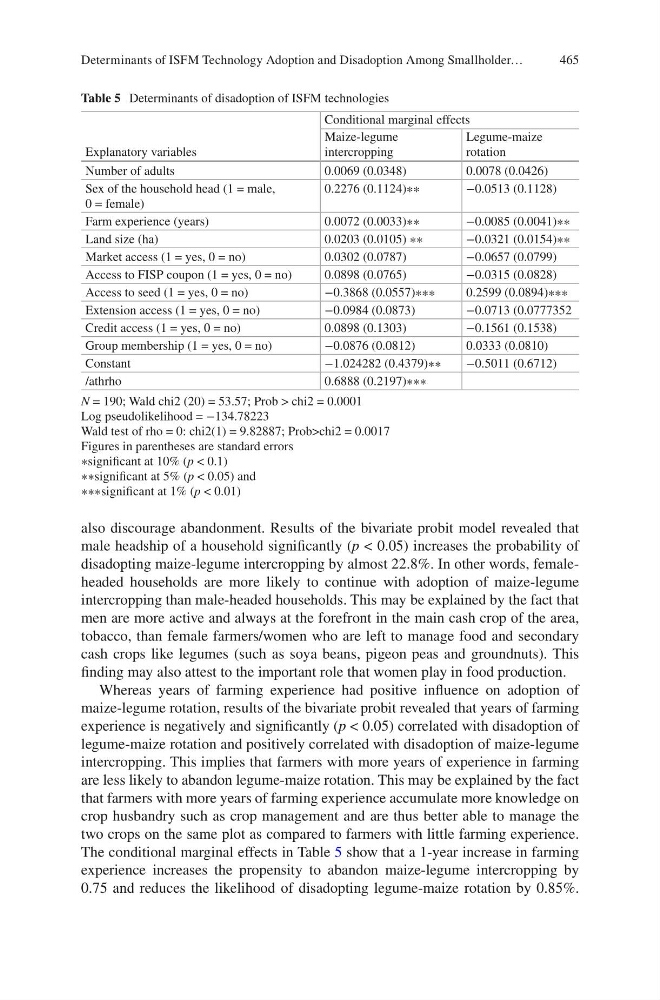
also discourage abandonment. Results of the bivariate probit model revealed that
male headship of a household significantly (p < 0.05) increases the probability of
disadopting maize-legume intercropping by almost 22.8%. In other words, femaleheaded households are more likely to continue with adoption of maize-legume
intercropping than male-headed households. This may be explained by the fact that
men are more active and always at the forefront in the main cash crop of the area,
tobacco, than female farmers/women who are left to manage food and secondary
cash crops like legumes (such as soya beans, pigeon peas and groundnuts). This
finding may also attest to the important role that women play in food production.
Whereas years of farming experience had positive influence on adoption of
maize-legume rotation, results of the bivariate probit revealed that years of farming
experience is negatively and significantly (p < 0.05) correlated with disadoption of
legume-maize rotation and positively correlated with disadoption of maize-legume
intercropping. This implies that farmers with more years of experience in farming
are less likely to abandon legume-maize rotation. This may be explained by the fact
that farmers with more years of farming experience accumulate more knowledge on
crop husbandry such as crop management and are thus better able to manage the
two crops on the same plot as compared to farmers with little farming experience.
The conditional marginal effects in Table 5 show that a 1-year increase in farming
experience increases the propensity to abandon maize-legume intercropping by
0.75 and reduces the likelihood of disadopting legume-maize rotation by 0.85%.
Table 5 Determinants of disadoption of ISFM technologies
Explanatory variables
Conditional marginal effects
Maize-legume
intercropping
Legume-maize
rotation
Number of adults
0.0069 (0.0348)
0.0078 (0.0426)
Sex of the household head (1 = male,
0 = female)
0.2276 (0.1124)∗∗
−0.0513 (0.1128)
Farm experience (years)
0.0072 (0.0033)∗∗
−0.0085 (0.0041)∗∗
Land size (ha)
0.0203 (0.0105) ∗∗
−0.0321 (0.0154)∗∗
Market access (1 = yes, 0 = no)
0.0302 (0.0787)
−0.0657 (0.0799)
Access to FISP coupon (1 = yes, 0 = no)
0.0898 (0.0765)
−0.0315 (0.0828)
Access to seed (1 = yes, 0 = no)
−0.3868 (0.0557)∗∗∗
0.2599 (0.0894)∗∗∗
Extension access (1 = yes, 0 = no)
−0.0984 (0.0873)
−0.0713 (0.0777352
Credit access (1 = yes, 0 = no)
0.0898 (0.1303)
−0.1561 (0.1538)
Group membership (1 = yes, 0 = no)
−0.0876 (0.0812)
0.0333 (0.0810)
Constant
−1.024282 (0.4379)∗∗
−0.5011 (0.6712)
/athrho
0.6888 (0.2197)∗∗∗
N = 190; Wald chi2 (20) = 53.57; Prob > chi2 = 0.0001
Log pseudolikelihood = −134.78223
Wald test of rho = 0: chi2(1) = 9.82887; Prob>chi2 = 0.0017
Figures in parentheses are standard errors
∗significant at 10% (p < 0.1)
∗∗significant at 5% (p < 0.05) and
∗∗∗significant at 1% (p < 0.01)
Determinants of ISFM Technology Adoption and Disadoption Among Smallholder…
also discourage abandonment. Results of the bivariate probit model revealed that
male headship of a household significantly (p < 0.05) increases the probability of
disadopting maize-legume intercropping by almost 22.8%. In other words, femaleheaded households are more likely to continue with adoption of maize-legume
intercropping than male-headed households. This may be explained by the fact that
men are more active and always at the forefront in the main cash crop of the area,
tobacco, than female farmers/women who are left to manage food and secondary
cash crops like legumes (such as soya beans, pigeon peas and groundnuts). This
finding may also attest to the important role that women play in food production.
Whereas years of farming experience had positive influence on adoption of
maize-legume rotation, results of the bivariate probit revealed that years of farming
experience is negatively and significantly (p < 0.05) correlated with disadoption of
legume-maize rotation and positively correlated with disadoption of maize-legume
intercropping. This implies that farmers with more years of experience in farming
are less likely to abandon legume-maize rotation. This may be explained by the fact
that farmers with more years of farming experience accumulate more knowledge on
crop husbandry such as crop management and are thus better able to manage the
two crops on the same plot as compared to farmers with little farming experience.
The conditional marginal effects in Table 5 show that a 1-year increase in farming
experience increases the propensity to abandon maize-legume intercropping by
0.75 and reduces the likelihood of disadopting legume-maize rotation by 0.85%.
Table 5 Determinants of disadoption of ISFM technologies
Explanatory variables
Conditional marginal effects
Maize-legume
intercropping
Legume-maize
rotation
Number of adults
0.0069 (0.0348)
0.0078 (0.0426)
Sex of the household head (1 = male,
0 = female)
0.2276 (0.1124)∗∗
−0.0513 (0.1128)
Farm experience (years)
0.0072 (0.0033)∗∗
−0.0085 (0.0041)∗∗
Land size (ha)
0.0203 (0.0105) ∗∗
−0.0321 (0.0154)∗∗
Market access (1 = yes, 0 = no)
0.0302 (0.0787)
−0.0657 (0.0799)
Access to FISP coupon (1 = yes, 0 = no)
0.0898 (0.0765)
−0.0315 (0.0828)
Access to seed (1 = yes, 0 = no)
−0.3868 (0.0557)∗∗∗
0.2599 (0.0894)∗∗∗
Extension access (1 = yes, 0 = no)
−0.0984 (0.0873)
−0.0713 (0.0777352
Credit access (1 = yes, 0 = no)
0.0898 (0.1303)
−0.1561 (0.1538)
Group membership (1 = yes, 0 = no)
−0.0876 (0.0812)
0.0333 (0.0810)
Constant
−1.024282 (0.4379)∗∗
−0.5011 (0.6712)
/athrho
0.6888 (0.2197)∗∗∗
N = 190; Wald chi2 (20) = 53.57; Prob > chi2 = 0.0001
Log pseudolikelihood = −134.78223
Wald test of rho = 0: chi2(1) = 9.82887; Prob>chi2 = 0.0017
Figures in parentheses are standard errors
∗significant at 10% (p < 0.1)
∗∗significant at 5% (p < 0.05) and
∗∗∗significant at 1% (p < 0.01)
Determinants of ISFM Technology Adoption and Disadoption Among Smallholder…