

463
maize-legume intercrop as opposed to those households that do not. Group
membership was, among others, found to facilitate access to legume seed by linking
farmers to external institutions such as Bunda College.
Complementarity and Substitutability of Adoption of ISFM Technologies
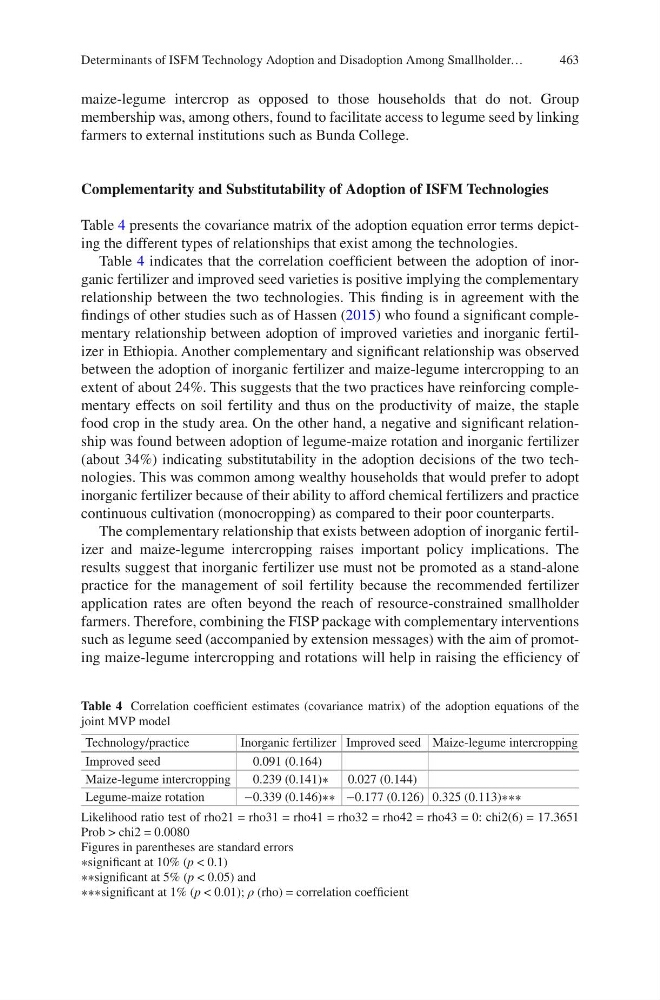
Table 4 presents the covariance matrix of the adoption equation error terms depicting the different types of relationships that exist among the technologies.
Table 4 indicates that the correlation coefficient between the adoption of inorganic fertilizer and improved seed varieties is positive implying the complementary
relationship between the two technologies. This finding is in agreement with the
findings of other studies such as of Hassen (2015) who found a significant complementary relationship between adoption of improved varieties and inorganic fertilizer in Ethiopia. Another complementary and significant relationship was observed
between the adoption of inorganic fertilizer and maize-legume intercropping to an
extent of about 24%. This suggests that the two practices have reinforcing complementary effects on soil fertility and thus on the productivity of maize, the staple
food crop in the study area. On the other hand, a negative and significant relationship was found between adoption of legume-maize rotation and inorganic fertilizer
(about 34%) indicating substitutability in the adoption decisions of the two technologies. This was common among wealthy households that would prefer to adopt
inorganic fertilizer because of their ability to afford chemical fertilizers and practice
continuous cultivation (monocropping) as compared to their poor counterparts.
The complementary relationship that exists between adoption of inorganic fertilizer and maize-legume intercropping raises important policy implications. The
results suggest that inorganic fertilizer use must not be promoted as a stand-alone
practice for the management of soil fertility because the recommended fertilizer
application rates are often beyond the reach of resource-constrained smallholder
farmers. Therefore, combining the FISP package with complementary interventions
such as legume seed (accompanied by extension messages) with the aim of promoting maize-legume intercropping and rotations will help in raising the efficiency of
Table 4 Correlation coefficient estimates (covariance matrix) of the adoption equations of the
joint MVP model
Technology/practice
Inorganic fertilizer Improved seed Maize-legume intercropping
Improved seed
0.091 (0.164)
Maize-legume intercropping
0.239 (0.141)∗
0.027 (0.144)
Legume-maize rotation
−0.339 (0.146)∗∗ −0.177 (0.126) 0.325 (0.113)∗∗∗
Likelihood ratio test of rho21 = rho31 = rho41 = rho32 = rho42 = rho43 = 0: chi2(6) = 17.3651
Prob > chi2 = 0.0080
Figures in parentheses are standard errors
∗significant at 10% (p < 0.1)
∗∗significant at 5% (p < 0.05) and
∗∗∗significant at 1% (p < 0.01); ρ (rho) = correlation coefficient
Determinants of ISFM Technology Adoption and Disadoption Among Smallholder…
maize-legume intercrop as opposed to those households that do not. Group
membership was, among others, found to facilitate access to legume seed by linking
farmers to external institutions such as Bunda College.
Complementarity and Substitutability of Adoption of ISFM Technologies
Table 4 presents the covariance matrix of the adoption equation error terms depicting the different types of relationships that exist among the technologies.
Table 4 indicates that the correlation coefficient between the adoption of inorganic fertilizer and improved seed varieties is positive implying the complementary
relationship between the two technologies. This finding is in agreement with the
findings of other studies such as of Hassen (2015) who found a significant complementary relationship between adoption of improved varieties and inorganic fertilizer in Ethiopia. Another complementary and significant relationship was observed
between the adoption of inorganic fertilizer and maize-legume intercropping to an
extent of about 24%. This suggests that the two practices have reinforcing complementary effects on soil fertility and thus on the productivity of maize, the staple
food crop in the study area. On the other hand, a negative and significant relationship was found between adoption of legume-maize rotation and inorganic fertilizer
(about 34%) indicating substitutability in the adoption decisions of the two technologies. This was common among wealthy households that would prefer to adopt
inorganic fertilizer because of their ability to afford chemical fertilizers and practice
continuous cultivation (monocropping) as compared to their poor counterparts.
The complementary relationship that exists between adoption of inorganic fertilizer and maize-legume intercropping raises important policy implications. The
results suggest that inorganic fertilizer use must not be promoted as a stand-alone
practice for the management of soil fertility because the recommended fertilizer
application rates are often beyond the reach of resource-constrained smallholder
farmers. Therefore, combining the FISP package with complementary interventions
such as legume seed (accompanied by extension messages) with the aim of promoting maize-legume intercropping and rotations will help in raising the efficiency of
Table 4 Correlation coefficient estimates (covariance matrix) of the adoption equations of the
joint MVP model
Technology/practice
Inorganic fertilizer Improved seed Maize-legume intercropping
Improved seed
0.091 (0.164)
Maize-legume intercropping
0.239 (0.141)∗
0.027 (0.144)
Legume-maize rotation
−0.339 (0.146)∗∗ −0.177 (0.126) 0.325 (0.113)∗∗∗
Likelihood ratio test of rho21 = rho31 = rho41 = rho32 = rho42 = rho43 = 0: chi2(6) = 17.3651
Prob > chi2 = 0.0080
Figures in parentheses are standard errors
∗significant at 10% (p < 0.1)
∗∗significant at 5% (p < 0.05) and
∗∗∗significant at 1% (p < 0.01); ρ (rho) = correlation coefficient
Determinants of ISFM Technology Adoption and Disadoption Among Smallholder…