

461
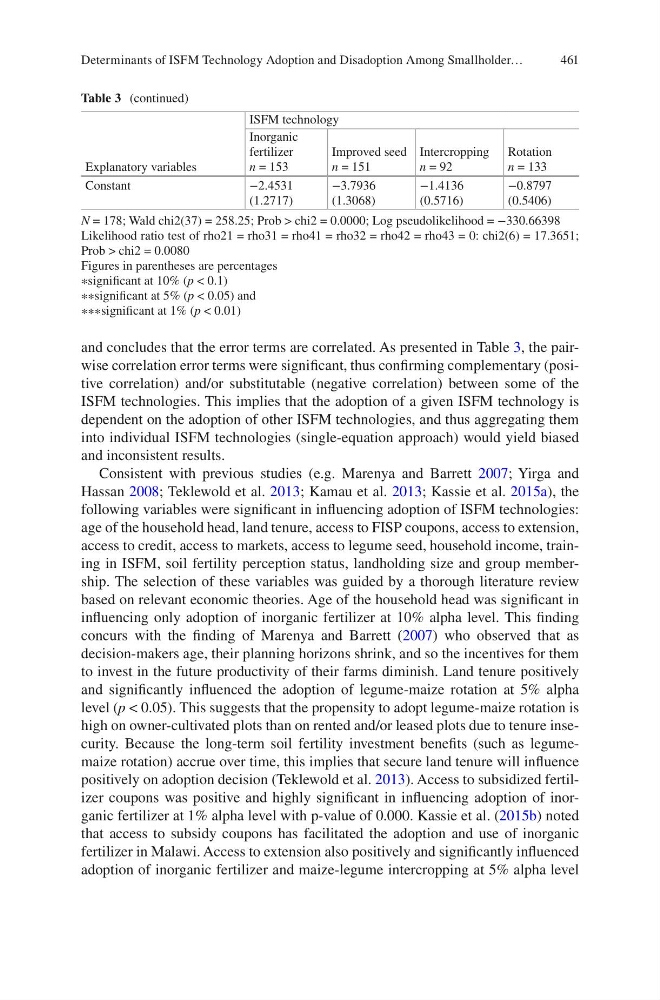
and concludes that the error terms are correlated. As presented in Table 3, the pairwise correlation error terms were significant, thus confirming complementary (positive correlation) and/or substitutable (negative correlation) between some of the
ISFM technologies. This implies that the adoption of a given ISFM technology is
dependent on the adoption of other ISFM technologies, and thus aggregating them
into individual ISFM technologies (single-equation approach) would yield biased
and inconsistent results.
Consistent with previous studies (e.g. Marenya and Barrett 2007; Yirga and
Hassan 2008; Teklewold et al. 2013; Kamau et al. 2013; Kassie et al. 2015a), the
following variables were significant in influencing adoption of ISFM technologies:
age of the household head, land tenure, access to FISP coupons, access to extension,
access to credit, access to markets, access to legume seed, household income, training in ISFM, soil fertility perception status, landholding size and group membership. The selection of these variables was guided by a thorough literature review
based on relevant economic theories. Age of the household head was significant in
influencing only adoption of inorganic fertilizer at 10% alpha level. This finding
concurs with the finding of Marenya and Barrett (2007) who observed that as
decision- makers age, their planning horizons shrink, and so the incentives for them
to invest in the future productivity of their farms diminish. Land tenure positively
and significantly influenced the adoption of legume-maize rotation at 5% alpha
level (p < 0.05). This suggests that the propensity to adopt legume-maize rotation is
high on owner-cultivated plots than on rented and/or leased plots due to tenure insecurity. Because the long-term soil fertility investment benefits (such as legumemaize rotation) accrue over time, this implies that secure land tenure will influence
positively on adoption decision (Teklewold et al. 2013). Access to subsidized fertilizer coupons was positive and highly significant in influencing adoption of inorganic fertilizer at 1% alpha level with p-value of 0.000. Kassie et al. (2015b) noted
that access to subsidy coupons has facilitated the adoption and use of inorganic
fertilizer in Malawi. Access to extension also positively and significantly influenced
adoption of inorganic fertilizer and maize-legume intercropping at 5% alpha level
Table 3 (continued)
Explanatory variables
ISFM technology
Inorganic
fertilizer
n = 153
Improved seed
n = 151
Intercropping
n = 92
Rotation
n = 133
Constant
−2.4531
(1.2717)
−3.7936
(1.3068)
−1.4136
(0.5716)
−0.8797
(0.5406)
N = 178; Wald chi2(37) = 258.25; Prob > chi2 = 0.0000; Log pseudolikelihood = −330.66398
Likelihood ratio test of rho21 = rho31 = rho41 = rho32 = rho42 = rho43 = 0: chi2(6) = 17.3651;
Prob > chi2 = 0.0080
Figures in parentheses are percentages
∗significant at 10% (p < 0.1)
∗∗significant at 5% (p < 0.05) and
∗∗∗significant at 1% (p < 0.01)
Determinants of ISFM Technology Adoption and Disadoption Among Smallholder…
and concludes that the error terms are correlated. As presented in Table 3, the pairwise correlation error terms were significant, thus confirming complementary (positive correlation) and/or substitutable (negative correlation) between some of the
ISFM technologies. This implies that the adoption of a given ISFM technology is
dependent on the adoption of other ISFM technologies, and thus aggregating them
into individual ISFM technologies (single-equation approach) would yield biased
and inconsistent results.
Consistent with previous studies (e.g. Marenya and Barrett 2007; Yirga and
Hassan 2008; Teklewold et al. 2013; Kamau et al. 2013; Kassie et al. 2015a), the
following variables were significant in influencing adoption of ISFM technologies:
age of the household head, land tenure, access to FISP coupons, access to extension,
access to credit, access to markets, access to legume seed, household income, training in ISFM, soil fertility perception status, landholding size and group membership. The selection of these variables was guided by a thorough literature review
based on relevant economic theories. Age of the household head was significant in
influencing only adoption of inorganic fertilizer at 10% alpha level. This finding
concurs with the finding of Marenya and Barrett (2007) who observed that as
decision- makers age, their planning horizons shrink, and so the incentives for them
to invest in the future productivity of their farms diminish. Land tenure positively
and significantly influenced the adoption of legume-maize rotation at 5% alpha
level (p < 0.05). This suggests that the propensity to adopt legume-maize rotation is
high on owner-cultivated plots than on rented and/or leased plots due to tenure insecurity. Because the long-term soil fertility investment benefits (such as legumemaize rotation) accrue over time, this implies that secure land tenure will influence
positively on adoption decision (Teklewold et al. 2013). Access to subsidized fertilizer coupons was positive and highly significant in influencing adoption of inorganic fertilizer at 1% alpha level with p-value of 0.000. Kassie et al. (2015b) noted
that access to subsidy coupons has facilitated the adoption and use of inorganic
fertilizer in Malawi. Access to extension also positively and significantly influenced
adoption of inorganic fertilizer and maize-legume intercropping at 5% alpha level
Table 3 (continued)
Explanatory variables
ISFM technology
Inorganic
fertilizer
n = 153
Improved seed
n = 151
Intercropping
n = 92
Rotation
n = 133
Constant
−2.4531
(1.2717)
−3.7936
(1.3068)
−1.4136
(0.5716)
−0.8797
(0.5406)
N = 178; Wald chi2(37) = 258.25; Prob > chi2 = 0.0000; Log pseudolikelihood = −330.66398
Likelihood ratio test of rho21 = rho31 = rho41 = rho32 = rho42 = rho43 = 0: chi2(6) = 17.3651;
Prob > chi2 = 0.0080
Figures in parentheses are percentages
∗significant at 10% (p < 0.1)
∗∗significant at 5% (p < 0.05) and
∗∗∗significant at 1% (p < 0.01)
Determinants of ISFM Technology Adoption and Disadoption Among Smallholder…