

432
include: adverse effects on non-target species, resistance to repeatedly used insecticides, pest resurgence, secondary pest outbreaks, environmental contamination
and negative effects on the health of the farmers, who often lack the adequate protective gears (Frank et al. 2015; Peng et al. 2014; Saini et al. 2014). In addition,
costs to repeatedly purchase insecticides would also be reduced. Unfortunately,
knowledge of the use of O. longinoda as biological control agent against cashew
pests is limited to few individuals, particularly researchers, and has not been
accessed by cashew growers.
4 The Use of Oecophylla longinoda in Controlling Cashew
Pests
African weaver ants, Oecophylla longinoda Latreille, are arboreal predatory insects
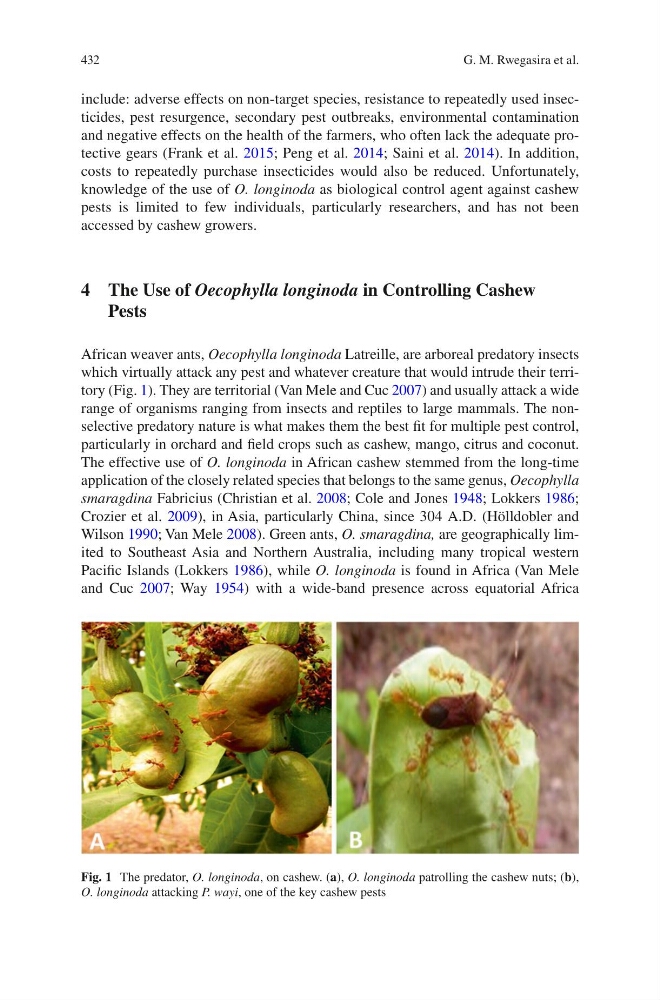
which virtually attack any pest and whatever creature that would intrude their territory (Fig. 1). They are territorial (Van Mele and Cuc 2007) and usually attack a wide
range of organisms ranging from insects and reptiles to large mammals. The nonselective predatory nature is what makes them the best fit for multiple pest control,
particularly in orchard and field crops such as cashew, mango, citrus and coconut.
The effective use of O. longinoda in African cashew stemmed from the long-time
application of the closely related species that belongs to the same genus, Oecophylla
smaragdina Fabricius (Christian et al. 2008; Cole and Jones 1948; Lokkers 1986;
Crozier et al. 2009), in Asia, particularly China, since 304 A.D. (Hölldobler and
Wilson 1990; Van Mele 2008). Green ants, O. smaragdina, are geographically limited to Southeast Asia and Northern Australia, including many tropical western
Pacific Islands (Lokkers 1986), while O. longinoda is found in Africa (Van Mele
and Cuc 2007; Way 1954) with a wide-band presence across equatorial Africa
Fig. 1 The predator, O. longinoda, on cashew. (a), O. longinoda patrolling the cashew nuts; (b),
O. longinoda attacking P. wayi, one of the key cashew pests
G. M. Rwegasira et al.
include: adverse effects on non-target species, resistance to repeatedly used insecticides, pest resurgence, secondary pest outbreaks, environmental contamination
and negative effects on the health of the farmers, who often lack the adequate protective gears (Frank et al. 2015; Peng et al. 2014; Saini et al. 2014). In addition,
costs to repeatedly purchase insecticides would also be reduced. Unfortunately,
knowledge of the use of O. longinoda as biological control agent against cashew
pests is limited to few individuals, particularly researchers, and has not been
accessed by cashew growers.
4 The Use of Oecophylla longinoda in Controlling Cashew
Pests
African weaver ants, Oecophylla longinoda Latreille, are arboreal predatory insects
which virtually attack any pest and whatever creature that would intrude their territory (Fig. 1). They are territorial (Van Mele and Cuc 2007) and usually attack a wide
range of organisms ranging from insects and reptiles to large mammals. The nonselective predatory nature is what makes them the best fit for multiple pest control,
particularly in orchard and field crops such as cashew, mango, citrus and coconut.
The effective use of O. longinoda in African cashew stemmed from the long-time
application of the closely related species that belongs to the same genus, Oecophylla
smaragdina Fabricius (Christian et al. 2008; Cole and Jones 1948; Lokkers 1986;
Crozier et al. 2009), in Asia, particularly China, since 304 A.D. (Hölldobler and
Wilson 1990; Van Mele 2008). Green ants, O. smaragdina, are geographically limited to Southeast Asia and Northern Australia, including many tropical western
Pacific Islands (Lokkers 1986), while O. longinoda is found in Africa (Van Mele
and Cuc 2007; Way 1954) with a wide-band presence across equatorial Africa
Fig. 1 The predator, O. longinoda, on cashew. (a), O. longinoda patrolling the cashew nuts; (b),
O. longinoda attacking P. wayi, one of the key cashew pests
G. M. Rwegasira et al.