

399
He claimed that most good answers could be captured with a few key numbers in a
few essential budgets, and that whole farm budgeting methods that focus on risky
elements as well as case studies can be very useful and enlightening.
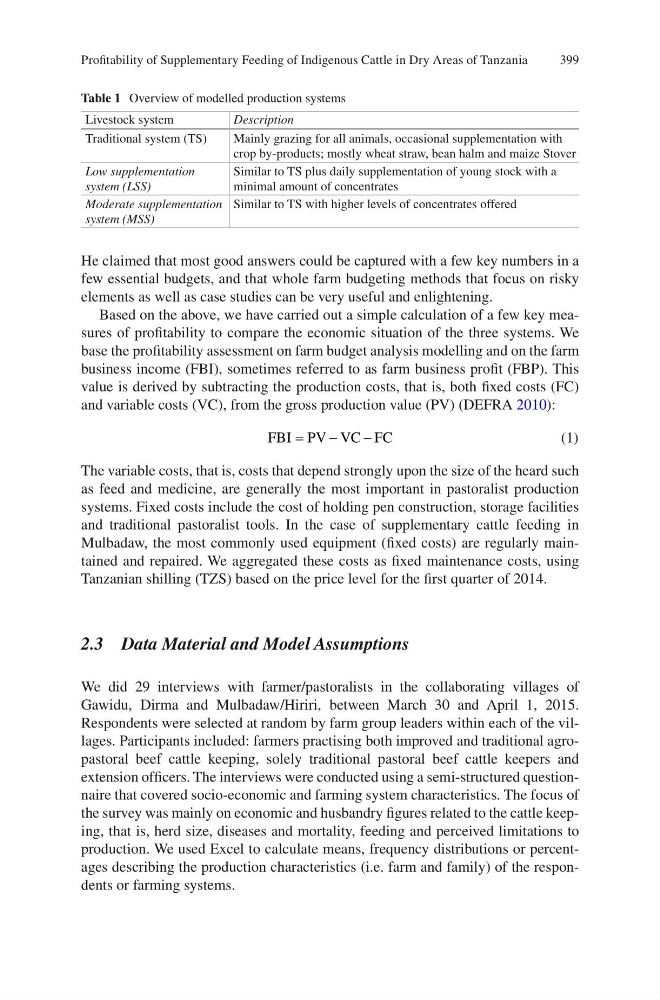
Based on the above, we have carried out a simple calculation of a few key measures of profitability to compare the economic situation of the three systems. We
base the profitability assessment on farm budget analysis modelling and on the farm
business income (FBI), sometimes referred to as farm business profit (FBP). This
value is derived by subtracting the production costs, that is, both fixed costs (FC)
and variable costs (VC), from the gross production value (PV) (DEFRA 2010):
FBI PV VC FC
=
−
−
(1)
The variable costs, that is, costs that depend strongly upon the size of the heard such
as feed and medicine, are generally the most important in pastoralist production
systems. Fixed costs include the cost of holding pen construction, storage facilities
and traditional pastoralist tools. In the case of supplementary cattle feeding in
Mulbadaw, the most commonly used equipment (fixed costs) are regularly maintained and repaired. We aggregated these costs as fixed maintenance costs, using
Tanzanian shilling (TZS) based on the price level for the first quarter of 2014.
2.3 Data Material and Model Assumptions
We did 29 interviews with farmer/pastoralists in the collaborating villages of
Gawidu, Dirma and Mulbadaw/Hiriri, between March 30 and April 1, 2015.
Respondents were selected at random by farm group leaders within each of the villages. Participants included: farmers practising both improved and traditional agropastoral beef cattle keeping, solely traditional pastoral beef cattle keepers and
extension officers. The interviews were conducted using a semi-structured questionnaire that covered socio-economic and farming system characteristics. The focus of
the survey was mainly on economic and husbandry figures related to the cattle keeping, that is, herd size, diseases and mortality, feeding and perceived limitations to
production. We used Excel to calculate means, frequency distributions or percentages describing the production characteristics (i.e. farm and family) of the respondents or farming systems.
Table 1 Overview of modelled production systems
Livestock system
Description
Traditional system (TS)
Mainly grazing for all animals, occasional supplementation with
crop by-products; mostly wheat straw, bean halm and maize Stover
Low supplementation
system (LSS)
Similar to TS plus daily supplementation of young stock with a
minimal amount of concentrates
Moderate supplementation
system (MSS)
Similar to TS with higher levels of concentrates offered
Profitability of Supplementary Feeding of Indigenous Cattle in Dry Areas of Tanzania
He claimed that most good answers could be captured with a few key numbers in a
few essential budgets, and that whole farm budgeting methods that focus on risky
elements as well as case studies can be very useful and enlightening.
Based on the above, we have carried out a simple calculation of a few key measures of profitability to compare the economic situation of the three systems. We
base the profitability assessment on farm budget analysis modelling and on the farm
business income (FBI), sometimes referred to as farm business profit (FBP). This
value is derived by subtracting the production costs, that is, both fixed costs (FC)
and variable costs (VC), from the gross production value (PV) (DEFRA 2010):
FBI PV VC FC
=
−
−
(1)
The variable costs, that is, costs that depend strongly upon the size of the heard such
as feed and medicine, are generally the most important in pastoralist production
systems. Fixed costs include the cost of holding pen construction, storage facilities
and traditional pastoralist tools. In the case of supplementary cattle feeding in
Mulbadaw, the most commonly used equipment (fixed costs) are regularly maintained and repaired. We aggregated these costs as fixed maintenance costs, using
Tanzanian shilling (TZS) based on the price level for the first quarter of 2014.
2.3 Data Material and Model Assumptions
We did 29 interviews with farmer/pastoralists in the collaborating villages of
Gawidu, Dirma and Mulbadaw/Hiriri, between March 30 and April 1, 2015.
Respondents were selected at random by farm group leaders within each of the villages. Participants included: farmers practising both improved and traditional agropastoral beef cattle keeping, solely traditional pastoral beef cattle keepers and
extension officers. The interviews were conducted using a semi-structured questionnaire that covered socio-economic and farming system characteristics. The focus of
the survey was mainly on economic and husbandry figures related to the cattle keeping, that is, herd size, diseases and mortality, feeding and perceived limitations to
production. We used Excel to calculate means, frequency distributions or percentages describing the production characteristics (i.e. farm and family) of the respondents or farming systems.
Table 1 Overview of modelled production systems
Livestock system
Description
Traditional system (TS)
Mainly grazing for all animals, occasional supplementation with
crop by-products; mostly wheat straw, bean halm and maize Stover
Low supplementation
system (LSS)
Similar to TS plus daily supplementation of young stock with a
minimal amount of concentrates
Moderate supplementation
system (MSS)
Similar to TS with higher levels of concentrates offered
Profitability of Supplementary Feeding of Indigenous Cattle in Dry Areas of Tanzania