

380
3.2 Adoption of Technology Versus Limited Use of Fuelled
Processing Methods
Adoption of the Solar Drying Method
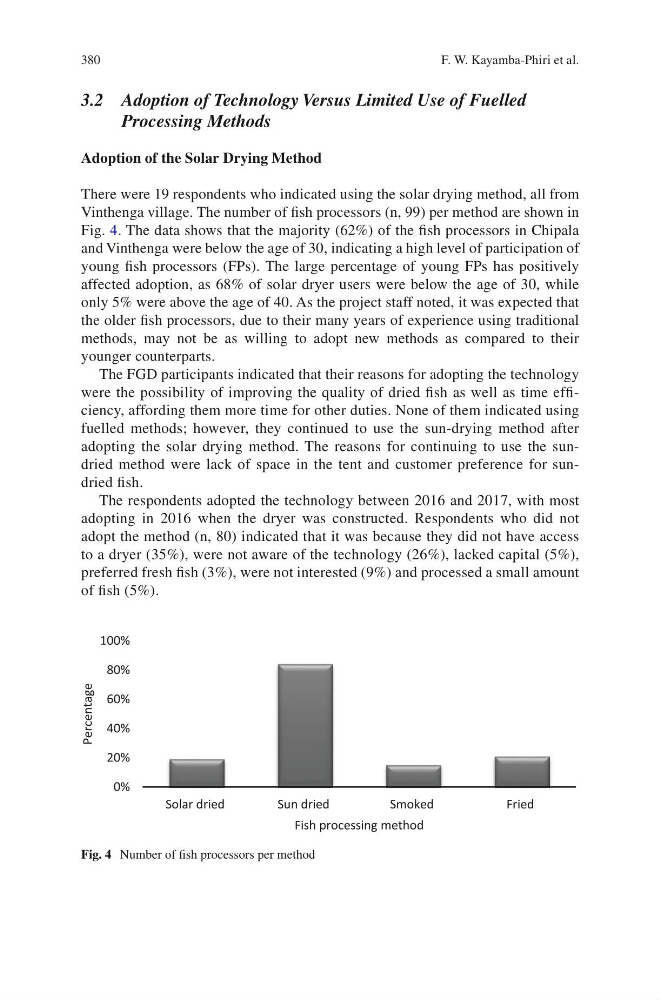
There were 19 respondents who indicated using the solar drying method, all from
Vinthenga village. The number of fish processors (n, 99) per method are shown in
Fig. 4. The data shows that the majority (62%) of the fish processors in Chipala
and Vinthenga were below the age of 30, indicating a high level of participation of
young fish processors (FPs). The large percentage of young FPs has positively
affected adoption, as 68% of solar dryer users were below the age of 30, while
only 5% were above the age of 40. As the project staff noted, it was expected that
the older fish processors, due to their many years of experience using traditional
methods, may not be as willing to adopt new methods as compared to their
younger counterparts.
The FGD participants indicated that their reasons for adopting the technology
were the possibility of improving the quality of dried fish as well as time efficiency, affording them more time for other duties. None of them indicated using
fuelled methods; however, they continued to use the sun-drying method after
adopting the solar drying method. The reasons for continuing to use the sundried method were lack of space in the tent and customer preference for sundried fish.
The respondents adopted the technology between 2016 and 2017, with most
adopting in 2016 when the dryer was constructed. Respondents who did not
adopt the method (n, 80) indicated that it was because they did not have access
to a dryer (35%), were not aware of the technology (26%), lacked capital (5%),
preferred fresh fish (3%), were not interested (9%) and processed a small amount
of fish (5%).
Fig. 4 Number of fish processors per method
F. W. Kayamba-Phiri et al.
3.2 Adoption of Technology Versus Limited Use of Fuelled
Processing Methods
Adoption of the Solar Drying Method
There were 19 respondents who indicated using the solar drying method, all from
Vinthenga village. The number of fish processors (n, 99) per method are shown in
Fig. 4. The data shows that the majority (62%) of the fish processors in Chipala
and Vinthenga were below the age of 30, indicating a high level of participation of
young fish processors (FPs). The large percentage of young FPs has positively
affected adoption, as 68% of solar dryer users were below the age of 30, while
only 5% were above the age of 40. As the project staff noted, it was expected that
the older fish processors, due to their many years of experience using traditional
methods, may not be as willing to adopt new methods as compared to their
younger counterparts.
The FGD participants indicated that their reasons for adopting the technology
were the possibility of improving the quality of dried fish as well as time efficiency, affording them more time for other duties. None of them indicated using
fuelled methods; however, they continued to use the sun-drying method after
adopting the solar drying method. The reasons for continuing to use the sundried method were lack of space in the tent and customer preference for sundried fish.
The respondents adopted the technology between 2016 and 2017, with most
adopting in 2016 when the dryer was constructed. Respondents who did not
adopt the method (n, 80) indicated that it was because they did not have access
to a dryer (35%), were not aware of the technology (26%), lacked capital (5%),
preferred fresh fish (3%), were not interested (9%) and processed a small amount
of fish (5%).
Fig. 4 Number of fish processors per method
F. W. Kayamba-Phiri et al.