

378
this case, all retailers and some wholesalers are fish processors. The analysis also
shows that wholesalers sell their fish in markets outside of Nkhotakota, while the
retailers sell their fish either in the local market or their homes. Only 3% of the fish
processed using the solar drying method is sold by wholesalers, which shows a
minimal exposure of the method to markets outside of Nkhotakota. Within
Nkhotakota, solar-dried fish constituted 10% of fish sold processed. The bulk (56%)
of the fish caught was sold sun-dried.
The study focussed on the methods used to process different fish species. The
data revealed that the two most common fish species sold by the respondents are
Copadichromis virginalis and Engraulicypris sardella, locally known and hereafter
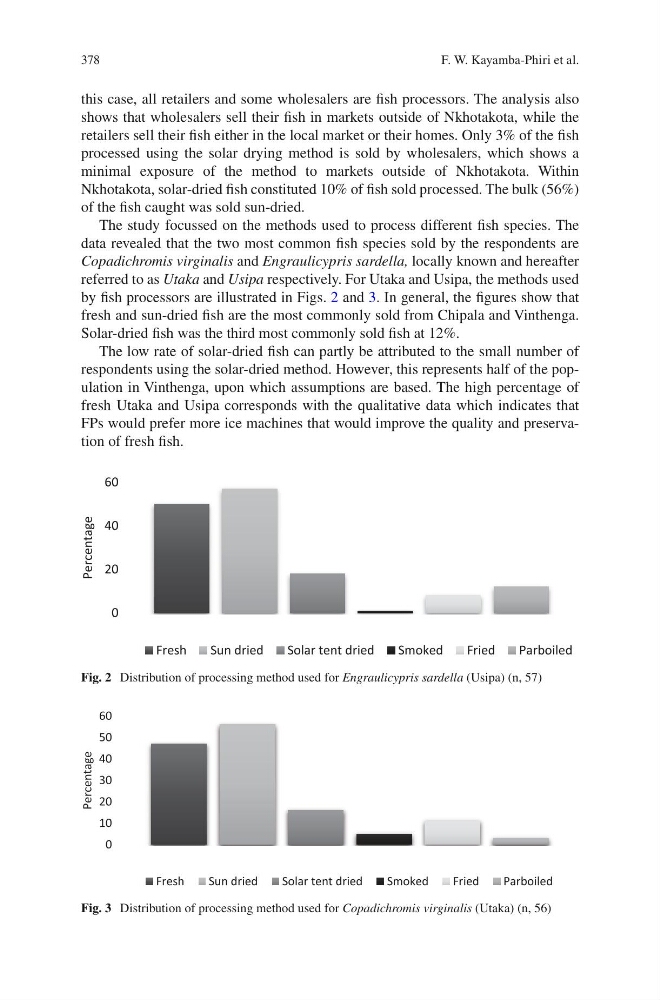
referred to as Utaka and Usipa respectively. For Utaka and Usipa, the methods used
by fish processors are illustrated in Figs. 2 and 3. In general, the figures show that
fresh and sun-dried fish are the most commonly sold from Chipala and Vinthenga.
Solar-dried fish was the third most commonly sold fish at 12%.
The low rate of solar-dried fish can partly be attributed to the small number of
respondents using the solar-dried method. However, this represents half of the population in Vinthenga, upon which assumptions are based. The high percentage of
fresh Utaka and Usipa corresponds with the qualitative data which indicates that
FPs would prefer more ice machines that would improve the quality and preservation of fresh fish.
Fig. 2 Distribution of processing method used for Engraulicypris sardella (Usipa) (n, 57)
Fig. 3 Distribution of processing method used for Copadichromis virginalis (Utaka) (n, 56)
F. W. Kayamba-Phiri et al.
this case, all retailers and some wholesalers are fish processors. The analysis also
shows that wholesalers sell their fish in markets outside of Nkhotakota, while the
retailers sell their fish either in the local market or their homes. Only 3% of the fish
processed using the solar drying method is sold by wholesalers, which shows a
minimal exposure of the method to markets outside of Nkhotakota. Within
Nkhotakota, solar-dried fish constituted 10% of fish sold processed. The bulk (56%)
of the fish caught was sold sun-dried.
The study focussed on the methods used to process different fish species. The
data revealed that the two most common fish species sold by the respondents are
Copadichromis virginalis and Engraulicypris sardella, locally known and hereafter
referred to as Utaka and Usipa respectively. For Utaka and Usipa, the methods used
by fish processors are illustrated in Figs. 2 and 3. In general, the figures show that
fresh and sun-dried fish are the most commonly sold from Chipala and Vinthenga.
Solar-dried fish was the third most commonly sold fish at 12%.
The low rate of solar-dried fish can partly be attributed to the small number of
respondents using the solar-dried method. However, this represents half of the population in Vinthenga, upon which assumptions are based. The high percentage of
fresh Utaka and Usipa corresponds with the qualitative data which indicates that
FPs would prefer more ice machines that would improve the quality and preservation of fresh fish.
Fig. 2 Distribution of processing method used for Engraulicypris sardella (Usipa) (n, 57)
Fig. 3 Distribution of processing method used for Copadichromis virginalis (Utaka) (n, 56)
F. W. Kayamba-Phiri et al.