

364
Transformative learners are able to think reflectively and foster freedom from suppression and oppression.
According to Freire (2005), learners should develop critical views against existing power dynamics and hierarchies (such as between large companies and farmers). They need to understand how power structures contribute to suppress or
oppress them. The ability to contest and challenge existing ideas or thoughts that
lead to suppressive practices in society (such as Western countries exploiting natural
and human resources in Africa) can result in transformation. Freire (2005) does not
believe in the concept of learners accumulating expertise in a ‘knowledge bank’
through the traditional pedagogical approach; rather, he believes in the development
of critical thinking and enhancing consciousness for ethical actions.
5.2 Path of Transformation
The transformative learning theory focuses on personal change. This change/shift
can be emotionally challenging for individuals maintaining a continuous pursuit to
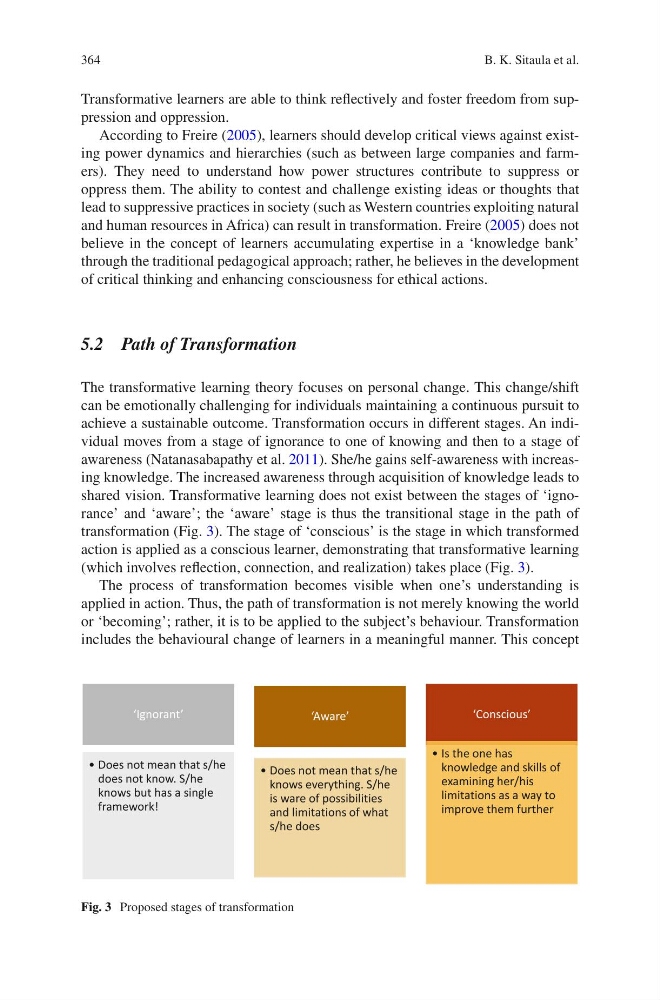
achieve a sustainable outcome. Transformation occurs in different stages. An individual moves from a stage of ignorance to one of knowing and then to a stage of
awareness (Natanasabapathy et al. 2011). She/he gains self-awareness with increasing knowledge. The increased awareness through acquisition of knowledge leads to
shared vision. Transformative learning does not exist between the stages of ‘ignorance’ and ‘aware’; the ‘aware’ stage is thus the transitional stage in the path of
transformation (Fig. 3). The stage of ‘conscious’ is the stage in which transformed
action is applied as a conscious learner, demonstrating that transformative learning
(which involves reflection, connection, and realization) takes place (Fig. 3).
The process of transformation becomes visible when one’s understanding is
applied in action. Thus, the path of transformation is not merely knowing the world
or ‘becoming’; rather, it is to be applied to the subject’s behaviour. Transformation
includes the behavioural change of learners in a meaningful manner. This concept
Fig. 3 Proposed stages of transformation
B. K. Sitaula et al.
Transformative learners are able to think reflectively and foster freedom from suppression and oppression.
According to Freire (2005), learners should develop critical views against existing power dynamics and hierarchies (such as between large companies and farmers). They need to understand how power structures contribute to suppress or
oppress them. The ability to contest and challenge existing ideas or thoughts that
lead to suppressive practices in society (such as Western countries exploiting natural
and human resources in Africa) can result in transformation. Freire (2005) does not
believe in the concept of learners accumulating expertise in a ‘knowledge bank’
through the traditional pedagogical approach; rather, he believes in the development
of critical thinking and enhancing consciousness for ethical actions.
5.2 Path of Transformation
The transformative learning theory focuses on personal change. This change/shift
can be emotionally challenging for individuals maintaining a continuous pursuit to
achieve a sustainable outcome. Transformation occurs in different stages. An individual moves from a stage of ignorance to one of knowing and then to a stage of
awareness (Natanasabapathy et al. 2011). She/he gains self-awareness with increasing knowledge. The increased awareness through acquisition of knowledge leads to
shared vision. Transformative learning does not exist between the stages of ‘ignorance’ and ‘aware’; the ‘aware’ stage is thus the transitional stage in the path of
transformation (Fig. 3). The stage of ‘conscious’ is the stage in which transformed
action is applied as a conscious learner, demonstrating that transformative learning
(which involves reflection, connection, and realization) takes place (Fig. 3).
The process of transformation becomes visible when one’s understanding is
applied in action. Thus, the path of transformation is not merely knowing the world
or ‘becoming’; rather, it is to be applied to the subject’s behaviour. Transformation
includes the behavioural change of learners in a meaningful manner. This concept
Fig. 3 Proposed stages of transformation
B. K. Sitaula et al.