

333
framework (Ellis and Freeman 2004; Ellis et al. 2003) in the context of the Poverty
Reduction Strategies (PRSP) implemented in Malawi and many other countries
supported by the International Financial Institutions in the late 1990s and early
2000s. In Ellis et al. (2003), the livelihood framework links macrolevel efforts to
develop comprehensive poverty reduction policies (such as the PRSPs and the
SDGs) with a microlevel understanding of the conditions faced by the rural poor.
A review of the available literature, along with data from the fourth Integrated
Household Survey (IHS4), is used to undertake the food system analysis (NSO
2017). In addition, a contextual understanding of the food system in Malawi is provided through our participation in the Norwegian-funded project Capacity Building
for Managing Climate Change in Malawi (CABMACC).
3 Sustainability of the Food System in Malawi
The food system in Malawi is far from sustainable and is at risk of becoming even
less so in the years ahead due to climate change along with other factors. In this
context, we define a food system as follows:
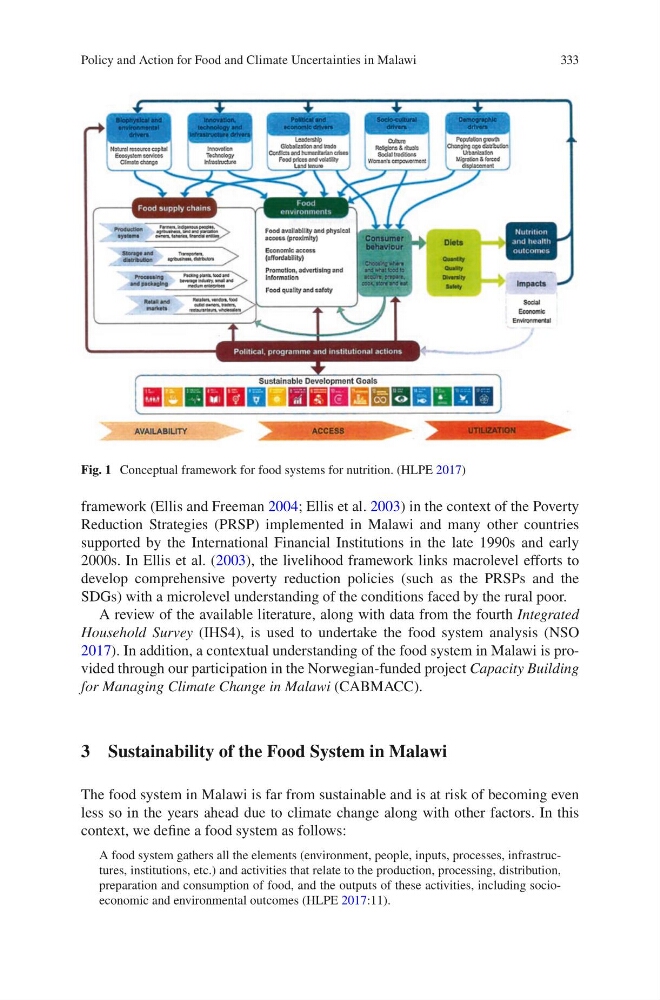
A food system gathers all the elements (environment, people, inputs, processes, infrastructures, institutions, etc.) and activities that relate to the production, processing, distribution,
preparation and consumption of food, and the outputs of these activities, including socioeconomic and environmental outcomes (HLPE 2017:11).
Fig. 1 Conceptual framework for food systems for nutrition. (HLPE 2017)
Policy and Action for Food and Climate Uncertainties in Malawi
framework (Ellis and Freeman 2004; Ellis et al. 2003) in the context of the Poverty
Reduction Strategies (PRSP) implemented in Malawi and many other countries
supported by the International Financial Institutions in the late 1990s and early
2000s. In Ellis et al. (2003), the livelihood framework links macrolevel efforts to
develop comprehensive poverty reduction policies (such as the PRSPs and the
SDGs) with a microlevel understanding of the conditions faced by the rural poor.
A review of the available literature, along with data from the fourth Integrated
Household Survey (IHS4), is used to undertake the food system analysis (NSO
2017). In addition, a contextual understanding of the food system in Malawi is provided through our participation in the Norwegian-funded project Capacity Building
for Managing Climate Change in Malawi (CABMACC).
3 Sustainability of the Food System in Malawi
The food system in Malawi is far from sustainable and is at risk of becoming even
less so in the years ahead due to climate change along with other factors. In this
context, we define a food system as follows:
A food system gathers all the elements (environment, people, inputs, processes, infrastructures, institutions, etc.) and activities that relate to the production, processing, distribution,
preparation and consumption of food, and the outputs of these activities, including socioeconomic and environmental outcomes (HLPE 2017:11).
Fig. 1 Conceptual framework for food systems for nutrition. (HLPE 2017)
Policy and Action for Food and Climate Uncertainties in Malawi