

277
whey proteins (especially β-LG) are denatured and attached to the casein micelles,
by intermolecular disulphide bonds and hydrophobic interactions. This reaction
between whey proteins and casein micelles is associated with the improved texture
of yoghurts (Tamime and Robinson 2007a).
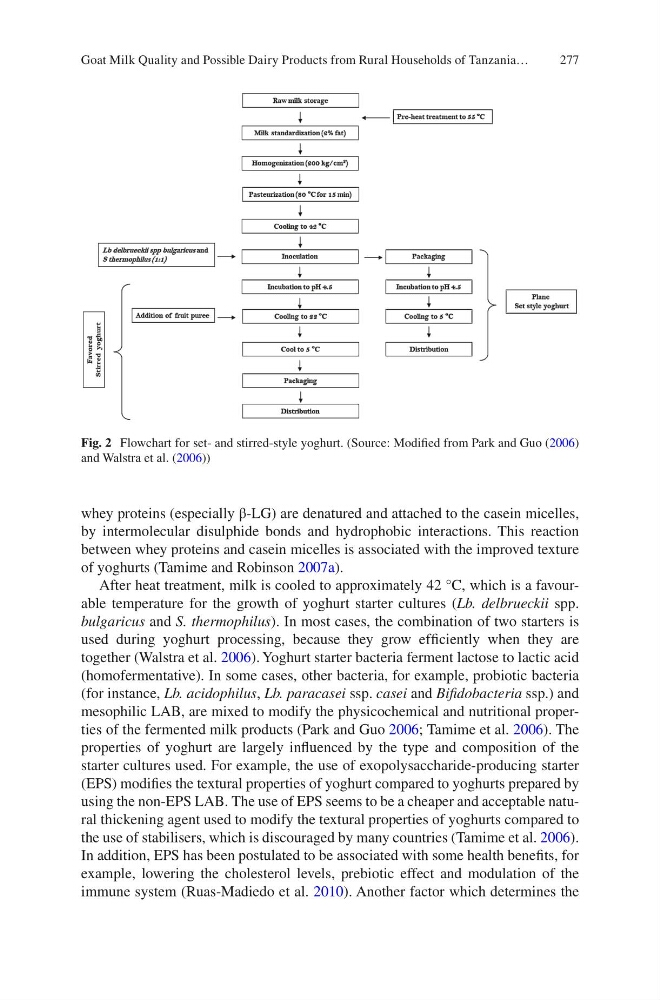
After heat treatment, milk is cooled to approximately 42 °C, which is a favourable temperature for the growth of yoghurt starter cultures (Lb. delbrueckii spp.
bulgaricus and S. thermophilus). In most cases, the combination of two starters is
used during yoghurt processing, because they grow efficiently when they are
together (Walstra et al. 2006). Yoghurt starter bacteria ferment lactose to lactic acid
(homofermentative). In some cases, other bacteria, for example, probiotic bacteria
(for instance, Lb. acidophilus, Lb. paracasei ssp. casei and Bifidobacteria ssp.) and
mesophilic LAB, are mixed to modify the physicochemical and nutritional properties of the fermented milk products (Park and Guo 2006; Tamime et al. 2006). The
properties of yoghurt are largely influenced by the type and composition of the
starter cultures used. For example, the use of exopolysaccharide-producing starter
(EPS) modifies the textural properties of yoghurt compared to yoghurts prepared by
using the non-EPS LAB. The use of EPS seems to be a cheaper and acceptable natural thickening agent used to modify the textural properties of yoghurts compared to
the use of stabilisers, which is discouraged by many countries (Tamime et al. 2006).
In addition, EPS has been postulated to be associated with some health benefits, for
example, lowering the cholesterol levels, prebiotic effect and modulation of the
immune system (Ruas-Madiedo et al. 2010). Another factor which determines the
Fig. 2 Flowchart for set- and stirred-style yoghurt. (Source: Modified from Park and Guo (2006)
and Walstra et al. (2006))
Goat Milk Quality and Possible Dairy Products from Rural Households of Tanzania…
whey proteins (especially β-LG) are denatured and attached to the casein micelles,
by intermolecular disulphide bonds and hydrophobic interactions. This reaction
between whey proteins and casein micelles is associated with the improved texture
of yoghurts (Tamime and Robinson 2007a).
After heat treatment, milk is cooled to approximately 42 °C, which is a favourable temperature for the growth of yoghurt starter cultures (Lb. delbrueckii spp.
bulgaricus and S. thermophilus). In most cases, the combination of two starters is
used during yoghurt processing, because they grow efficiently when they are
together (Walstra et al. 2006). Yoghurt starter bacteria ferment lactose to lactic acid
(homofermentative). In some cases, other bacteria, for example, probiotic bacteria
(for instance, Lb. acidophilus, Lb. paracasei ssp. casei and Bifidobacteria ssp.) and
mesophilic LAB, are mixed to modify the physicochemical and nutritional properties of the fermented milk products (Park and Guo 2006; Tamime et al. 2006). The
properties of yoghurt are largely influenced by the type and composition of the
starter cultures used. For example, the use of exopolysaccharide-producing starter
(EPS) modifies the textural properties of yoghurt compared to yoghurts prepared by
using the non-EPS LAB. The use of EPS seems to be a cheaper and acceptable natural thickening agent used to modify the textural properties of yoghurts compared to
the use of stabilisers, which is discouraged by many countries (Tamime et al. 2006).
In addition, EPS has been postulated to be associated with some health benefits, for
example, lowering the cholesterol levels, prebiotic effect and modulation of the
immune system (Ruas-Madiedo et al. 2010). Another factor which determines the
Fig. 2 Flowchart for set- and stirred-style yoghurt. (Source: Modified from Park and Guo (2006)
and Walstra et al. (2006))
Goat Milk Quality and Possible Dairy Products from Rural Households of Tanzania…