

274
To commercialise goat milk, it is important to establish quality control measures
of the raw milk to ensure the quality of the final product (Park and Guo 2006).
Rennet coagulation properties (clotting time, curd firming rate and curd firmness) of
the milk should be observed as a part of the milk quality control procedure to evaluate the milk quality for cheesemaking. Favourable rennet coagulation properties
(short clotting time and high curd firmness) are associated with the improved texture of the cheese and improved cheese yield. Higher contents of total Ca and P,
protein, fat and κ-CN have been shown to be associated with favourable cheesemaking properties (Ketto et al. 2017). Cow milk has a higher α s1 -CN and total casein
content than goat milk. This explains the differences in texture between the goat and
cow cheeses (Skeie et al. 2014). Through selective breeding, it was possible to
reduce the frequency of goats which produce milk with low or without α s1 -CN
(α s1 -CN “null” variant) in Norwegian dairy goats (Skeie et al. 2014). The elimination of such goats over the years improved the flavour of the milk and the textural
properties of the goat cheeses in Norway (Skeie et al. 2014). The proportion of
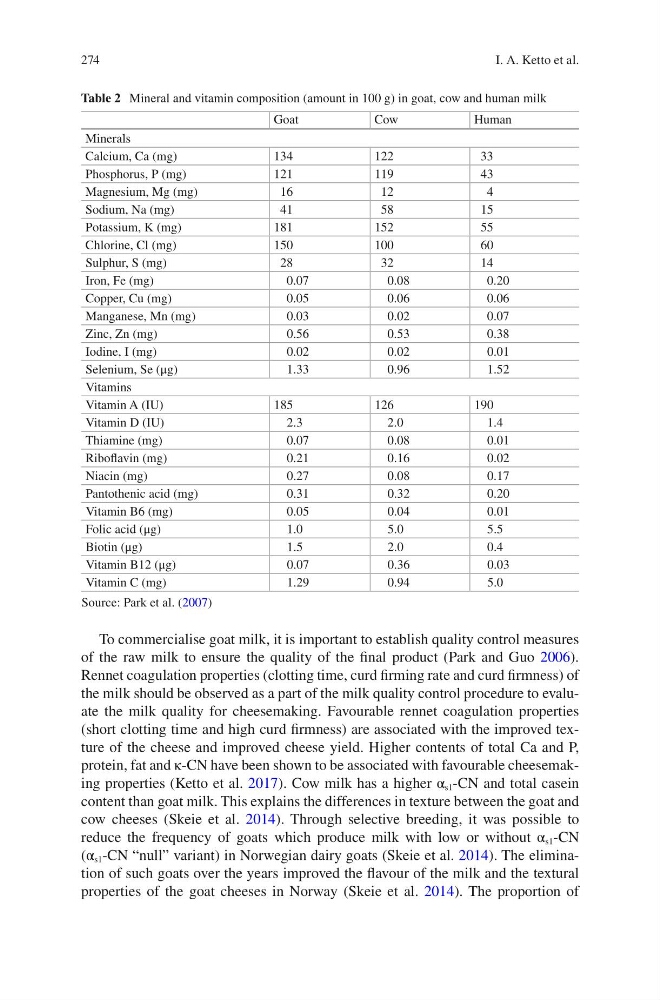
Table 2 Mineral and vitamin composition (amount in 100 g) in goat, cow and human milk
Goat
Cow
Human
Minerals
Calcium, Ca (mg)
134
122
33
Phosphorus, P (mg)
121
119
43
Magnesium, Mg (mg)
16
12
4
Sodium, Na (mg)
41
58
15
Potassium, K (mg)
181
152
55
Chlorine, Cl (mg)
150
100
60
Sulphur, S (mg)
28
32
14
Iron, Fe (mg)
0.07
0.08
0.20
Copper, Cu (mg)
0.05
0.06
0.06
Manganese, Mn (mg)
0.03
0.02
0.07
Zinc, Zn (mg)
0.56
0.53
0.38
Iodine, I (mg)
0.02
0.02
0.01
Selenium, Se (μg)
1.33
0.96
1.52
Vitamins
Vitamin A (IU)
185
126
190
Vitamin D (IU)
2.3
2.0
1.4
Thiamine (mg)
0.07
0.08
0.01
Riboflavin (mg)
0.21
0.16
0.02
Niacin (mg)
0.27
0.08
0.17
Pantothenic acid (mg)
0.31
0.32
0.20
Vitamin B6 (mg)
0.05
0.04
0.01
Folic acid (μg)
1.0
5.0
5.5
Biotin (μg)
1.5
2.0
0.4
Vitamin B12 (μg)
0.07
0.36
0.03
Vitamin C (mg)
1.29
0.94
5.0
Source: Park et al. (2007)
I. A. Ketto et al.
To commercialise goat milk, it is important to establish quality control measures
of the raw milk to ensure the quality of the final product (Park and Guo 2006).
Rennet coagulation properties (clotting time, curd firming rate and curd firmness) of
the milk should be observed as a part of the milk quality control procedure to evaluate the milk quality for cheesemaking. Favourable rennet coagulation properties
(short clotting time and high curd firmness) are associated with the improved texture of the cheese and improved cheese yield. Higher contents of total Ca and P,
protein, fat and κ-CN have been shown to be associated with favourable cheesemaking properties (Ketto et al. 2017). Cow milk has a higher α s1 -CN and total casein
content than goat milk. This explains the differences in texture between the goat and
cow cheeses (Skeie et al. 2014). Through selective breeding, it was possible to
reduce the frequency of goats which produce milk with low or without α s1 -CN
(α s1 -CN “null” variant) in Norwegian dairy goats (Skeie et al. 2014). The elimination of such goats over the years improved the flavour of the milk and the textural
properties of the goat cheeses in Norway (Skeie et al. 2014). The proportion of
Table 2 Mineral and vitamin composition (amount in 100 g) in goat, cow and human milk
Goat
Cow
Human
Minerals
Calcium, Ca (mg)
134
122
33
Phosphorus, P (mg)
121
119
43
Magnesium, Mg (mg)
16
12
4
Sodium, Na (mg)
41
58
15
Potassium, K (mg)
181
152
55
Chlorine, Cl (mg)
150
100
60
Sulphur, S (mg)
28
32
14
Iron, Fe (mg)
0.07
0.08
0.20
Copper, Cu (mg)
0.05
0.06
0.06
Manganese, Mn (mg)
0.03
0.02
0.07
Zinc, Zn (mg)
0.56
0.53
0.38
Iodine, I (mg)
0.02
0.02
0.01
Selenium, Se (μg)
1.33
0.96
1.52
Vitamins
Vitamin A (IU)
185
126
190
Vitamin D (IU)
2.3
2.0
1.4
Thiamine (mg)
0.07
0.08
0.01
Riboflavin (mg)
0.21
0.16
0.02
Niacin (mg)
0.27
0.08
0.17
Pantothenic acid (mg)
0.31
0.32
0.20
Vitamin B6 (mg)
0.05
0.04
0.01
Folic acid (μg)
1.0
5.0
5.5
Biotin (μg)
1.5
2.0
0.4
Vitamin B12 (μg)
0.07
0.36
0.03
Vitamin C (mg)
1.29
0.94
5.0
Source: Park et al. (2007)
I. A. Ketto et al.