

8
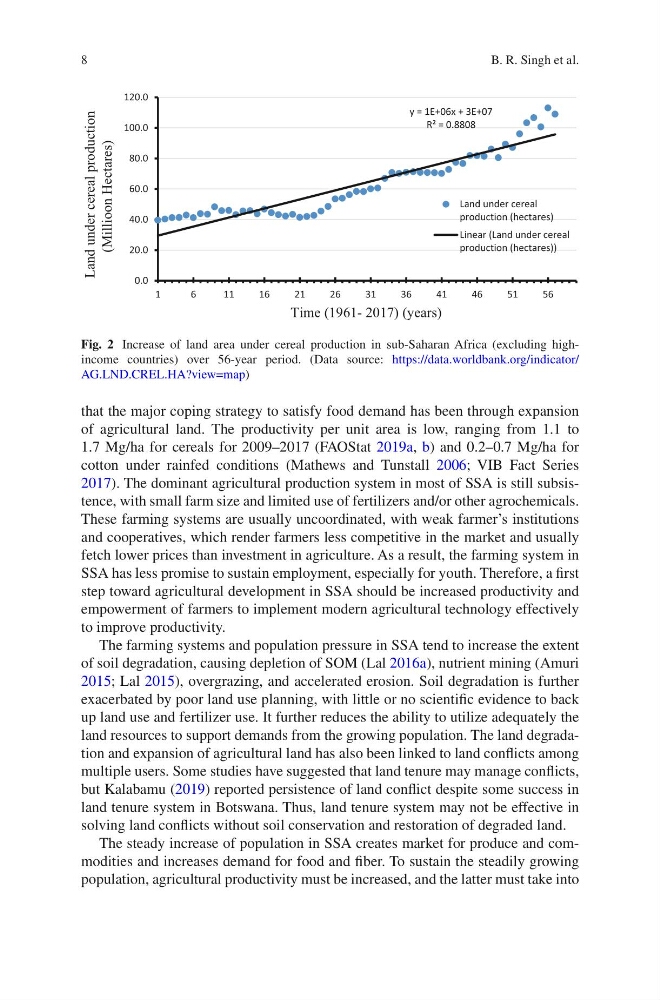
that the major coping strategy to satisfy food demand has been through expansion
of agricultural land. The productivity per unit area is low, ranging from 1.1 to
1.7 Mg/ha for cereals for 2009–2017 (FAOStat 2019a, b) and 0.2–0.7 Mg/ha for
cotton under rainfed conditions (Mathews and Tunstall 2006; VIB Fact Series
2017). The dominant agricultural production system in most of SSA is still subsistence, with small farm size and limited use of fertilizers and/or other agrochemicals.
These farming systems are usually uncoordinated, with weak farmer’s institutions
and cooperatives, which render farmers less competitive in the market and usually
fetch lower prices than investment in agriculture. As a result, the farming system in
SSA has less promise to sustain employment, especially for youth. Therefore, a first
step toward agricultural development in SSA should be increased productivity and
empowerment of farmers to implement modern agricultural technology effectively
to improve productivity.
The farming systems and population pressure in SSA tend to increase the extent
of soil degradation, causing depletion of SOM (Lal 2016a), nutrient mining (Amuri
2015; Lal 2015), overgrazing, and accelerated erosion. Soil degradation is further
exacerbated by poor land use planning, with little or no scientific evidence to back
up land use and fertilizer use. It further reduces the ability to utilize adequately the
land resources to support demands from the growing population. The land degradation and expansion of agricultural land has also been linked to land conflicts among
multiple users. Some studies have suggested that land tenure may manage conflicts,
but Kalabamu (2019) reported persistence of land conflict despite some success in
land tenure system in Botswana. Thus, land tenure system may not be effective in
solving land conflicts without soil conservation and restoration of degraded land.
The steady increase of population in SSA creates market for produce and commodities and increases demand for food and fiber. To sustain the steadily growing
population, agricultural productivity must be increased, and the latter must take into
Land under cereal production
(Millioon Hectares)
Time (1961- 2017) (years)
Fig. 2 Increase of land area under cereal production in sub-Saharan Africa (excluding highincome countries) over 56-year period. (Data source: https://data.worldbank.org/indicator/
AG.LND.CREL.HA?view=map)
B. R. Singh et al.
that the major coping strategy to satisfy food demand has been through expansion
of agricultural land. The productivity per unit area is low, ranging from 1.1 to
1.7 Mg/ha for cereals for 2009–2017 (FAOStat 2019a, b) and 0.2–0.7 Mg/ha for
cotton under rainfed conditions (Mathews and Tunstall 2006; VIB Fact Series
2017). The dominant agricultural production system in most of SSA is still subsistence, with small farm size and limited use of fertilizers and/or other agrochemicals.
These farming systems are usually uncoordinated, with weak farmer’s institutions
and cooperatives, which render farmers less competitive in the market and usually
fetch lower prices than investment in agriculture. As a result, the farming system in
SSA has less promise to sustain employment, especially for youth. Therefore, a first
step toward agricultural development in SSA should be increased productivity and
empowerment of farmers to implement modern agricultural technology effectively
to improve productivity.
The farming systems and population pressure in SSA tend to increase the extent
of soil degradation, causing depletion of SOM (Lal 2016a), nutrient mining (Amuri
2015; Lal 2015), overgrazing, and accelerated erosion. Soil degradation is further
exacerbated by poor land use planning, with little or no scientific evidence to back
up land use and fertilizer use. It further reduces the ability to utilize adequately the
land resources to support demands from the growing population. The land degradation and expansion of agricultural land has also been linked to land conflicts among
multiple users. Some studies have suggested that land tenure may manage conflicts,
but Kalabamu (2019) reported persistence of land conflict despite some success in
land tenure system in Botswana. Thus, land tenure system may not be effective in
solving land conflicts without soil conservation and restoration of degraded land.
The steady increase of population in SSA creates market for produce and commodities and increases demand for food and fiber. To sustain the steadily growing
population, agricultural productivity must be increased, and the latter must take into
Land under cereal production
(Millioon Hectares)
Time (1961- 2017) (years)
Fig. 2 Increase of land area under cereal production in sub-Saharan Africa (excluding highincome countries) over 56-year period. (Data source: https://data.worldbank.org/indicator/
AG.LND.CREL.HA?view=map)
B. R. Singh et al.