

218
4.3 Perceived Effects and Impacts of Climate Change
and Weather Variability on Cattle Production
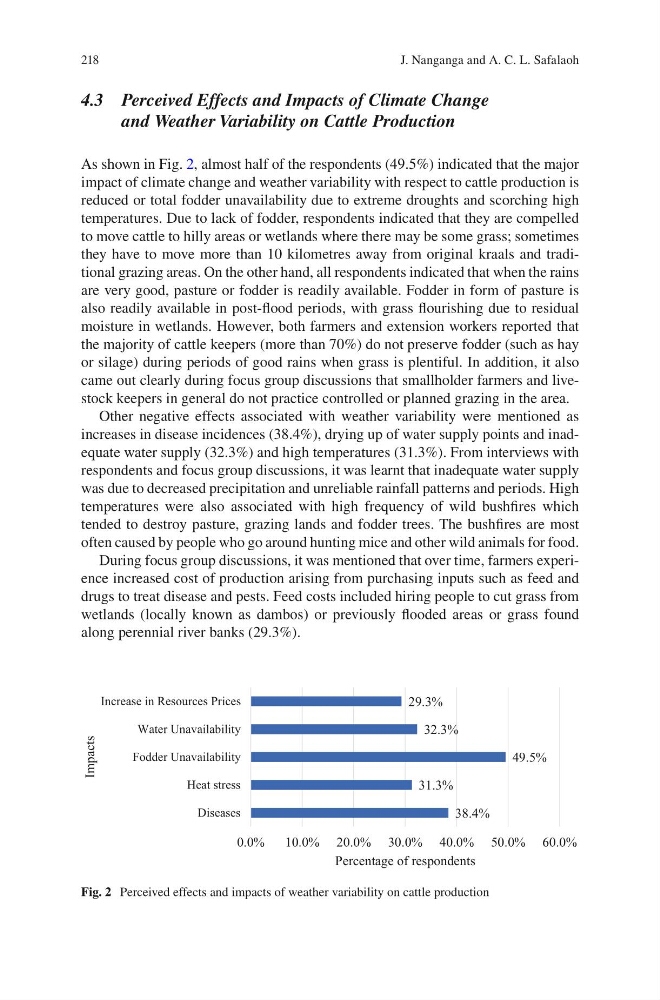
As shown in Fig. 2, almost half of the respondents (49.5%) indicated that the major
impact of climate change and weather variability with respect to cattle production is
reduced or total fodder unavailability due to extreme droughts and scorching high
temperatures. Due to lack of fodder, respondents indicated that they are compelled
to move cattle to hilly areas or wetlands where there may be some grass; sometimes
they have to move more than 10 kilometres away from original kraals and traditional grazing areas. On the other hand, all respondents indicated that when the rains
are very good, pasture or fodder is readily available. Fodder in form of pasture is
also readily available in post-flood periods, with grass flourishing due to residual
moisture in wetlands. However, both farmers and extension workers reported that
the majority of cattle keepers (more than 70%) do not preserve fodder (such as hay
or silage) during periods of good rains when grass is plentiful. In addition, it also
came out clearly during focus group discussions that smallholder farmers and livestock keepers in general do not practice controlled or planned grazing in the area.
Other negative effects associated with weather variability were mentioned as
increases in disease incidences (38.4%), drying up of water supply points and inadequate water supply (32.3%) and high temperatures (31.3%). From interviews with
respondents and focus group discussions, it was learnt that inadequate water supply
was due to decreased precipitation and unreliable rainfall patterns and periods. High
temperatures were also associated with high frequency of wild bushfires which
tended to destroy pasture, grazing lands and fodder trees. The bushfires are most
often caused by people who go around hunting mice and other wild animals for food.
During focus group discussions, it was mentioned that over time, farmers experience increased cost of production arising from purchasing inputs such as feed and
drugs to treat disease and pests. Feed costs included hiring people to cut grass from
wetlands (locally known as dambos) or previously flooded areas or grass found
along perennial river banks (29.3%).
38.4%
31.3%
49.5%
32.3%
29.3%
0.0%
10.0% 20.0% 30.0% 40.0% 50.0% 60.0%
Diseases
Heat stress
Fodder Unavailability
Water Unavailability
Increase in Resources Prices
Percentage of respondents
Impacts
Fig. 2 Perceived effects and impacts of weather variability on cattle production
J. Nanganga and A. C. L. Safalaoh
4.3 Perceived Effects and Impacts of Climate Change
and Weather Variability on Cattle Production
As shown in Fig. 2, almost half of the respondents (49.5%) indicated that the major
impact of climate change and weather variability with respect to cattle production is
reduced or total fodder unavailability due to extreme droughts and scorching high
temperatures. Due to lack of fodder, respondents indicated that they are compelled
to move cattle to hilly areas or wetlands where there may be some grass; sometimes
they have to move more than 10 kilometres away from original kraals and traditional grazing areas. On the other hand, all respondents indicated that when the rains
are very good, pasture or fodder is readily available. Fodder in form of pasture is
also readily available in post-flood periods, with grass flourishing due to residual
moisture in wetlands. However, both farmers and extension workers reported that
the majority of cattle keepers (more than 70%) do not preserve fodder (such as hay
or silage) during periods of good rains when grass is plentiful. In addition, it also
came out clearly during focus group discussions that smallholder farmers and livestock keepers in general do not practice controlled or planned grazing in the area.
Other negative effects associated with weather variability were mentioned as
increases in disease incidences (38.4%), drying up of water supply points and inadequate water supply (32.3%) and high temperatures (31.3%). From interviews with
respondents and focus group discussions, it was learnt that inadequate water supply
was due to decreased precipitation and unreliable rainfall patterns and periods. High
temperatures were also associated with high frequency of wild bushfires which
tended to destroy pasture, grazing lands and fodder trees. The bushfires are most
often caused by people who go around hunting mice and other wild animals for food.
During focus group discussions, it was mentioned that over time, farmers experience increased cost of production arising from purchasing inputs such as feed and
drugs to treat disease and pests. Feed costs included hiring people to cut grass from
wetlands (locally known as dambos) or previously flooded areas or grass found
along perennial river banks (29.3%).
38.4%
31.3%
49.5%
32.3%
29.3%
0.0%
10.0% 20.0% 30.0% 40.0% 50.0% 60.0%
Diseases
Heat stress
Fodder Unavailability
Water Unavailability
Increase in Resources Prices
Percentage of respondents
Impacts
Fig. 2 Perceived effects and impacts of weather variability on cattle production
J. Nanganga and A. C. L. Safalaoh