

177
practised in some areas in the Western cotton growing area, like Meatu and Maswa
districts in Simiyu Region and in Singida Region. The production is contract based,
where farmers enter production contracts with private companies. The contracting
company provides organic seeds and biopesticides and offers training and extension
services. In turn, the company is entitled to purchase the entire crop. The organic
cotton production practices for nutrient management include the use of FYM, crop
rotation and intercropping with legumes. For pest management, the practices also
include trap crops (e.g. intercropping with sunflower) and the use of organic pesticides (neem-leaf extract or pyrethrum). However, there is no local documented
information on agronomic, economic and environmental performance of these
practices.
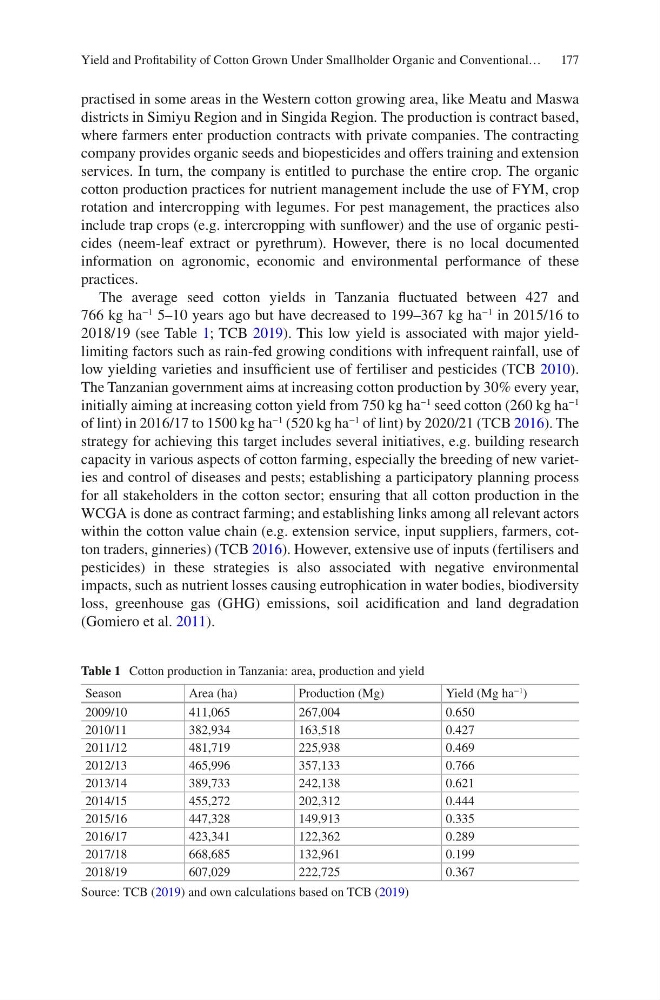
The average seed cotton yields in Tanzania fluctuated between 427 and
766 kg ha
−1
5–10 years ago but have decreased to 199–367 kg ha
−1
in 2015/16 to
2018/19 (see Table 1; TCB 2019). This low yield is associated with major yieldlimiting factors such as rain-fed growing conditions with infrequent rainfall, use of
low yielding varieties and insufficient use of fertiliser and pesticides (TCB 2010).
The Tanzanian government aims at increasing cotton production by 30% every year,
initially aiming at increasing cotton yield from 750 kg ha
−1
seed cotton (260 kg ha
−1
of lint) in 2016/17 to 1500 kg ha
−1
(520 kg ha
−1
of lint) by 2020/21 (TCB 2016). The
strategy for achieving this target includes several initiatives, e.g. building research
capacity in various aspects of cotton farming, especially the breeding of new varieties and control of diseases and pests; establishing a participatory planning process
for all stakeholders in the cotton sector; ensuring that all cotton production in the
WCGA is done as contract farming; and establishing links among all relevant actors
within the cotton value chain (e.g. extension service, input suppliers, farmers, cotton traders, ginneries) (TCB 2016). However, extensive use of inputs (fertilisers and
pesticides) in these strategies is also associated with negative environmental
impacts, such as nutrient losses causing eutrophication in water bodies, biodiversity
loss, greenhouse gas (GHG) emissions, soil acidification and land degradation
(Gomiero et al. 2011).
Table 1 Cotton production in Tanzania: area, production and yield
Season
Area (ha)
Production (Mg)
Yield (Mg ha
−1
)
2009/10
411,065
267,004
0.650
2010/11
382,934
163,518
0.427
2011/12
481,719
225,938
0.469
2012/13
465,996
357,133
0.766
2013/14
389,733
242,138
0.621
2014/15
455,272
202,312
0.444
2015/16
447,328
149,913
0.335
2016/17
423,341
122,362
0.289
2017/18
668,685
132,961
0.199
2018/19
607,029
222,725
0.367
Source: TCB (2019) and own calculations based on TCB (2019)
Yield and Profitability of Cotton Grown Under Smallholder Organic and Conventional…
practised in some areas in the Western cotton growing area, like Meatu and Maswa
districts in Simiyu Region and in Singida Region. The production is contract based,
where farmers enter production contracts with private companies. The contracting
company provides organic seeds and biopesticides and offers training and extension
services. In turn, the company is entitled to purchase the entire crop. The organic
cotton production practices for nutrient management include the use of FYM, crop
rotation and intercropping with legumes. For pest management, the practices also
include trap crops (e.g. intercropping with sunflower) and the use of organic pesticides (neem-leaf extract or pyrethrum). However, there is no local documented
information on agronomic, economic and environmental performance of these
practices.
The average seed cotton yields in Tanzania fluctuated between 427 and
766 kg ha
−1
5–10 years ago but have decreased to 199–367 kg ha
−1
in 2015/16 to
2018/19 (see Table 1; TCB 2019). This low yield is associated with major yieldlimiting factors such as rain-fed growing conditions with infrequent rainfall, use of
low yielding varieties and insufficient use of fertiliser and pesticides (TCB 2010).
The Tanzanian government aims at increasing cotton production by 30% every year,
initially aiming at increasing cotton yield from 750 kg ha
−1
seed cotton (260 kg ha
−1
of lint) in 2016/17 to 1500 kg ha
−1
(520 kg ha
−1
of lint) by 2020/21 (TCB 2016). The
strategy for achieving this target includes several initiatives, e.g. building research
capacity in various aspects of cotton farming, especially the breeding of new varieties and control of diseases and pests; establishing a participatory planning process
for all stakeholders in the cotton sector; ensuring that all cotton production in the
WCGA is done as contract farming; and establishing links among all relevant actors
within the cotton value chain (e.g. extension service, input suppliers, farmers, cotton traders, ginneries) (TCB 2016). However, extensive use of inputs (fertilisers and
pesticides) in these strategies is also associated with negative environmental
impacts, such as nutrient losses causing eutrophication in water bodies, biodiversity
loss, greenhouse gas (GHG) emissions, soil acidification and land degradation
(Gomiero et al. 2011).
Table 1 Cotton production in Tanzania: area, production and yield
Season
Area (ha)
Production (Mg)
Yield (Mg ha
−1
)
2009/10
411,065
267,004
0.650
2010/11
382,934
163,518
0.427
2011/12
481,719
225,938
0.469
2012/13
465,996
357,133
0.766
2013/14
389,733
242,138
0.621
2014/15
455,272
202,312
0.444
2015/16
447,328
149,913
0.335
2016/17
423,341
122,362
0.289
2017/18
668,685
132,961
0.199
2018/19
607,029
222,725
0.367
Source: TCB (2019) and own calculations based on TCB (2019)
Yield and Profitability of Cotton Grown Under Smallholder Organic and Conventional…