

162
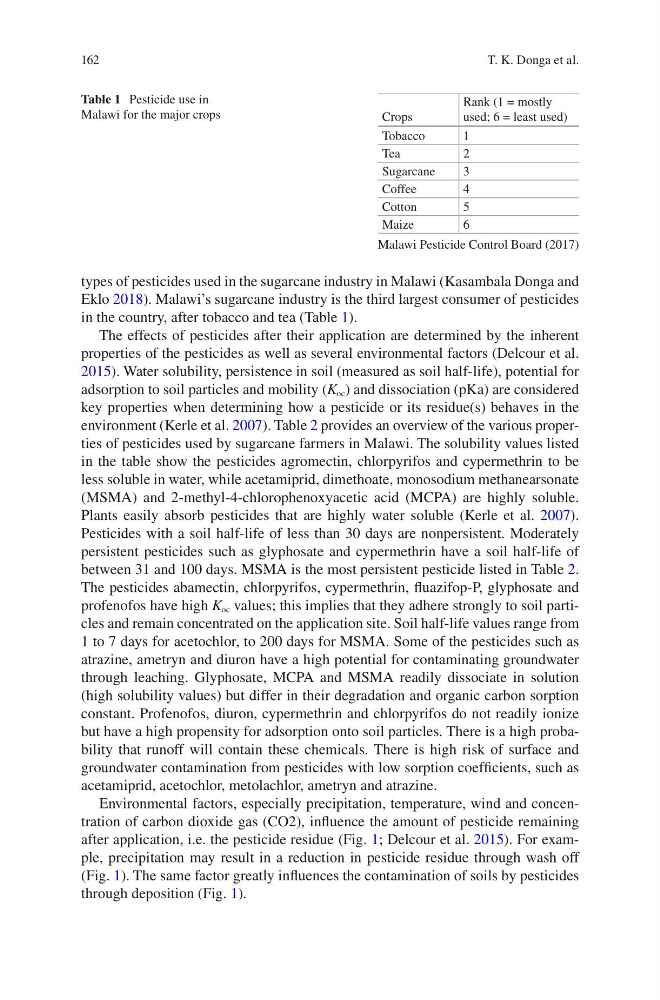
Table 1 Pesticide use in
Malawi for the major crops
Crops
Rank (1 = mostly
used; 6 = least used)
Tobacco
1
Tea
2
Sugarcane
3
Coffee
4
Cotton
5
Maize
6
Malawi Pesticide Control Board (2017)
types of pesticides used in the sugarcane industry in Malawi (Kasambala Donga and
Eklo 2018). Malawi’s sugarcane industry is the third largest consumer of pesticides
in the country, after tobacco and tea (Table 1).
The effects of pesticides after their application are determined by the inherent
properties of the pesticides as well as several environmental factors (Delcour et al.
2015). Water solubility, persistence in soil (measured as soil half-life), potential for
adsorption to soil particles and mobility (K oc ) and dissociation (pKa) are considered
key properties when determining how a pesticide or its residue(s) behaves in the
environment (Kerle et al. 2007). Table 2 provides an overview of the various properties of pesticides used by sugarcane farmers in Malawi. The solubility values listed
in the table show the pesticides agromectin, chlorpyrifos and cypermethrin to be
less soluble in water, while acetamiprid, dimethoate, monosodium methanearsonate
(MSMA) and 2-methyl-4-chlorophenoxyacetic acid (MCPA) are highly soluble.
Plants easily absorb pesticides that are highly water soluble (Kerle et al. 2007).
Pesticides with a soil half-life of less than 30 days are nonpersistent. Moderately
persistent pesticides such as glyphosate and cypermethrin have a soil half-life of
between 31 and 100 days. MSMA is the most persistent pesticide listed in Table 2.
The pesticides abamectin, chlorpyrifos, cypermethrin, fluazifop-P, glyphosate and
profenofos have high K oc values; this implies that they adhere strongly to soil particles and remain concentrated on the application site. Soil half-life values range from
1 to 7 days for acetochlor, to 200 days for MSMA. Some of the pesticides such as
atrazine, ametryn and diuron have a high potential for contaminating groundwater
through leaching. Glyphosate, MCPA and MSMA readily dissociate in solution
(high solubility values) but differ in their degradation and organic carbon sorption
constant. Profenofos, diuron, cypermethrin and chlorpyrifos do not readily ionize
but have a high propensity for adsorption onto soil particles. There is a high probability that runoff will contain these chemicals. There is high risk of surface and
groundwater contamination from pesticides with low sorption coefficients, such as
acetamiprid, acetochlor, metolachlor, ametryn and atrazine.
Environmental factors, especially precipitation, temperature, wind and concentration of carbon dioxide gas (CO2), influence the amount of pesticide remaining
after application, i.e. the pesticide residue (Fig. 1; Delcour et al. 2015). For example, precipitation may result in a reduction in pesticide residue through wash off
(Fig. 1). The same factor greatly influences the contamination of soils by pesticides
through deposition (Fig. 1).
T. K. Donga et al.
Table 1 Pesticide use in
Malawi for the major crops
Crops
Rank (1 = mostly
used; 6 = least used)
Tobacco
1
Tea
2
Sugarcane
3
Coffee
4
Cotton
5
Maize
6
Malawi Pesticide Control Board (2017)
types of pesticides used in the sugarcane industry in Malawi (Kasambala Donga and
Eklo 2018). Malawi’s sugarcane industry is the third largest consumer of pesticides
in the country, after tobacco and tea (Table 1).
The effects of pesticides after their application are determined by the inherent
properties of the pesticides as well as several environmental factors (Delcour et al.
2015). Water solubility, persistence in soil (measured as soil half-life), potential for
adsorption to soil particles and mobility (K oc ) and dissociation (pKa) are considered
key properties when determining how a pesticide or its residue(s) behaves in the
environment (Kerle et al. 2007). Table 2 provides an overview of the various properties of pesticides used by sugarcane farmers in Malawi. The solubility values listed
in the table show the pesticides agromectin, chlorpyrifos and cypermethrin to be
less soluble in water, while acetamiprid, dimethoate, monosodium methanearsonate
(MSMA) and 2-methyl-4-chlorophenoxyacetic acid (MCPA) are highly soluble.
Plants easily absorb pesticides that are highly water soluble (Kerle et al. 2007).
Pesticides with a soil half-life of less than 30 days are nonpersistent. Moderately
persistent pesticides such as glyphosate and cypermethrin have a soil half-life of
between 31 and 100 days. MSMA is the most persistent pesticide listed in Table 2.
The pesticides abamectin, chlorpyrifos, cypermethrin, fluazifop-P, glyphosate and
profenofos have high K oc values; this implies that they adhere strongly to soil particles and remain concentrated on the application site. Soil half-life values range from
1 to 7 days for acetochlor, to 200 days for MSMA. Some of the pesticides such as
atrazine, ametryn and diuron have a high potential for contaminating groundwater
through leaching. Glyphosate, MCPA and MSMA readily dissociate in solution
(high solubility values) but differ in their degradation and organic carbon sorption
constant. Profenofos, diuron, cypermethrin and chlorpyrifos do not readily ionize
but have a high propensity for adsorption onto soil particles. There is a high probability that runoff will contain these chemicals. There is high risk of surface and
groundwater contamination from pesticides with low sorption coefficients, such as
acetamiprid, acetochlor, metolachlor, ametryn and atrazine.
Environmental factors, especially precipitation, temperature, wind and concentration of carbon dioxide gas (CO2), influence the amount of pesticide remaining
after application, i.e. the pesticide residue (Fig. 1; Delcour et al. 2015). For example, precipitation may result in a reduction in pesticide residue through wash off
(Fig. 1). The same factor greatly influences the contamination of soils by pesticides
through deposition (Fig. 1).
T. K. Donga et al.