

152
ing (T4). For millet, there was no significant yield difference between the two fertilizer treatments. However, for sorghum in Nossombougou, yields were significantly
higher with the 2 g treatment compared to the 0.5 g treatment (Table 4). The 2 g
fertilizer treatment increased yield by 73% at this site, while the 0.5 g fertilizer
treatment increased yield by 41%. At Konobougou there was no significant difference between the microdosing treatments, but the yield increase compared to the
control for the two microdosing treatments was in the order of 30%. The lower
response to microdosing in Konobougou compared to Nossombougou could be the
result of a residual fertilizer effect of previous cotton field planting, as Konobougou
is located in the cotton belt of Mali.
This response to seed priming and microdosing is in line with previous experiments with these methods (Aune et al. 2007; Aune et al. 2012; Aune and Ousman
2011). The yields are however higher in this study, and the percentage yield increase
is therefore less than in the previous studies.
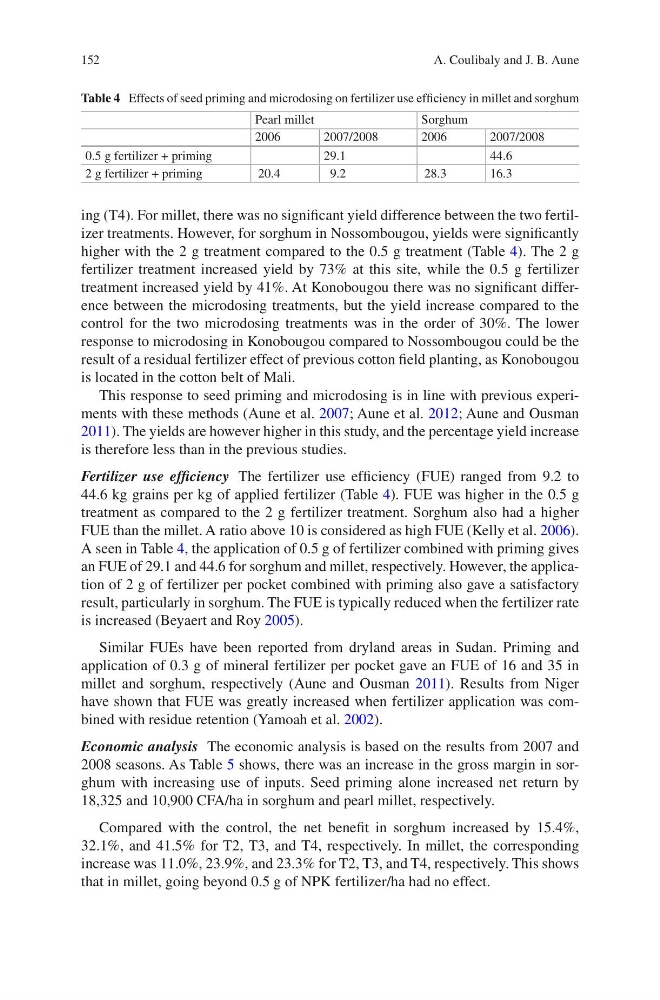
Fertilizer use efficiency The fertilizer use efficiency (FUE) ranged from 9.2 to
44.6 kg grains per kg of applied fertilizer (Table 4). FUE was higher in the 0.5 g
treatment as compared to the 2 g fertilizer treatment. Sorghum also had a higher
FUE than the millet. A ratio above 10 is considered as high FUE (Kelly et al. 2006).
A seen in Table 4, the application of 0.5 g of fertilizer combined with priming gives
an FUE of 29.1 and 44.6 for sorghum and millet, respectively. However, the application of 2 g of fertilizer per pocket combined with priming also gave a satisfactory
result, particularly in sorghum. The FUE is typically reduced when the fertilizer rate
is increased (Beyaert and Roy 2005).
Similar FUEs have been reported from dryland areas in Sudan. Priming and
application of 0.3 g of mineral fertilizer per pocket gave an FUE of 16 and 35 in
millet and sorghum, respectively (Aune and Ousman 2011). Results from Niger
have shown that FUE was greatly increased when fertilizer application was combined with residue retention (Yamoah et al. 2002).
Economic analysis The economic analysis is based on the results from 2007 and
2008 seasons. As Table 5 shows, there was an increase in the gross margin in sorghum with increasing use of inputs. Seed priming alone increased net return by
18,325 and 10,900 CFA/ha in sorghum and pearl millet, respectively.
Compared with the control, the net benefit in sorghum increased by 15.4%,
32.1%, and 41.5% for T2, T3, and T4, respectively. In millet, the corresponding
increase was 11.0%, 23.9%, and 23.3% for T2, T3, and T4, respectively. This shows
that in millet, going beyond 0.5 g of NPK fertilizer/ha had no effect.
Table 4 Effects of seed priming and microdosing on fertilizer use efficiency in millet and sorghum
Pearl millet
Sorghum
2006
2007/2008
2006
2007/2008
0.5 g fertilizer + priming
29.1
44.6
2 g fertilizer + priming
20.4
9.2
28.3
16.3
A. Coulibaly and J. B. Aune
ing (T4). For millet, there was no significant yield difference between the two fertilizer treatments. However, for sorghum in Nossombougou, yields were significantly
higher with the 2 g treatment compared to the 0.5 g treatment (Table 4). The 2 g
fertilizer treatment increased yield by 73% at this site, while the 0.5 g fertilizer
treatment increased yield by 41%. At Konobougou there was no significant difference between the microdosing treatments, but the yield increase compared to the
control for the two microdosing treatments was in the order of 30%. The lower
response to microdosing in Konobougou compared to Nossombougou could be the
result of a residual fertilizer effect of previous cotton field planting, as Konobougou
is located in the cotton belt of Mali.
This response to seed priming and microdosing is in line with previous experiments with these methods (Aune et al. 2007; Aune et al. 2012; Aune and Ousman
2011). The yields are however higher in this study, and the percentage yield increase
is therefore less than in the previous studies.
Fertilizer use efficiency The fertilizer use efficiency (FUE) ranged from 9.2 to
44.6 kg grains per kg of applied fertilizer (Table 4). FUE was higher in the 0.5 g
treatment as compared to the 2 g fertilizer treatment. Sorghum also had a higher
FUE than the millet. A ratio above 10 is considered as high FUE (Kelly et al. 2006).
A seen in Table 4, the application of 0.5 g of fertilizer combined with priming gives
an FUE of 29.1 and 44.6 for sorghum and millet, respectively. However, the application of 2 g of fertilizer per pocket combined with priming also gave a satisfactory
result, particularly in sorghum. The FUE is typically reduced when the fertilizer rate
is increased (Beyaert and Roy 2005).
Similar FUEs have been reported from dryland areas in Sudan. Priming and
application of 0.3 g of mineral fertilizer per pocket gave an FUE of 16 and 35 in
millet and sorghum, respectively (Aune and Ousman 2011). Results from Niger
have shown that FUE was greatly increased when fertilizer application was combined with residue retention (Yamoah et al. 2002).
Economic analysis The economic analysis is based on the results from 2007 and
2008 seasons. As Table 5 shows, there was an increase in the gross margin in sorghum with increasing use of inputs. Seed priming alone increased net return by
18,325 and 10,900 CFA/ha in sorghum and pearl millet, respectively.
Compared with the control, the net benefit in sorghum increased by 15.4%,
32.1%, and 41.5% for T2, T3, and T4, respectively. In millet, the corresponding
increase was 11.0%, 23.9%, and 23.3% for T2, T3, and T4, respectively. This shows
that in millet, going beyond 0.5 g of NPK fertilizer/ha had no effect.
Table 4 Effects of seed priming and microdosing on fertilizer use efficiency in millet and sorghum
Pearl millet
Sorghum
2006
2007/2008
2006
2007/2008
0.5 g fertilizer + priming
29.1
44.6
2 g fertilizer + priming
20.4
9.2
28.3
16.3
A. Coulibaly and J. B. Aune