

148
1 Introduction
Crop production is challenging in the Sahel-Sudanian zone of Mali owing to frequent droughts occurring throughout the growing season, which affect crop establishment, tillering, flowering, and grain filling of the cereals. The rainfall is also
often unevenly distributed in time and across the landscape. Crop development is
further constrained by the limited supply of plant nutrients, particularly nitrogen
and phosphorus (Penning de Vries 1982). These factors make crop production a
risky undertaking.
Several technologies have been proposed to improve crop production in drylands. Promising methods include seed priming (Harris 2006; Aune and Ousman
2011), microdosing (placing small amounts of mineral fertilizer adjacent to the
plants) (Buerkert et al. 2001; Aune and Ousman 2011), ridging (Subbarao et al.
2000), and stone bunds and zais for water retention (Sawadogo 2011). These methods can ensure a uniform crop establishment, vigorous crop growth, and improved
grain filling.
Intensification of crop production in the Sahel has previously been described as
climbing a ladder (Aune and Bationo 2008). We build on this theoretical approach
and test the approach under field conditions in Mali. The experiment (on-farm)
included seed priming and increasing levels of fertilizer microdosing. The study
explored the effect of these technologies on crop establishment, yield, gross margin,
and value cost ratio. The objective of this study was to assess under which conditions intensification is likely to be beneficial and to identify appropriate levels of
intensification in southern Mali (Koulikoro and Segou regions). The methods proposed here do not intend to maximize yields, but rather to intensify cereal production within the means that are available to the resource-poor farmers in the Sahel.
2 Materials and Methods
The experiments were located in Nossombougou and Didieni in the region of
Koulikoro and Konobougou in the region of Segou. Nine villages were involved in
the study. In each village, the project identified 15 voluntary farmers who agreed to
test the treatments. The soils in the project areas were leached sandy loam and
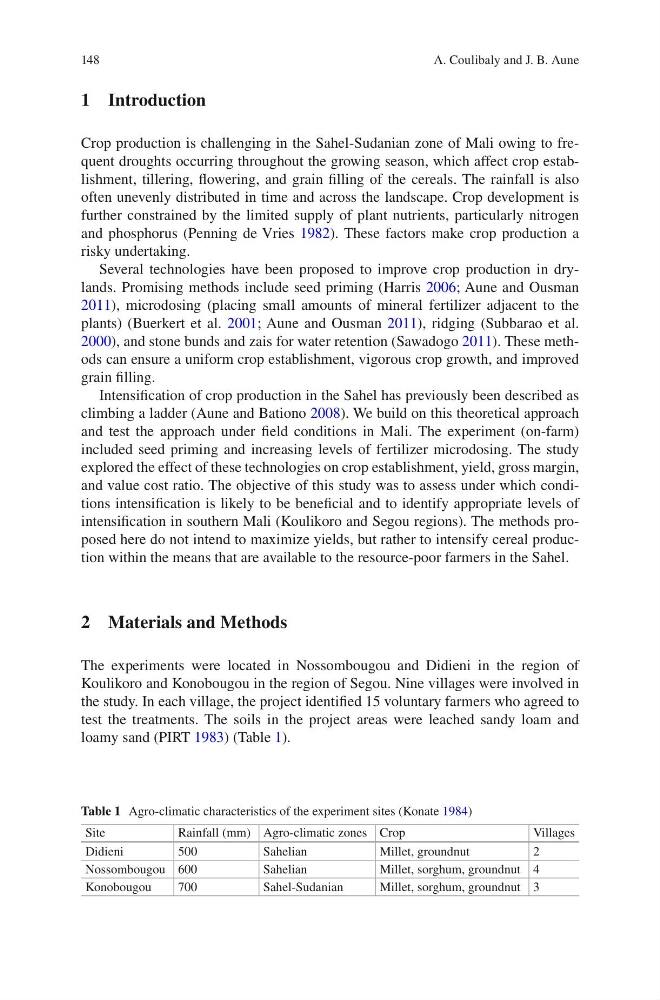
loamy sand (PIRT 1983) (Table 1).
Table 1 Agro-climatic characteristics of the experiment sites (Konate 1984)
Site
Rainfall (mm) Agro-climatic zones Crop
Villages
Didieni
500
Sahelian
Millet, groundnut
2
Nossombougou 600
Sahelian
Millet, sorghum, groundnut 4
Konobougou
700
Sahel-Sudanian
Millet, sorghum, groundnut 3
A. Coulibaly and J. B. Aune
1 Introduction
Crop production is challenging in the Sahel-Sudanian zone of Mali owing to frequent droughts occurring throughout the growing season, which affect crop establishment, tillering, flowering, and grain filling of the cereals. The rainfall is also
often unevenly distributed in time and across the landscape. Crop development is
further constrained by the limited supply of plant nutrients, particularly nitrogen
and phosphorus (Penning de Vries 1982). These factors make crop production a
risky undertaking.
Several technologies have been proposed to improve crop production in drylands. Promising methods include seed priming (Harris 2006; Aune and Ousman
2011), microdosing (placing small amounts of mineral fertilizer adjacent to the
plants) (Buerkert et al. 2001; Aune and Ousman 2011), ridging (Subbarao et al.
2000), and stone bunds and zais for water retention (Sawadogo 2011). These methods can ensure a uniform crop establishment, vigorous crop growth, and improved
grain filling.
Intensification of crop production in the Sahel has previously been described as
climbing a ladder (Aune and Bationo 2008). We build on this theoretical approach
and test the approach under field conditions in Mali. The experiment (on-farm)
included seed priming and increasing levels of fertilizer microdosing. The study
explored the effect of these technologies on crop establishment, yield, gross margin,
and value cost ratio. The objective of this study was to assess under which conditions intensification is likely to be beneficial and to identify appropriate levels of
intensification in southern Mali (Koulikoro and Segou regions). The methods proposed here do not intend to maximize yields, but rather to intensify cereal production within the means that are available to the resource-poor farmers in the Sahel.
2 Materials and Methods
The experiments were located in Nossombougou and Didieni in the region of
Koulikoro and Konobougou in the region of Segou. Nine villages were involved in
the study. In each village, the project identified 15 voluntary farmers who agreed to
test the treatments. The soils in the project areas were leached sandy loam and
loamy sand (PIRT 1983) (Table 1).
Table 1 Agro-climatic characteristics of the experiment sites (Konate 1984)
Site
Rainfall (mm) Agro-climatic zones Crop
Villages
Didieni
500
Sahelian
Millet, groundnut
2
Nossombougou 600
Sahelian
Millet, sorghum, groundnut 4
Konobougou
700
Sahel-Sudanian
Millet, sorghum, groundnut 3
A. Coulibaly and J. B. Aune