

99
2.9 Data Analysis
Data was subjected to analysis of variance (ANOVA) using GenStat 15 statistical
package. Separation of means was achieved using Tukey’s honestly significant difference (HSD) test, where the cropping system and fertilizer N rate factors were
analysed. Additionally, one-way ANOVA was used to analyse a specific factor,
where means were separated by the least significant differences (LSD) at 5% significant level. Data for each site were analysed separately.
3 Results
3.1 Monthly Rainfall at the Lilongwe and Dowa Sites
in the 2014/2015 Cropping Season
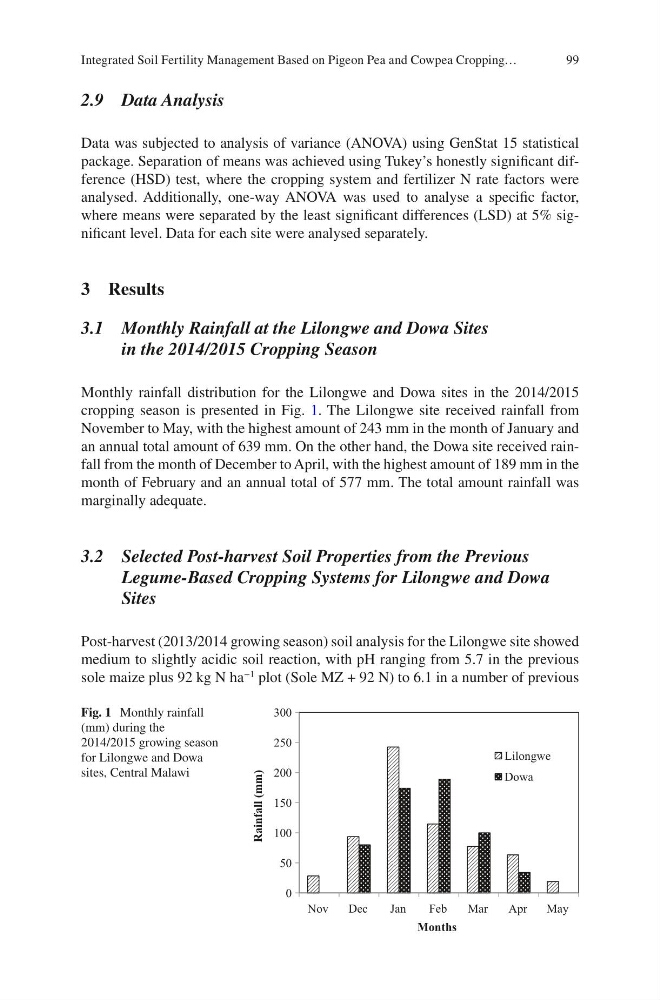
Monthly rainfall distribution for the Lilongwe and Dowa sites in the 2014/2015
cropping season is presented in Fig. 1. The Lilongwe site received rainfall from
November to May, with the highest amount of 243 mm in the month of January and
an annual total amount of 639 mm. On the other hand, the Dowa site received rainfall from the month of December to April, with the highest amount of 189 mm in the
month of February and an annual total of 577 mm. The total amount rainfall was
marginally adequate.
3.2 Selected Post-harvest Soil Properties from the Previous
Legume-Based Cropping Systems for Lilongwe and Dowa
Sites
Post-harvest (2013/2014 growing season) soil analysis for the Lilongwe site showed
medium to slightly acidic soil reaction, with pH ranging from 5.7 in the previous
sole maize plus 92 kg N ha
−1
plot (Sole MZ + 92 N) to 6.1 in a number of previous
0
50
100
150
200
250
300
Nov
Dec
Jan
Feb
Mar
Apr
May
Rainfall (mm)
Months
Lilongwe
Dowa
Fig. 1 Monthly rainfall
(mm) during the
2014/2015 growing season
for Lilongwe and Dowa
sites, Central Malawi
Integrated Soil Fertility Management Based on Pigeon Pea and Cowpea Cropping…
2.9 Data Analysis
Data was subjected to analysis of variance (ANOVA) using GenStat 15 statistical
package. Separation of means was achieved using Tukey’s honestly significant difference (HSD) test, where the cropping system and fertilizer N rate factors were
analysed. Additionally, one-way ANOVA was used to analyse a specific factor,
where means were separated by the least significant differences (LSD) at 5% significant level. Data for each site were analysed separately.
3 Results
3.1 Monthly Rainfall at the Lilongwe and Dowa Sites
in the 2014/2015 Cropping Season
Monthly rainfall distribution for the Lilongwe and Dowa sites in the 2014/2015
cropping season is presented in Fig. 1. The Lilongwe site received rainfall from
November to May, with the highest amount of 243 mm in the month of January and
an annual total amount of 639 mm. On the other hand, the Dowa site received rainfall from the month of December to April, with the highest amount of 189 mm in the
month of February and an annual total of 577 mm. The total amount rainfall was
marginally adequate.
3.2 Selected Post-harvest Soil Properties from the Previous
Legume-Based Cropping Systems for Lilongwe and Dowa
Sites
Post-harvest (2013/2014 growing season) soil analysis for the Lilongwe site showed
medium to slightly acidic soil reaction, with pH ranging from 5.7 in the previous
sole maize plus 92 kg N ha
−1
plot (Sole MZ + 92 N) to 6.1 in a number of previous
0
50
100
150
200
250
300
Nov
Dec
Jan
Feb
Mar
Apr
May
Rainfall (mm)
Months
Lilongwe
Dowa
Fig. 1 Monthly rainfall
(mm) during the
2014/2015 growing season
for Lilongwe and Dowa
sites, Central Malawi
Integrated Soil Fertility Management Based on Pigeon Pea and Cowpea Cropping…