

72
oxide)-b-poly(ε-caprolactone) (PEO-b-PCL) block copolymers as
ideal drug delivery vehicles of hydrophobic drugs [8–10].
Over the last few years, curcumin has attracted a lot of research
interest, as it exhibits low cytotoxicity and potential anticancer
effects as proved by experiments in animals and human cancer cell
lines [11, 12]. It is characterized as an antiproliferative, antiinflammatory, antitumor and antioxidant polyphenol-type hydrophobic drug [13]. On the other hand, indomethacin is a
nonsteroidal anti-inflammatory and analgesic hydrophobic drug,
commonly used for various therapeutic applications related to
rheumatic disease (arthritis) [14]. Along with its antipyretic properties, recent studies focused on its potential chemoprotective
effects against tumors [15]. However, most of the clinical applications of hydrophobic drugs are restricted mainly due to their lack
of solubility in water, poor bioavailability and high prevalence of
their side effects [16].
In this chapter, two different encapsulation protocols, that of
thin-film hydration and the one involving the use of an organic
cosolvent, for encapsulating the above-mentioned hydrophobic
drugs into amphiphilic block copolymer micelles are described in
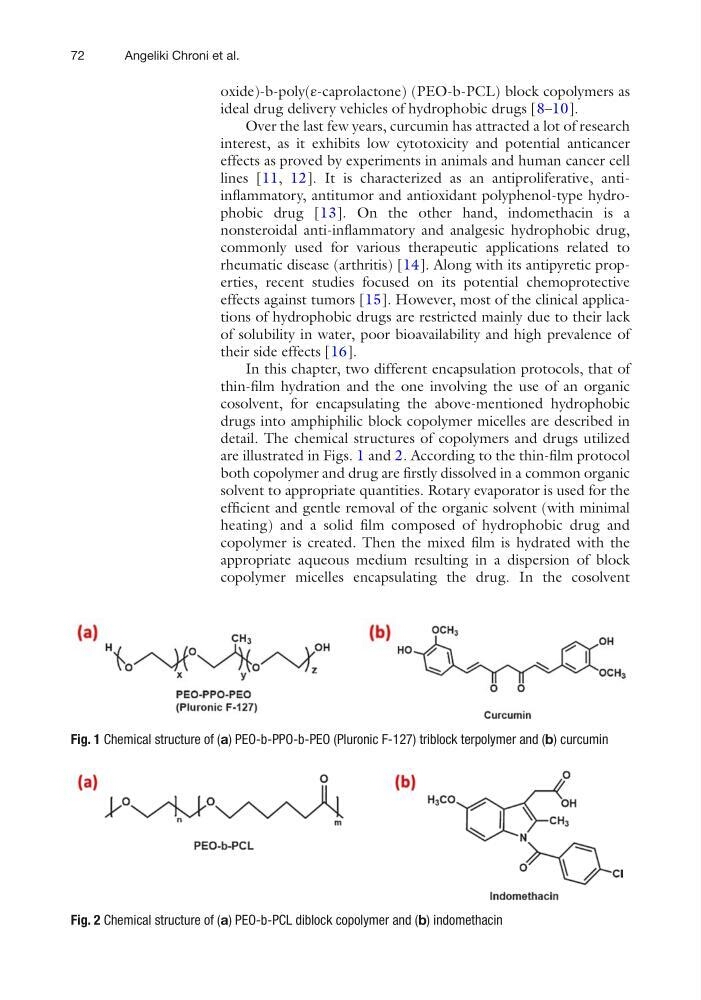
detail. The chemical structures of copolymers and drugs utilized
are illustrated in Figs. 1 and 2. According to the thin-film protocol
both copolymer and drug are firstly dissolved in a common organic
solvent to appropriate quantities. Rotary evaporator is used for the
efficient and gentle removal of the organic solvent (with minimal
heating) and a solid film composed of hydrophobic drug and
copolymer is created. Then the mixed film is hydrated with the
appropriate aqueous medium resulting in a dispersion of block
copolymer micelles encapsulating the drug. In the cosolvent
Fig. 1 Chemical structure of (a) PEO-b-PPO-b-PEO (Pluronic F-127) triblock terpolymer and (b) curcumin
Fig. 2 Chemical structure of (a) PEO-b-PCL diblock copolymer and (b) indomethacin
Angeliki Chroni et al.
oxide)-b-poly(ε-caprolactone) (PEO-b-PCL) block copolymers as
ideal drug delivery vehicles of hydrophobic drugs [8–10].
Over the last few years, curcumin has attracted a lot of research
interest, as it exhibits low cytotoxicity and potential anticancer
effects as proved by experiments in animals and human cancer cell
lines [11, 12]. It is characterized as an antiproliferative, antiinflammatory, antitumor and antioxidant polyphenol-type hydrophobic drug [13]. On the other hand, indomethacin is a
nonsteroidal anti-inflammatory and analgesic hydrophobic drug,
commonly used for various therapeutic applications related to
rheumatic disease (arthritis) [14]. Along with its antipyretic properties, recent studies focused on its potential chemoprotective
effects against tumors [15]. However, most of the clinical applications of hydrophobic drugs are restricted mainly due to their lack
of solubility in water, poor bioavailability and high prevalence of
their side effects [16].
In this chapter, two different encapsulation protocols, that of
thin-film hydration and the one involving the use of an organic
cosolvent, for encapsulating the above-mentioned hydrophobic
drugs into amphiphilic block copolymer micelles are described in
detail. The chemical structures of copolymers and drugs utilized
are illustrated in Figs. 1 and 2. According to the thin-film protocol
both copolymer and drug are firstly dissolved in a common organic
solvent to appropriate quantities. Rotary evaporator is used for the
efficient and gentle removal of the organic solvent (with minimal
heating) and a solid film composed of hydrophobic drug and
copolymer is created. Then the mixed film is hydrated with the
appropriate aqueous medium resulting in a dispersion of block
copolymer micelles encapsulating the drug. In the cosolvent
Fig. 1 Chemical structure of (a) PEO-b-PPO-b-PEO (Pluronic F-127) triblock terpolymer and (b) curcumin
Fig. 2 Chemical structure of (a) PEO-b-PCL diblock copolymer and (b) indomethacin
Angeliki Chroni et al.